
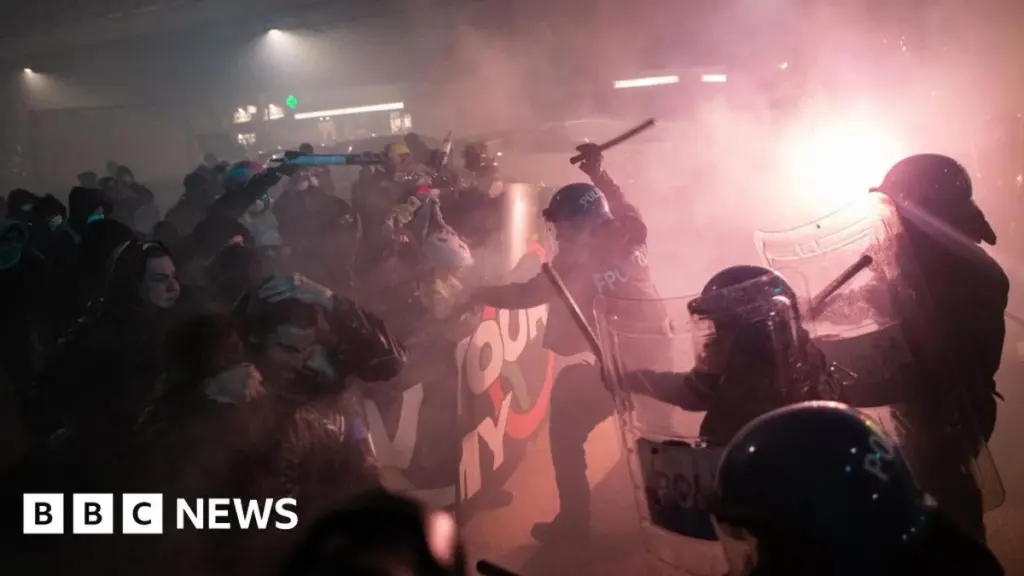
Six individuals were apprehended following confrontations between police and demonstrators in Milan, a designated host city for the Winter Olympic Games. The arrests occurred on the inaugural day of the competition.
Thousands of people gathered in the northern Italian city on Saturday. Their protest addressed a variety of concerns, notably the rising cost of living. Some participants directed flares and hurled stones toward law enforcement officers, who responded with the deployment of water cannons.
These events transpired subsequent to the government’s decision to enhance protest legislation, a move prompted by a demonstration in Turin the preceding weekend. According to official figures, over 100 officers sustained injuries during that incident.
Concurrently, authorities are investigating potential acts of sabotage targeting the northern Italy railway network. The incidents took place on Saturday, causing significant disruptions.
Deputy Prime Minister Matteo Salvini characterized those involved in the Milan disturbances as “criminals.” He remarked, “Just days after the shameful violence in Turin, more clashes, more attacks on law enforcement.” Salvini added, “We are proud to have championed a new security package that will enable more effective interventions against thugs and criminals.”
The demonstration in Turin, initially called in opposition to the eviction of an unofficial social center, began peacefully. However, the situation escalated when armed groups encountered police. This led to the arrest of more than 30 individuals. One officer was reportedly attacked with a hammer, an act described by Prime Minister Giorgia Meloni as an attempted murder.
A recently enacted security package, fast-tracked and adopted on Thursday following the Turin violence, now permits police to detain individuals suspected of causing unrest for up to 12 hours before demonstrations commence. This measure aims to prevent the escalation of disturbances. Critics, however, have labeled the legislation as repressive.
The majority of individuals participating in Saturday’s protest in Milan maintained a peaceful stance. Francesca Missana, a participant, conveyed to the AFP news agency that the Olympic Games are “no longer sustainable from an environmental or social point of view; their time is up.”
Alberto di Monte, an organizer of the protest, informed AFP that the Games were initially promoted as sustainable and cost-neutral. He explained that the widespread dispersal of venues across multiple locations necessitated billions spent on infrastructure, diverting funds from environmental protection efforts in the mountains.
Saturday also witnessed considerable disruption across parts of Italy’s northern rail networks, with suspected acts of sabotage leading to hours-long delays for travelers.
A fire significantly impacted rail infrastructure situated between Bologna and Venice. Following the incident, law enforcement discovered severed electrical cables and an explosive device in nearby areas. Police reported that a track switch was ignited near Pesaro, along the Adriatic coast. Additionally, electric cables were found cut near Bologna, accompanied by a rudimentary explosive device discovered near the tracks.
Bologna’s central railway station serves as a crucial transit hub, connecting cities both north-south and east-west throughout the country.
RFI, the owner of Italy’s national railways, confirmed that services have since been restored to their normal operational status.
The Ministry of Transport characterized these incidents as “suspected sabotage” and drew parallels to acts of vandalism that occurred at the commencement of the Paris Olympics in 2024.
Salvini, who also holds the position of transport minister, stated on Saturday that “These actions of unprecedented seriousness do not in any way tarnish Italy’s image in the world, an image that the Games will make even more compelling.”
The Winter Olympics are scheduled to continue until February 22. The Games are being held across various locations, including Milan, the resort town of Cortina d’Ampezzo, the Dolomite regions of Predazzo and Tesero, and the Alpine resorts of Livigno and Bormio.