
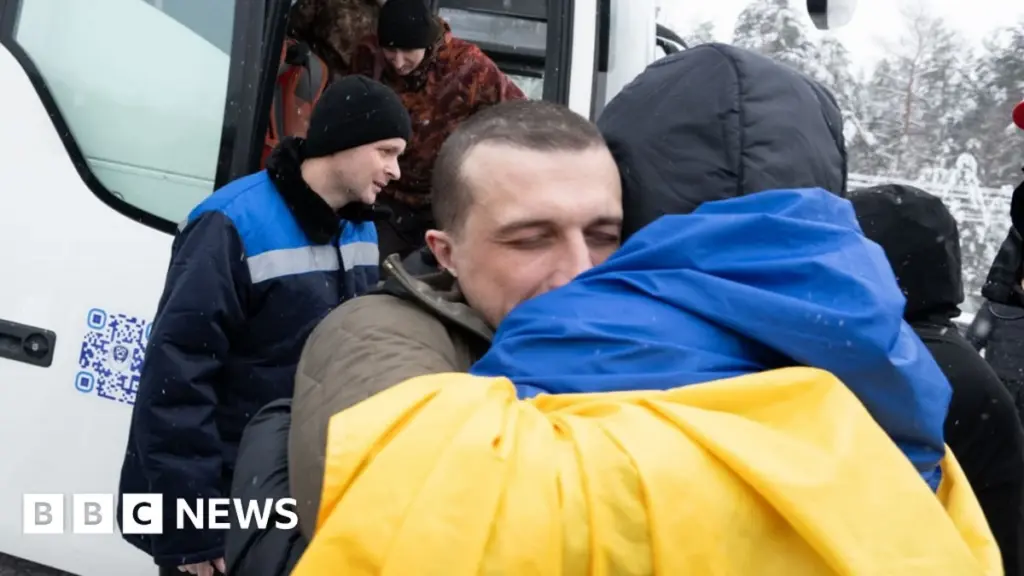
A significant prisoner exchange has taken place between Ukraine and Russia, involving both military personnel and civilians. This rare event occurred following two days of mediated peace talks in Abu Dhabi, brokered by the United States. The exchange saw the return of 157 Ukrainian individuals, including seven civilians, to their homeland. Concurrently, 157 Russian soldiers were also repatriated. This marks the first such swap in a period of four months.
The discussions, held in the United Arab Emirates’ capital, involved delegations from Russia, Ukraine, and the United States. Key obstacles in the negotiations were reportedly related to territorial concessions that Ukraine is under pressure to consider, alongside security assurances designed to prevent future Russian aggressions should an agreement to end the four-year conflict be reached. Despite these efforts, no breakthrough has been publicly announced.
Ukrainian President Volodymyr Zelensky characterized the talks as challenging, expressing a desire for swifter outcomes. Russia initiated its full-scale invasion of Ukraine in February 2022. In a social media update, President Zelensky noted that Thursday’s prisoner exchange followed a considerable hiatus, referencing the previous swap that occurred in October.
Zelensky stated, “We are bringing our people home—157 Ukrainians. Soldiers of the Armed Forces, National Guard, State Border Service.” He added, “Civilians are also returning with the defenders. Most have been in captivity since 2012.” The Ukrainian president reiterated his commitment to securing the return of all Ukrainians still held captive by Russia. Ukrainian officials indicated that 139 of the released Ukrainians had been in Russian custody since 2022.
The Russian Ministry of Defence confirmed the return of 157 of its prisoners of war by Kyiv. The ministry also reported the handover of three Russian civilians who had been “illegally held.” These individuals were residents of the western Kursk region, an area that experienced Ukrainian occupation during incursions in 2024-2025.
These talks in Abu Dhabi, representing the second round of discussions in recent weeks, are a component of United States President Donald Trump’s initiative to facilitate an end to the war. Special envoy Steve Witkoff and Jared Kushner, Trump’s son-in-law, have been leading these negotiation efforts. Witkoff described the discussions on X as “detailed and productive,” while acknowledging that “significant work remains.”
Key Sticking Points in Negotiations
Territory emerged as the most contentious issue. Russia is insisting that Ukraine cede the remaining parts of the eastern industrial region of Donbas that Moscow does not currently control. Another significant point of contention is understood to be Kyiv’s demand for robust security guarantees from its European allies and the United States.
No specific details regarding these aspects have been disclosed. The trilateral negotiations commenced at a time when Russia resumed its intense attacks on Ukraine, following a pause of approximately one week. This pause had been requested by President Trump, urging Russian President Vladimir Putin to observe it as a severe cold front swept across Ukraine. Moscow’s recent actions have focused on targeting the country’s energy infrastructure, resulting in widespread power, heating, and water outages for thousands of people amidst freezing temperatures.