
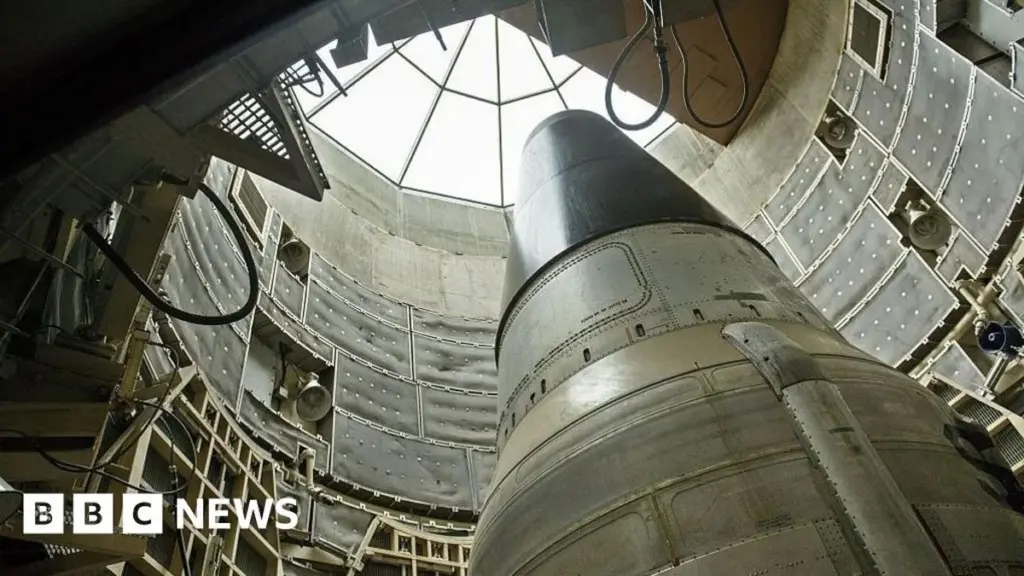
The final remaining nuclear weapons control treaty between the United States and Russia has expired, igniting concerns about a potential new arms race.
The Strategic Arms Reduction Treaty, commonly known as “New START” and inked in 2010, was among a critical series of agreements intended to avert catastrophic nuclear conflict.
United Nations Secretary-General António Guterres declared its end a “grave moment for international peace and security.” He urged Russia and the US to promptly negotiate a replacement framework.
The treaty’s expiry, precisely at midnight GMT, effectively concluded the arms control cooperation between Washington and Moscow that played a significant role in fostering the end of the Cold War.
Under its terms, the treaty had capped deployed strategic nuclear warheads for each party at 1,550. It also established crucial transparency measures, including data exchanges, notifications, and on-site inspections.
Without this agreement, Guterres warned, the world now faces a situation devoid of limitations on the strategic nuclear arsenals of the nations possessing the vast majority of global nuclear weapons.
He appealed to both countries to “reset and create an arms control regime fit for a rapidly evolving context,” highlighting that the “risk of a nuclear weapon being used is the highest in decades.”
Guterres acknowledged the US and Russian leaders’ stated desire to prevent “unchecked nuclear proliferation” but stressed the need to “translate words into action.”
Earlier in the week, Pope Leo also made a similar call, urging both nations to renew the treaty and noting that the current global climate necessitates “doing everything possible to avert a new arms race.”
Historical Context of Arms Control
The original START treaty, signed in 1991 by the US and the Soviet Union, prohibited each signatory from deploying more than 6,000 nuclear warheads.
New START, its successor, was signed in 2010 in Prague by the United States and Russia, which assumed the role of the Soviet Union’s successor state.
Although Russia indicated a suspension of the treaty three years prior amidst escalating tensions related to the Ukraine conflict, both nations were believed to have largely adhered to its provisions.
This agreement had been instrumental in preventing an unchecked build-up of nuclear weapons and provided crucial transparency mechanisms for the two largest nuclear powers, thereby mitigating the risk of misinterpreting each other’s intentions.
A Pattern of Treaty Erosion
The expiration of New START follows a concerning trend of other long-standing arms control treaties falling by the wayside.
- The Intermediate-Range Nuclear Forces (INF) Agreement, which was instrumental in largely eliminating the deployment of shorter-range nuclear weapons within Europe.
- The Open Skies Treaty, which permitted signatories, including the US and Russia, to conduct unarmed reconnaissance flights over each other’s territories for military monitoring purposes.
- The Conventional Armed Forces in Europe (CFE) Treaty, which imposed limits on the numbers of tanks, troops, and artillery systems deployable by both Russia and NATO forces within Europe.
Britain’s former head of the armed forces, Admiral Sir Tony Radakin, has cautioned that the established architecture and frameworks contributing to global safety “now risks unravelling.”
In a speech delivered last year, he identified the collapse of these pivotal arms control treaties as “one of the most dangerous aspects of our current global security,” alongside the “increasing prominence of nuclear weapons.”
Reactions and Stances
Dmitry Medvedev, who as Russia’s president in 2010 signed the New START treaty, stated that its expiration should “alarm everyone.” This is a particularly notable comment given his recent rhetoric has included nuclear threats.
On Wednesday, a senior advisor to Russian President Vladimir Putin indicated an intention to “act in a measured manner and responsibly” following the treaty’s expiration.
Later that day, the Russian foreign ministry issued a statement asserting that due to “the current circumstances, we assume that the parties to the New START are no longer bound by any obligations or symmetrical declarations in the context of the Treaty, including its core provisions, and are in principle free to choose their next steps.”
“In doing so the Russian Federation intends to act responsibly and in a balanced manner,” the statement continued, adding that Moscow “remains ready to take decisive military-technical measures to counter potential additional threats to the national security.”
US President Donald Trump has expressed a less concerned outlook. Last month, he commented to The New York Times: “If it expires, it expires… We’ll just do a better agreement.”
Washington maintains that any future arms control agreement must also encompass China, which has been actively expanding its nuclear arsenal.
This viewpoint was echoed by German Foreign Minister Johann Wadephul on Thursday, who told reporters in Canberra, “China has to be included.”
“China keeps emphasising that they stand with multilateralism, they also have to show in the field of arms control that they are ready to show restraint and that they invest trust in international relations,” he added.
Conversely, Russia has long advocated for any future arms control treaty to include France and the United Kingdom, both European nuclear powers.
Modernizing Arsenals and Emerging Technologies
Darya Dolzikova, a Senior Research Fellow at the UK-based RUSI’s Proliferation and Nuclear Policy Programme, described the expiration of New START as “concerning, because there are drivers on both sides to expand their strategic capabilities.”
Both the United States and Russia are currently engaged in modernizing their nuclear forces and enhancing their strategic capabilities. Some observers suggest a new arms race is already underway.
Dolzikova noted that Russia appears to have “some concerns about their ability to penetrate US air defences.” These concerns have reportedly intensified following plans to develop a “Golden Dome” designed to protect North America from long-range weapons.
In response, Russia has been developing new weapon systems intended to overcome air defenses. These include the Poseidon, a new intercontinental, nuclear-armed, and nuclear-powered autonomous undersea torpedo, as well as Burevestnik, a nuclear-armed and powered cruise missile.
The United States, Russia, and China are all reportedly developing long-range hypersonic missiles. These weapons can maneuver at speeds exceeding 4,000 mph (6,437 kmh), making them significantly more difficult to intercept.
Dolzikova suggested that these expanding military capabilities will “only make it harder” to reach a new arms control treaty. This is compounded by what she termed the “growing salience of nuclear weapons,” with an increasing number of countries appearing to seek them as a deterrent.
Neither the US nor Russia show immediate signs of urgency in signing a new arms control treaty. The subject was reportedly discussed during Russian President Vladimir Putin’s meeting with President Trump in Alaska last year, but no concrete progress was made.
While a new deal remains a possibility, the expiration of the New START treaty signals the onset of a more volatile and potentially dangerous era in international security.