
Feedback, a regular feature in New Scientist, highlights curious news and technological developments for its readers and invites submissions via email to [email protected].
Caped Crusaders and Courtesies
Recalling the difficulties of securing a seat on public transport while pregnant, a recent experiment explored whether an unusual intervention could influence passenger behavior. The challenge of being publicly pregnant, as Mrs. Feedback remembers, often meant limited consideration from fellow commuters.
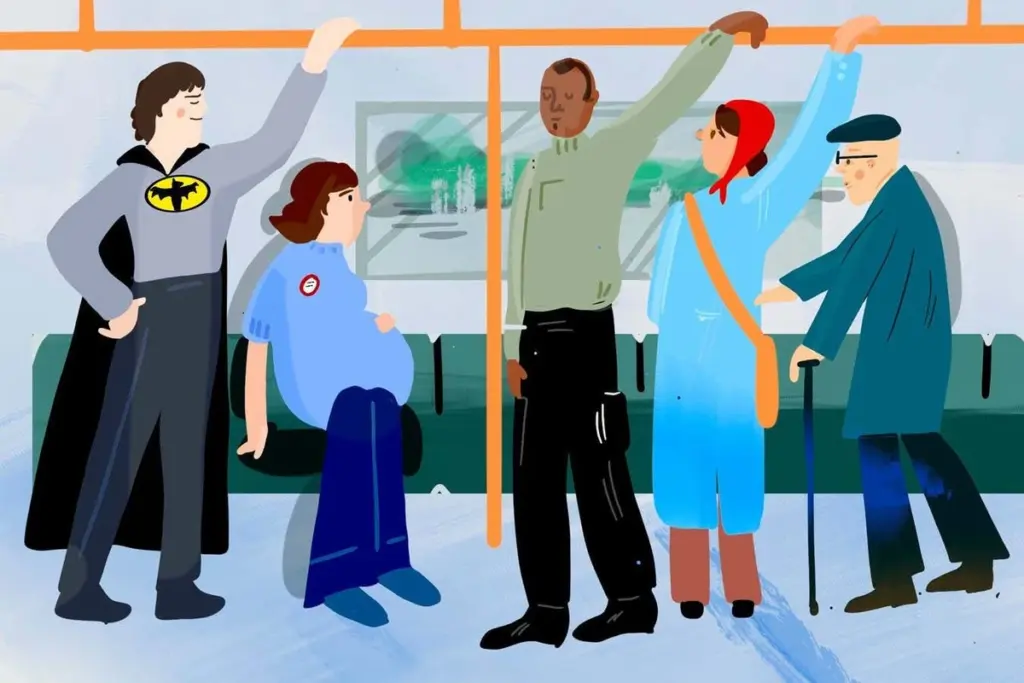
However, an experiment on the Milan metro system, led by Francesco Pagnini and published in npj Mental Health Research in November 2025, suggested that the presence of a familiar figure might subtly alter social dynamics. Researchers employed a female team member to simulate pregnancy using a prosthetic bump. This participant, accompanied by an observer, boarded trains on 138 occasions.
In a specific condition of the trials, a third experimenter joined them, dressed in a costume designed to be instantly recognizable as Batman. The attire included “the characteristic cape, logo, and pointed cowl,” though the mask was omitted “to avoid potentially scaring passengers.” A review of the costume depicted in the study indicates it would be unlikely to intimidate anyone, resembling the outfit worn by George Clooney in “Batman and Robin.”
The results indicated a notable difference: passengers offered seats to the “pregnant” woman 67 percent of the time when Batman was present, sharply contrasting with the 38 percent rate when he was absent. The researchers propose that “unexpected events can promote prosociality.” Intriguingly, many passengers did not consciously register Batman’s presence. Approximately 44 percent of those who offered their seats in his vicinity reported not having seen him.
The implication, Feedback muses, is that Batman, as a long-standing advocate for social justice, might have subconsciously prompted passengers to consider concepts like fairness and decency. The research team acknowledged this possibility but also noted the difficulties in replicating findings from social priming experiments, a phenomenon affected by the “replication crisis” in social sciences. This led them to focus on the element of surprise associated with Batman’s unexpected appearance.
Extending their findings, the study suggests that “psychologists may consider ways to integrate ‘positive disruptions’ into daily life.” This could involve “artistic or theatrical interventions in public spaces” intended to “momentarily break routine and engage individuals more deeply with their environment and community.” This concept echoes the idea of “nudging” for improved behavior, another area that has faced replication challenges. It also implies a significant need for a variety of costumes.
Feedback observed that personal experiences might differ; in some locations, a person in a Batman costume boarding a train would likely be assumed to be heading to a comic convention, suggesting variations in local culture or cosplay visibility.
The Art of the Whimsical Title
Academics occasionally employ pop culture references or adopt whimsical titles in their published works, a strategy Feedback has noted before. This approach aims to capture reader attention, and when successful, it is highly effective. Rebekah White and Anna Remington’s 2018 study, titled “Object personification in autism: This paper will be very sad if you don’t read it,” exemplifies this technique.
The research investigated the prevalence of object personification among autistic and non-autistic individuals and its impact on their emotional lives. Initially, Feedback considered this an uncommon practice, as its own vacuum cleaner remained an inanimate object. However, acknowledging a tendency to name vehicles, such as the current car Kitty (following Carol, deemed “rubbish”), and bicycles, revealed a personal connection to the phenomenon.
This inclination is not isolated. Social media discussions following the paper’s release revealed similar behaviors. One user shared a debate about a robot vacuum’s gender and potential name. Feedback suggested naming it after the Mario villain Goomba, possibly fitting a brown floppy hat and big black eyebrows. Another commenter mentioned a habit of taking the last croissant or bun to prevent the item from feeling unwanted, a practice Feedback also admits to, albeit for different motivations.
Reviewer 2 and the Peer Review Gauntlet
The process of academic publication involves peer review, where researchers are critiqued by their anonymous colleagues. This phase is often discussed by academics with a degree of apprehension, akin to naming figures of extreme disapproval in everyday life.
Historian Andre Pagliarini shared a notable peer review experience on social media. He reported that in rejecting an article he submitted, “reviewer 2 noted I failed to engage the work of one Andre Pagliarini.” This situation creates a difficult bind for authors, as citing one’s own work extensively can invite accusations of self-promotion or lead to rejection based on a perceived lack of novelty.
Many online respondents echoed a sentiment of exasperation, comparable to the phrase, “But doctor, I am Pagliarini.” Feedback noted that explaining the reference in detail would exceed available space.
Share Your Story
Submissions for Feedback can be sent via email to [email protected], and should include a home address. Previous and current Feedback articles are available on the New Scientist website.