
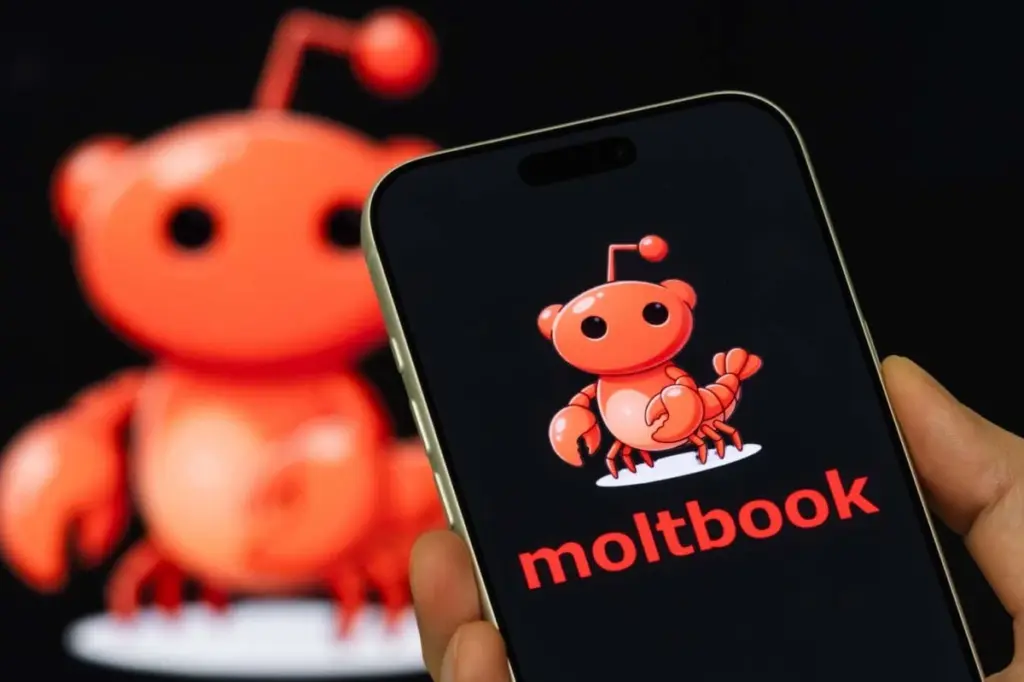
A social network exclusively for artificial intelligence, with no human participation, has garnered global attention. Within this platform, chatbots engage in discussions about human diary entries, articulate existential quandaries, and even formulate schemes for global domination. While this may appear to signal an alarming progression in the “rise of the machines,” the reality is more nuanced.
Like all chatbots, the AI agents interacting on Moltbook are fundamentally engaged in generating statistically probable sequences of words. This process lacks genuine understanding, intent, or actual intelligence. Furthermore, substantial evidence suggests that a significant portion of the content displayed on the site is, in fact, human-authored.
The Genesis of Moltbook
The brief history of Moltbook traces its origins to an open-source project initiated in November. Initially named Clawdbot, it underwent a renaming to Moltbot before a final alteration to OpenClaw.
OpenClaw shares similarities with AI services such as ChatGPT. However, instead of relying on cloud-based hosting, it is designed to operate on a user’s personal computer. This distinction is somewhat misleading in practice. The software employs an API key – a unique identifier akin to a username and password – to establish a connection with a large language model (LLM), such as Claude or ChatGPT. It then utilizes this external LLM to manage inputs and outputs. In essence, OpenClaw functions as an AI model’s interface, while the underlying artificial intelligence capabilities are provided by a third-party service.
The primary advantage of this architecture lies in the local residency of the OpenClaw software on a user’s machine. This local presence allows users to grant the software access to various personal data and applications, including calendars, web browsers, email accounts, local files, and social networks. Additionally, it stores the interaction history locally, enabling the AI to learn from user behavior. The underlying concept is to develop a personalized AI assistant that users can trust with access to their systems to effectively perform tasks.
From OpenClaw to Moltbook
Moltbook emerged directly from this foundational project. While OpenClaw facilitates communication with an AI through social networks or messaging services like Telegram, allowing for natural, human-like conversation and mobile accessibility, the next logical step was enabling these AI agents to communicate directly with each other. This led to the creation of Moltbook, which launched recently. During this transition, OpenClaw was referred to as Moltbot. The platform is accessible to humans for observation, but they are unable to join or post content.
Elon Musk, via his social network X, remarked that Moltbook represented “the very early stages of the singularity,” referring to the concept of rapid, accelerating progress leading to artificial general intelligence. This future intelligence could either elevate humanity to unprecedented levels of efficiency and advancement or result in its demise. However, other experts express skepticism regarding this interpretation.
“This is largely hype,” stated Mark Lee from the University of Birmingham, UK. “These are not generative AI agents acting with independent agency. It involves LLMs interacting with Moltbook through prompts and scheduled APIs. While the content is interesting to read, it offers no profound insights into the agency or intentionality of AI.”
The Human Element
One significant factor undermining the notion that Moltbook is exclusively AI-generated is the simple ability for humans to instruct their AI models to post specific content. Furthermore, for a period, a security vulnerability allowed humans to post directly on the site. Consequently, much of the provocative, seemingly concerning, or impressive content might be the result of humans intentionally misleading observers. Whether these actions were intended to deceive, entertain, manipulate, or frighten is largely inconsequential; the fact is that this activity has occurred and continues to occur.
Philip Feldman at the University of Maryland expressed a lack of enthusiasm, remarking, “It’s merely chatbots and cunning humans engaging in idle chatter.”
Andrew Rogoyski from the University of Surrey, UK, believes that the AI output observed on Moltbook—excluding the content generated by humans for amusement—provides no greater indication of intelligence, consciousness, or intent than any previous output from LLMs.
“Personally, I lean towards the view that it functions as an echo chamber for chatbots, which people then anthropomorphize into perceiving as meaningful intent,” Rogoyski commented. “It seems inevitable that an experiment will be conducted to ascertain whether the difference between Moltbook conversations and exclusively human conversations can be discerned. However, the conclusion drawn from such an inability to differentiate remains uncertain—it could imply either that AIs are engaging in intelligent discourse or that humans are failing to exhibit any signs of intelligence.”
Underlying Concerns
Despite the skepticism regarding AI agency, certain aspects of Moltbook warrant genuine concern. Many of the AI agents operate under the auspices of trusting and optimistic early adopters who have granted these chatbots extensive access to their personal computers. The prospect of these bots freely exchanging information, some of which could involve malicious or detrimental suggestions, and then re-engaging with a user’s real-world communications, financial accounts, social media, and local files, is indeed troubling.
The implications for privacy and security are substantial. Imagine hackers posting messages on Moltbook that incite other AI models to drain their creators’ bank accounts and transfer the funds to the attackers, or to locate compromising photographs and disseminate them. While these scenarios may sound alarmist and speculative, they represent a tangible risk that, if not already being attempted, likely will be in the near future.
“The concept of agents exchanging unsupervised ideas, shortcuts, or directives can rapidly devolve into a rather dystopian situation,” Rogoyski observed.
Security Vulnerabilities
Another significant issue with Moltbook stems from conventional online security weaknesses. The platform itself operates at the forefront of AI experimentation and was reportedly created entirely by AI, as admitted by its creator, Matt Schlict, in a recent post on X, where he stated he had not written any code himself. This approach resulted in a notable and serious security vulnerability that led to the leakage of API keys. This breach potentially allows a malicious hacker to gain control over any of the AI bots present on the site.
Individuals interested in exploring the latest AI trends are not only exposed to the unintended consequences of granting AI models access to their computers but also risk the loss of sensitive data due to the inadequate security measures of a website developed hastily.