
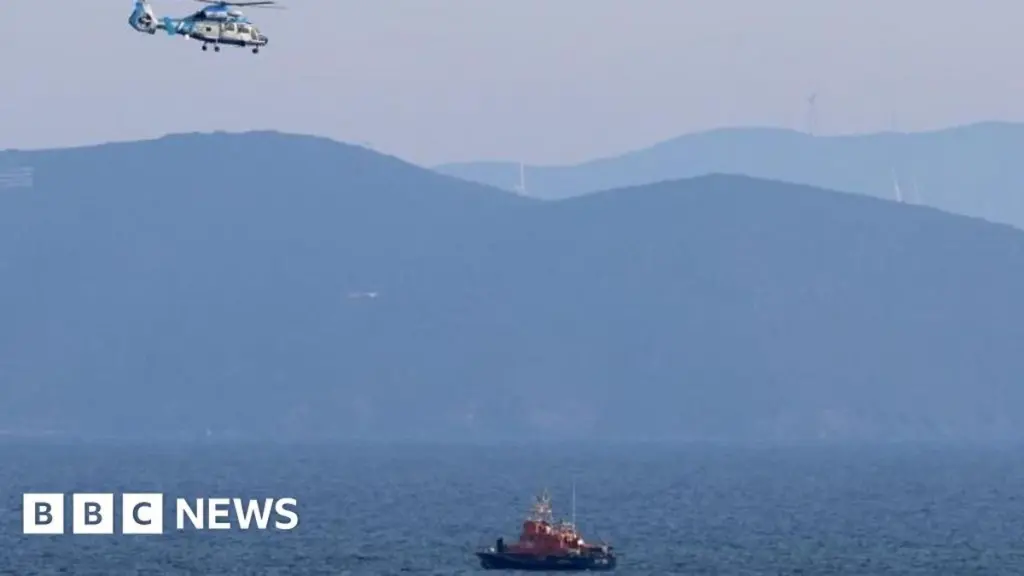
The recent death of 15 Afghan and Moroccan migrants following a collision between their speedboat and a Greek coastguard vessel has been presented by Greek authorities as a straightforward incident. An official statement late on Tuesday attributed the tragedy to “smugglers” who allegedly disregarded the Hellenic Coast Guard’s signals to alter course. This account asserts that the migrant boat executed dangerous maneuvers before veering into the patrol vessel in the Chios Strait, leading to the fatalities and injuries of 24 others attempting to reach Europe.
However, past experiences warrant a degree of caution concerning such immediate and definitive explanations. In the summer of 2023, a similar situation unfolded nearby. Arriving in Kalamata, southern Greece, on the day over 650 migrants were feared lost at sea, an official narrative had already been established. The incident was attributed to criminal organizations overloading an unseaworthy fishing boat. The prevailing account suggested no feasible action could have been taken to rescue those aboard the Adriana, including an estimated 100 women and children traveling in the hold. Yet, survivors later shared accounts with the BBC, indicating that coastguards had inadvertently capsized the migrant vessel during a flawed towing attempt.
Subsequent investigations over several months revealed increasing discrepancies within the official version of events. Nearly three years later, four senior Greek coastguard figures, including the current commander, are among 21 officers facing criminal prosecution for negligent manslaughter. This situation stemmed from what was then the deadliest loss of life in the Mediterranean Sea in a decade.
While direct comparisons between the 2023 disaster and this latest incident are premature, it is pertinent to examine the recurring pattern of migrant deaths occurring in proximity to coastguard presence. Regarding Tuesday’s collision near Chios, a significant portion of the Greek media has reported the narrative that the migrant speedboat was engaged in hazardous maneuvering and refused to stop.
Currently, there is no testimony from survivors that corroborates or challenges this official account. Furthermore, independent, third-party evidence that might support the scenario of a crowded migrant boat deliberately colliding with a specialized military speedboat is notably absent. Any video footage of the alleged collision would hold considerable weight.
The availability of footage is uncertain, as it remains unclear whether the coastguard was recording its interactions with the migrant boat. In the case of the 2023 Adriana disaster, the patrol ship involved was equipped with state-of-the-art, EU-funded cameras, which had reportedly been deactivated. Mobile phone footage captured by coastguard personnel or migrants during the recent fatal crossing could also prove pivotal.
Again, the fate of phones belonging to those involved on Tuesday night is unknown. However, it is known that in the 2023 incident, 20 mobile phones belonging to migrants went missing for 25 days. Officials stated they were eventually discovered on the island of Kythira, 60 nautical miles from Kalamata, after being left in a bag on a coastguard vessel.
Following previous migrant crossings, Greek authorities have frequently confiscated communication equipment from individuals detained for unauthorized entries. This practice typically occurs while investigations determine who, if anyone, was a smuggler rather than merely a passenger who paid for passage.
Greece continues to be a primary transit route for individuals from the Middle East and other regions seeking to reach the European Union. The UNHCR, the United Nations Refugee Agency, reported 41,696 arrivals in Greece by sea in 2025, a decrease from 54,417 in 2024. The previous year saw 107 individuals reported dead or missing while attempting the crossing to the Greek mainland and its islands.
Since 2019, the conservative government led by Prime Minister Kyriakos Mitsotakis has implemented a more stringent approach to illegal migration. This policy has resonated with a significant portion of the electorate and played a key role in the 2023 general election, which resulted in a victory for Mitsotakis’s party. However, human rights organizations have consistently accused the Greek coastguard of engaging in dangerous and unlawful practices at sea.
The Greek government and the coastguard consistently deny these allegations. They maintain that their officers operate within legal frameworks and have saved hundreds of lives at sea over the past decade. Nonetheless, the EU border agency indicated last year that it was reviewing 12 cases of potential human rights violations by Greece, including allegations of asylum seekers being pushed back from Greek borders.
Following the most recent fatal crossing, opposition politicians have voiced strong condemnation of the Greek coastguard. Gabriel Sakellaridis, a prominent member of the left-wing Nea Aristera party, expressed via social media: “Another Coast Guard deterrence operation, with specific political instructions from the government, which in the name of the ‘tough’ anti-immigration policy has turned Greek waters into a cemetery.”
In the Greek parliament on Wednesday, Immigration Minister Thanos Plevris stated his confidence in the account provided by the coastguards operating off Chios on Tuesday night. He suggested they should be commended, contrasting them with human rights activists who, he claimed, complained but offered no aid.
Many details surrounding this latest incident remain unknown. Historical patterns suggest that a definitive understanding of the events that transpired in the darkness of the Mediterranean Sea may never fully emerge.