
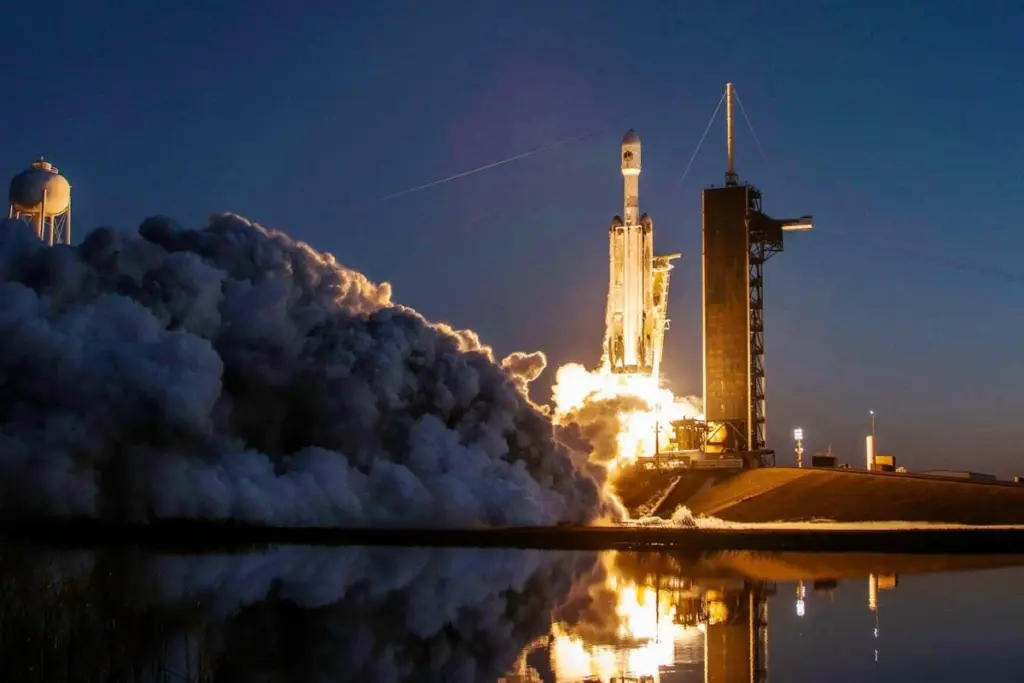
As 2026 unfolds, the conversation surrounding space endeavors is increasingly dominated by the concept of mega-constellations and the ambitious plans to deploy thousands of new satellites into Earth’s orbit.
SpaceX has recently submitted a request to the Federal Communications Commission (FCC) in the United States, seeking authorization to launch an astonishing one million orbital data center satellites. This filing represents an unprecedented scale of request. For context, the prior largest submission to the FCC, also from SpaceX, was for 42,000 Starlink satellites back in 2019.
“This proposal surpasses anything previously put forth by any constellation,” stated Victoria Samson from the Secure World Foundation in the US.
The Scope of SpaceX’s Ambitions
SpaceX currently manages the most extensive satellite network in orbit, known as the Starlink internet constellation. This system accounts for approximately 9,500 of the 14,500 satellites currently in orbit. The company’s plan for orbital data centers, however, involves a staggering 1% of its total future deployment. Even the existing Starlink satellites are already contributing to hazardous conditions in orbit, with SpaceX having to manage an estimated 300,000 potential collision avoidance maneuvers in 2025 alone.
In its filing on January 31st, which was also detailed in an update from CEO Elon Musk, SpaceX outlined its intention to establish extensive orbital data centers in space intended to power artificial intelligence (AI). Musk elaborated on this vision, stating, “Launching a constellation of a million satellites to operate as orbital data centers marks a crucial first step toward achieving Kardashev II-level civilization status.” He was referencing the Kardashev scale, a framework developed in 1964 by Soviet astronomer Nikolai Kardashev to gauge a civilization’s technological advancement.
The Rationale Behind Orbital Data Centers
The concept of deploying data centers into space, where they could benefit from uninterrupted solar power, has gained traction in recent years. This surge in interest is directly linked to the escalating energy demands of AI technologies.
In November 2025, the US-based company Starcloud successfully launched a demonstration data center into orbit, featuring an advanced Nvidia chip. Concurrently, the European Commission concluded a study indicating the feasibility of orbital data centers.
Musk has suggested that the deployment of this massive constellation will be facilitated by SpaceX’s reusable Starship rocket, currently under development and recognized as the most powerful rocket ever constructed. He projected, “With launches occurring every hour and carrying 200 tons per flight, Starship will deliver millions of tons to orbit and beyond annually, paving the way for an exciting future where humanity ventures amongst the stars.”
This filing preceded SpaceX’s February 2nd announcement regarding its acquisition of xAI, another company founded by Musk. xAI is affiliated with the social media platform X and the controversial Grok chatbot. Ruth Pritchard-Kelly, a specialist in satellite regulation in the US, commented on this integration, suggesting, “If AI is the intended application for these orbital data centers, then this acquisition appears to be a bundled offering.”
Global Competition and Regulatory Hurdles
SpaceX is not the sole entity pursuing extensive satellite deployments. On December 29th, China submitted an application to the International Telecommunications Union (ITU), a United Nations body responsible for allocating radio spectrum in space. China’s application seeks permission to launch 200,000 satellites. While no definitive limit exists for the number of satellites that can be safely operated in orbit, prior research indicates that managing a constellation exceeding 100,000 satellites would present significant challenges.
The FCC is expected to take several months to review SpaceX’s request, during which time the application will be open for public comment. A separate submission will also be required by the ITU. Should the FCC grant approval, SpaceX typically faces a six-year deadline to deploy half of the constellation, a condition usually mandated by the FCC. However, SpaceX has requested a waiver of this requirement, arguing that the satellites would primarily utilize optical communication links, thus minimizing radio interference.
SpaceX intends to position these satellites at altitudes ranging from 500 to 2,000 kilometers, employing slightly polar orbits, predominantly above the current operational altitude of Starlink. The exact dimensions of each proposed satellite remain undisclosed. Assuming they are comparable in size to current Starlink satellites, and that each Starship launch can accommodate approximately 100 such satellites, an estimated 10,000 Starship launches would be necessary to complete the constellation.
If launches occur at the hourly frequency suggested by Musk, the deployment of one million satellites could be accomplished in just over a year. SpaceX asserts its commitment to orbital safety by planning to move the satellites into “disposal orbits” at the end of their operational life. These orbits would either be positioned high above Earth, where re-entry would take centuries, or directed into an orbit around the sun.
Impact on Astronomy and Scientific Discovery
Musk’s proposed mega-constellation is projected to have a substantial impact on astronomical observation. SpaceX stated in its application that it would “continue its long track record of successful collaboration and innovation with the scientific and astronomy community.” However, research published in December by Alejandro Borlaff at NASA Ames Research Center in California and his colleagues highlighted potential negative consequences. They found that adding 500,000 satellites to Earth’s orbit could result in “nearly every single telescope image obtained from the ground or space will be contaminated by satellites,” severely impacting scientific discovery.
Orbital data center satellites might exhibit even greater brightness compared to many existing satellites. This is attributed to their requirement for large reflective solar panels for power generation, as well as substantial radiators to dissipate heat into the vacuum of space, similar to those found on the International Space Station.
Skepticism and Future Considerations
The seriousness of SpaceX’s proposal to launch one million satellites remains a point of discussion. According to Pritchard-Kelly, it is possible that this is a deliberate, even humorous, exaggeration by Musk, given the sheer magnitude of the number. “It’s gobsmackingly large,” she commented. “It could simply be for shock and awe,” suggesting the actual number of planned satellites might be considerably lower. SpaceX and the FCC did not respond to requests for comment.