
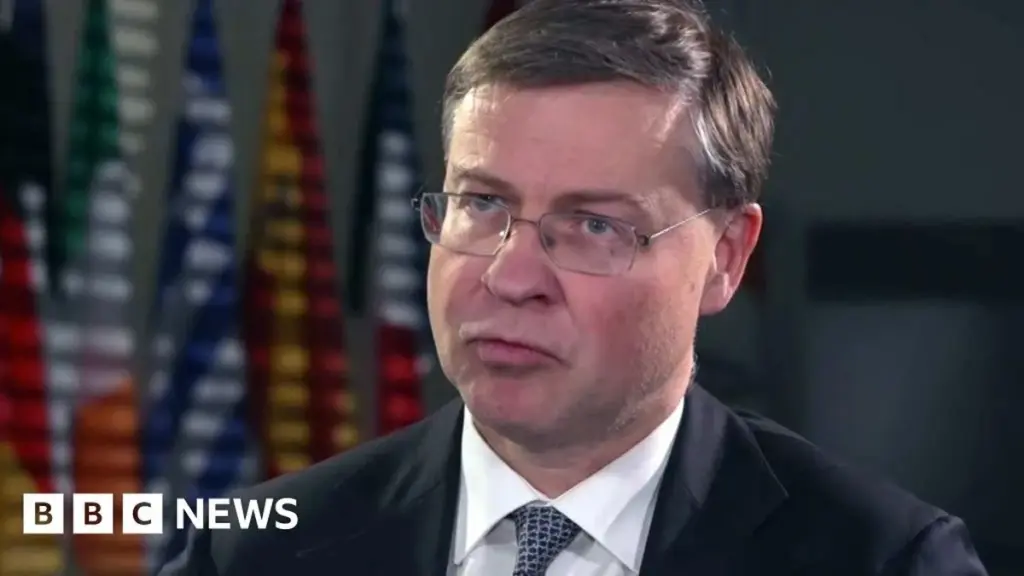
The European Union has indicated a willingness to explore closer trade relationships with the United Kingdom, including the potential for a customs union. This sentiment was conveyed by the European Commissioner for finance, Valdis Dombrovskis, in a recent interview with the BBC.
Dombrovskis stated that the bloc would approach discussions with an “open mind” regarding the UK’s interest in such an arrangement. He confirmed that the EU is “ready to engage” if the UK wishes to pursue this path, a concept that the Labour party has faced increasing calls to consider.
Following significant discussions with British ministers, including Chancellor Rachel Reeves, Dombrovskis also suggested the possibility of removing the majority of food checks between the UK and the EU. Additionally, he indicated an openness to Britain potentially joining the EU’s substantial defense loans scheme, valued at €150 billion, following the breakdown of previous agreement talks last year.
Broader Engagement Amid Global Uncertainty
Dombrovskis’s remarks represent the most explicit statement yet from Brussels regarding its readiness to re-establish engagement with Britain, particularly against a backdrop of escalating global instability. At a collaborative event in London, attended by Dombrovskis, Chancellor Reeves highlighted the growing importance of fortified ties in a world where “the rules are less clear.”
Understanding a Customs Union
A customs union would effectively eliminate tariffs, or taxes on goods, between the UK and the EU, thereby reducing administrative burdens. However, opponents of such a union raise concerns that it would significantly restrict the UK’s autonomy in negotiating independent global trade agreements. This is due to the EU’s practice of applying a common external tariff to all goods entering the customs union zone from outside, and its expectation that member nations will adhere to these shared standards.
Labour’s Stance and Growing Support
The Labour party’s election manifesto explicitly ruled out joining the existing EU customs union. The party also confirmed that it would not seek re-entry into the EU’s single market. The single market allows for easier trade in goods and services by requiring member states to adopt common regulations in specific sectors.
Despite the manifesto commitment, support for a customs union with the EU has been growing among Labour Members of Parliament. Justice Secretary David Lammy, for instance, has suggested that such a move could stimulate economic growth.
EU’s Openness to Dialogue
When questioned by the BBC about Brussels’ reception to discussions on the UK rejoining a customs union, Dombrovskis responded, “I cannot jump to conclusions, but I can say that we are ready to engage with an open mind and seek those areas of cooperation.”
He did, however, suggest that a return to the EU’s single market was unlikely. Dombrovskis emphasized that any access to the single market would necessitate the UK’s acceptance of freedom of movement. The single market operates on the principle of accepting “the four freedoms”: the unimpeded movement of people, goods, services, and capital.
“Quint” Group for Coordinated Dialogue
Chancellor Reeves hosted Dombrovskis and European Commissioner for Trade, Maroš Šefčovič, alongside cabinet ministers Peter Kyle and Nick Thomas Symonds. This group, informally referred to as the “Quint” by diplomatic circles, is intended to convene regularly to coordinate responses to the significant shifts observed in the trade and economic landscape in recent months.
While the “Quint” will not formally negotiate a reset of the post-Brexit relationship, its formation signifies a mutual desire for cooperation between the UK and EU in light of global uncertainties. During their meeting, Reeves communicated that the UK and EU “share values and objectives when it comes to the economy, to trade, and to security.” She also stressed the importance of collaborative efforts and, where feasible, presenting a unified stance.
Addressing Trade Friction and Defense Cooperation
Labour has already secured several bilateral agreements with the EU, including a significant accord on food standards that is still undergoing finalization. Dombrovskis indicated that, once implemented, this agreement could potentially eliminate almost all checks on goods traveling between Britain and the EU. Such checks have previously caused considerable disruption for businesses operating across the border, provided the UK aligns with EU sanitary and phytosanitary regulations.
Furthermore, Dombrovskis noted that discussions concerning a youth mobility scheme are “very advanced.”
Challenges in Security Action for Europe (SAFE) Participation
Progress has been stalled, however, in the area of Britain’s involvement with the Security Action for Europe (SAFE) scheme. SAFE is a substantial program designed to provide loans to EU countries for the procurement of defense equipment. Currently, British companies involved in this scheme are limited to supplying only 35% of the total value of a completed defense product. Negotiations for an improved arrangement broke down in November.
Asked about the possibility of a new agreement, Dombrovskis stated, “We are open for further discussions, we know the prime minister has expressed interest, actually, to come back to this issue, and there is certainly openness from the EU side for this.”
Global Context and EU’s Assertiveness
These meetings take place following a period of considerable international flux. This was exemplified by actions such as former US President Donald Trump’s suggestions regarding Greenland and the imposition of tariffs on NATO allies.
In response to such pressures, the European Commission had threatened retaliatory tariffs against the US. Trump eventually rescinded his actions, agreeing to a deal aimed at enhancing Greenland’s security without infringing on its sovereignty.
Dombrovskis characterized Brussels’ firm stance against Trump’s threats as instrumental in redirecting discussions to a “more productive” path. He commented, “That was clearly unacceptable, and we made it very clear from EU side, also indicating that we are ready to take counter measures if necessary.”