
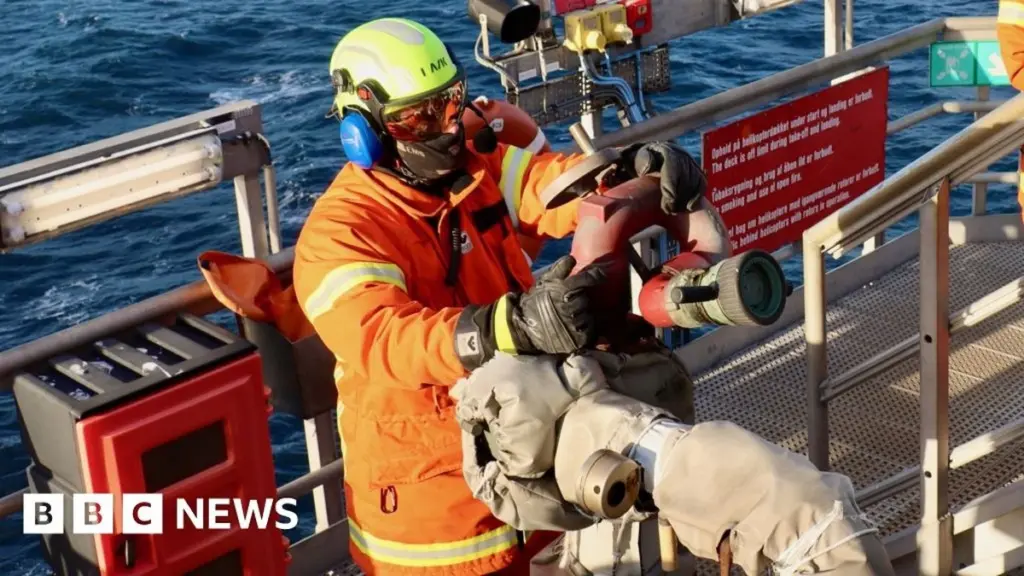
A pilot announces an offshore landing, guiding the helicopter toward a platform situated 250 kilometers from Denmark’s western coast. The aircraft had just completed a circuit around Nini, a nearby rig that rises from the North Sea’s turbulent waters.
This rig is positioned above an almost depleted oilfield, now slated for a second life as a substantial carbon storage project known as Greensand Future. The initiative intends to inject thousands of tons of climate-warming CO2 into the abandoned oilfield.
Upon disembarking, we step onto Siri, a larger “mother platform” housing a control center operated by offshore workers. Mads Gade, CEO of Ineos Energy, gestures towards the substantial pipes of the wellhead. For decades, these conduits facilitated the extraction of oil and gas from beneath the seabed.
“Rather than extracting oil and gas from the earth,” Gade explains, “we will be injecting CO2 into the ground.”
Carbon Capture and Storage (CCS) technology focuses on capturing and permanently sequestering carbon dioxide. The Greensand Future project, supported by a consortium led by the British multinational chemicals company Ineos, is set to become the European Union’s first large-scale offshore CO2 storage facility once commercial operations commence in the coming months.
The company projects the storage of approximately 400,000 tons of CO2 this year. This volume could potentially escalate to eight million tons annually by 2030, according to company statements.
“This figure represents nearly 40% of Denmark’s emission reduction target, a significant impact,” Gade notes.
Both the Intergovernmental Panel on Climate Change (IPCC), the United Nations’ leading climate science body, and the International Energy Agency (IEA) recognize that, alongside substantial and immediate emissions reductions, technologies for capturing and removing carbon are crucial tools in mitigating global warming.
Concerns and Criticisms of Carbon Capture Technology
However, CCS technology faces criticism. Some observers caution that it might inadvertently reduce the impetus for cutting CO2 emissions.
The technology is also considerably expensive. Furthermore, certain environmental organizations argue that emission reductions can be achieved more cost-effectively by utilizing existing technologies such as wind power, solar energy, and electric vehicles.
“I do not object to CCS application in sectors where emissions are genuinely difficult to abate or impossible to eliminate,” states Helene Hagel, head of climate and environmental policy at Greenpeace Denmark. “However, there are contexts where its application is entirely inappropriate.”
Hagel further contends that current actions might create future challenges. “If our generation utilizes the seabed for storing carbon that we should not have emitted in the first place, future generations will be deprived of its use for their own emissions,” she warns.
Global and European CCS Initiatives
Globally, hundreds of CCS initiatives are either in progress or under development. Within Europe, several extensive projects are advancing in the North Sea region, notably in Norway, the Netherlands, Denmark, and the United Kingdom.
Last August, Norway’s Northern Lights project, marketed as the world’s first commercial carbon storage service, began sequestering CO2 beneath the seabed near Bergen.
Several carbon capture clusters are also under development in the UK, including Scotland’s Acorn Project and the Viking project located off the coast of Lincolnshire.
Geological Suitability and Infrastructure Advantages
One primary reason the North Sea is emerging as a hub for CCS is its extensive history of oil and gas extraction. Niels Schovsbo, a senior researcher at the Geological Survey of Greenland and Denmark (GEUS), highlights that decades of production have led to a thorough understanding of the geology at potential storage sites.
The region also benefits from existing offshore infrastructure and established technical expertise. This existing framework is a key factor in attracting early adopters, Gade observes.
“The Nini platform is nearing the end of its operational life,” he mentioned. “Instead of complete dismantling, we have the opportunity to repurpose the facilities, along with the existing skills and competencies.”
Within a large warehouse on the outskirts of Copenhagen, racks filled with rock samples are stored from floor to ceiling. Schovsbo opens a container to reveal a speckled green slab extracted from the seafloor.
According to Schovsbo, the geology in this particular area of the North Sea is highly suitable for CO2 storage. The rock formations contain a significant number of pores, or small cavities, capable of holding captured carbon dioxide.
“A layer of clay, approximately one kilometer thick, acts as a cap rock,” Schovsbo explains. “This layer will effectively seal the CO2, much like it trapped oil and gas for millions of years. The sealing mechanism remains the same.”
He added that the volume of CO2 that can be stored is comparable to the volume of oil and gas extracted. This suggests a potential operational lifespan for CCS sites ranging from 10 to 30 years.
New Opportunities for Offshore Workers
For the numerous offshore workers in the region, carbon storage presents novel employment opportunities. Peter Bjerre, a maintenance manager, informed the BBC that “a significant portion of today’s work, involving the maintenance of turbines and gas compressors, will transition to servicing high-pressure pumps used for CO2 injection.”
Bjerre, a local resident of Esbjerg, reflected on the economic evolution of the area. “Fifty years ago, our livelihood was fishing. Then we moved into oil and gas,” he stated. “It is truly remarkable to witness a future being built here through the green transition.”