
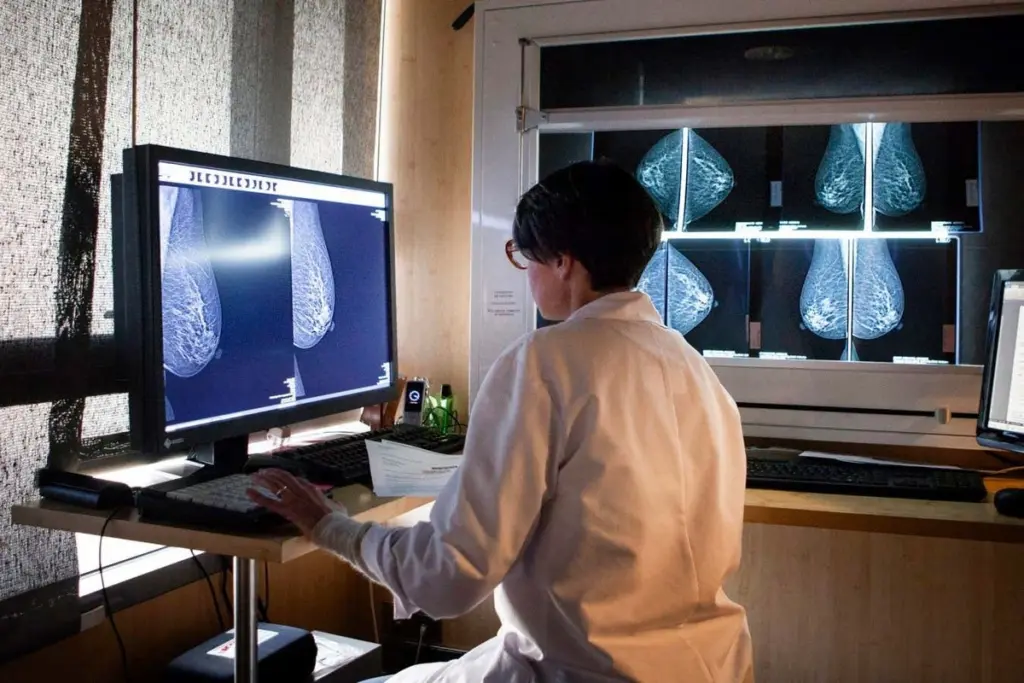
A recent randomized controlled trial has revealed that women screened for breast cancer with the support of artificial intelligence exhibit a lower incidence of aggressive cancers developing between scheduled screenings compared to those examined by radiologists alone. This development offers a promising outlook for potentially saving lives through AI-enhanced screening protocols.
Kristina Lång from Lund University in Sweden highlighted that this marks the inaugural randomized controlled trial focusing on the application of AI within mammography screening. The AI system, meticulously trained on over 200,000 mammography scans sourced from ten different countries, functions by analyzing visual patterns within the scans to quantify the probability of cancer presence on a scale from 1 to 10.
Mammograms scoring between 1 and 9 are subsequently reviewed by a single experienced radiologist. Scans achieving a score of 10, which signifies a high likelihood of cancer, are then subjected to evaluation by two specialist radiologists. This targeted assessment protocol aims to optimize the use of radiologist expertise.
An earlier investigation demonstrated that this AI-integrated approach could identify 29% more cancers than conventional screening methods. Standard screening typically involves two radiologists independently assessing each mammogram. Crucially, the AI-assisted method did not increase the rate of false positives – instances where a potential malignancy is flagged but subsequent tests confirm its absence or non-threatening nature. Fiona Gilbert of the University of Cambridge, who was not involved in the current trial, described this earlier finding as “terrific.”
Lång and her research team have now advanced this research, uncovering that the AI-supported screening also diminishes the probability of individuals developing what are known as interval cancers. These particular tumors emerge rapidly within the interval between routine screenings, making them characteristically aggressive and more prone to metastasize to other parts of the body.
The discovery emerged during an analysis of data from over 100,000 Swedish women, whose average age was 55. Participants were randomly allocated. Approximately half underwent standard breast cancer screening, where each mammogram was reviewed by two radiologists. The remaining participants initially had their mammograms processed by an AI model. This AI, developed by the Dutch biotech firm ScreenPoint Medical, then facilitated the assessment by radiologists, the majority of whom possessed at least five years of experience in mammogram analysis.
Women who received AI-assisted screening experienced a 12% reduction, on average, in the likelihood of developing an interval cancer when compared to those who underwent standard screening. “When we got the results, we were extremely thrilled,” Lång stated, expressing the team’s significant satisfaction with the findings. This outcome is attributed to the AI’s enhanced capability in detecting cancers at their nascent stages. Radiologists might overlook subtle tumors that could progress into interval cancers, whereas the AI appears adept at identifying them early.
However, the study was primarily designed to ascertain if AI could perform comparably to standard screening, rather than definitively prove its superiority. According to Lång, further trials are essential to confirm if the AI approach is indeed more effective. The research team also did not examine the AI-supported approach’s performance across different ethnic groups. Gilbert suggests that subsequent trials, including an ongoing study in the UK, will help address this specific aspect.
Further research is also warranted to determine if radiologists with less experience achieve similar benefits when utilizing AI. Gilbert, however, anticipates that the impact might not differ drastically.
Building upon these encouraging results, Lång anticipates the AI approach will be implemented across south-west Sweden, the region where the trial was conducted, within the next few months. Gilbert estimates it will take approximately five years for other countries to complete comparable trials that would justify wider adoption. She noted that nations must assess the impact on their specific populations, considering variations in screening frequency and ethnic diversity.
Additionally, the cost-effectiveness of the AI approach needs to be established. Estimates suggest that AI assistance could be a valuable investment if it leads to a reduction in interval cancer rates of at least 5 percent. Training for radiologists will also be necessary, though Lång believes this will not pose a significant challenge due to the software’s user-friendly nature.
It is crucial to emphasize that even with AI advancements, breast screening should consistently involve radiologists. Lång stated, “Women that participate in screening say they do not want to have AI as a standalone tool; they want to have a human in the loop, and I agree with them. I think it’s very important that it’s a tool for radiologists.”