
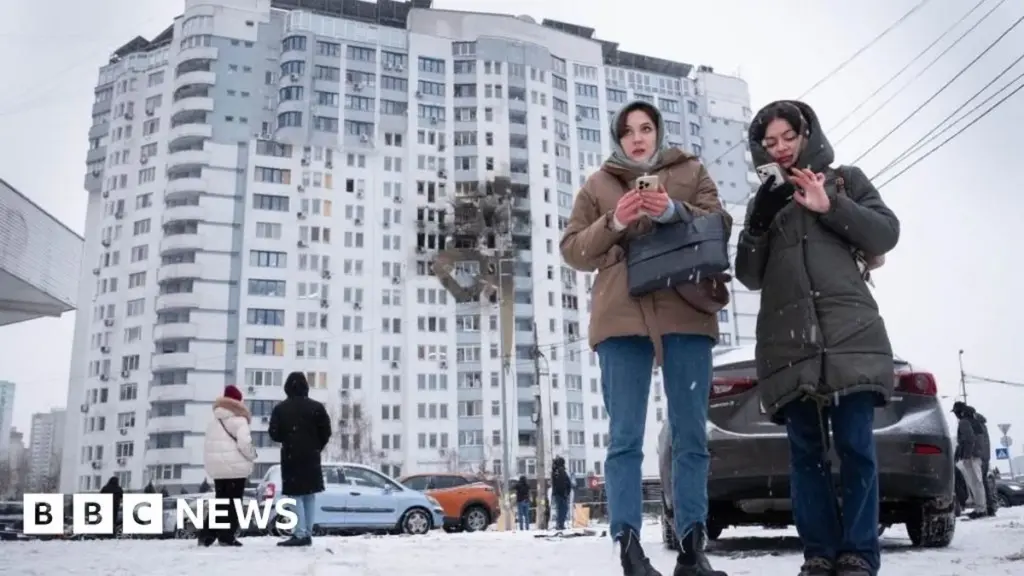
Former US President Donald Trump stated that Russian President Vladimir Putin has committed to refraining from attacking Ukrainian cities, including the capital Kyiv, for a period of one week. Trump attributed this alleged agreement to “extraordinary cold” weather conditions expected to affect the region.
While Moscow has not publicly confirmed any such understanding, Ukrainian President Volodymyr Zelensky acknowledged Trump’s statement, expressing his expectation that Russia would honor the purported pledge. Trump did not specify the exact commencement date for this pause in hostilities. However, temperatures in Kyiv are projected to drop significantly, reaching as low as -24°C (-11°F) within the coming days, following a predicted plunge starting Thursday night.
Russia has notably escalated its assaults on Ukraine’s energy infrastructure during the current harsh winter. This pattern mirrors similar tactics employed during cold periods since the commencement of the full-scale invasion in 2022. Trump made his remarks during a televised cabinet meeting in Washington D.C.
“I personally asked President Putin not to fire into Kyiv and the various towns for a week, and he agreed to do that,” Trump informed reporters. “It was very nice. A lot of people said, ‘Don’t waste the call, you’re not going to get that.’ And he [Putin] did it,” he added. Trump suggested that Ukrainian officials, who he claimed were “struggling badly,” were relieved by this development, though initially skeptical.
Later on Thursday, President Zelensky posted a statement on social media referring to Trump’s “important statement.” He highlighted a “possibility of providing security for Kyiv and other Ukrainian cities during this extreme winter period.” Zelensky further indicated that discussions had occurred between their teams while in the United Arab Emirates (UAE) and that his administration anticipates the implementation of these agreements.
It is understood that Ukraine has, in turn, agreed to reciprocal actions, pausing its own attacks on Russian oil refineries. This development follows trilateral talks held in the UAE last week between Russian, Ukrainian, and US negotiators—the first such discussions since the conflict began.
All parties involved characterized these negotiations as constructive. However, no public announcement emerged regarding any Russian agreement to halt attacks for the duration of the severe cold gripping the region. In the absence of such a confirmed ceasefire, attacks have continued, significantly impacting the power supply to major Ukrainian cities and leaving millions without essential heating and electricity.
Electrical repair crews are working around the clock to restore power. Nevertheless, these efforts are frequently negated by subsequent Russian aerial assaults. Even when power is re-established, the supply is often limited to a few hours, insufficient for adequately warming homes, though it may allow for the charging of appliances.