
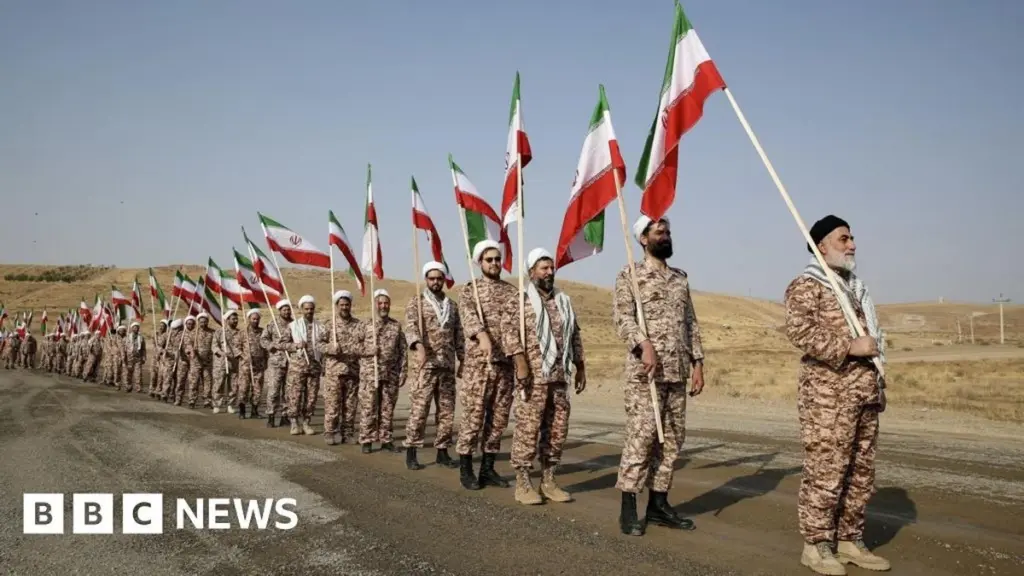
The European Union has officially added Iran’s Islamic Revolutionary Guard Corps (IRGC) to its list of terrorist entities. This significant decision follows a period of severe and lethal suppression of ongoing protests within Iran.
Kaja Kallas, the EU’s chief diplomat, characterized the move as a “decisive step,” emphasizing that such repression could not go unaddressed. Speaking before the decision, Kallas indicated that this blacklisting would place the IRGC, a formidable military, economic, and political institution in Iran, on par with designated jihadist groups such as al-Qaeda and the Islamic State group.
Estimates from human rights organizations suggest that security forces, including the IRGC, were responsible for the deaths of thousands of protesters during unrest that extended through December and January. French Foreign Minister Jean-Noel Barrot, speaking in Brussels on a Thursday, described the situation as “the most violent repression in Iran’s modern history,” asserting that perpetrators of such crimes would face no impunity.
France had previously expressed reservations about adding the IRGC to the EU’s terror list, concerned that such an action could sever all diplomatic ties with Iran. However, the country shifted its stance on Wednesday, giving strong backing to a proposal spearheaded by Italy to blacklist the organization.
“Any regime that kills thousands of its own people is working toward its own demise,” Kaja Kallas stated in a brief social media announcement. She also indicated her expectation that diplomatic channels with Iran would remain open despite the IRGC’s designation.
Organizations designated on the EU’s terrorist list are subject to various sanctions, including travel bans and asset freezes. The primary objective of these measures is to dismantle their support networks.
In addition to the IRGC, the EU has imposed new sanctions on six entities and fifteen individuals within Iran. Among those targeted are Interior Minister Eskandar Momeni, Prosecutor General Mohammad Movahedi Azad, and Iman Afshari, a presiding judge. The EU’s statement noted their involvement in the “violent repression of peaceful protests and the arbitrary arrest of political activists and human rights defenders.”
While Australia, Canada, and the United States have already classified the IRGC as a terrorist group, the United Kingdom has not yet proscribed it. UK Deputy Prime Minister David Lammy condemned Iran’s “brutal oppression of peaceful protesters” on Wednesday, but stated that government policy precluded commenting on specific organizations under consideration for proscription.
Broader Geopolitical Context and Tensions
The EU’s announcement arrives amidst heightened regional tensions, following a statement from US President Donald Trump regarding the movement of a “massive Armada” towards Iran with “great power, enthusiasm, and purpose.” Trump issued a warning that “time was running out” for Iran to reach an agreement on its nuclear program, urging Tehran to engage in negotiations.
He further threatened an attack significantly “far worse” than previous US strikes if a deal was not achieved. In response, Iran’s Foreign Minister Abbas Araghchi declared that the nation’s armed forces were prepared to “immediately and powerfully respond” to any aggression, with “fingers on the trigger.” According to Iran’s semi-official Tasnim news agency, army chief Amir Hatami also vowed a “crushing response” to any US aggression, reporting that various military units had received a consignment of 1,000 drones.
Araghchi is scheduled to visit Turkey on Friday, where his counterpart, Hakan Fidan, has indicated Turkey’s readiness to “contribute to resolving the current tensions through dialogue.” Trump’s recent warning follows a prior commitment from Washington to intervene and assist those involved in the recent fatal crackdown on protesters.
Information Gaps and Conflicting Figures
Assessing the full extent of the government’s violence against protesters has been challenging due to an internet blackout imposed by Iranian authorities. The US-based Human Rights Activists News Agency (HRANA) reports confirming the deaths of over 6,301 individuals, including 5,925 protesters. A separate group, the Norway-based Iran Human Rights (IHR), suggests the final death toll could surpass 25,000.
Iranian authorities, however, claim that more than 3,100 people have been killed, stating that the majority of these were security personnel or bystanders who fell victim to attacks by “rioters.” International news organizations, including the BBC, are largely barred from operating within Iran. Nevertheless, the BBC has verified video evidence depicting security forces firing live ammunition into crowds.