
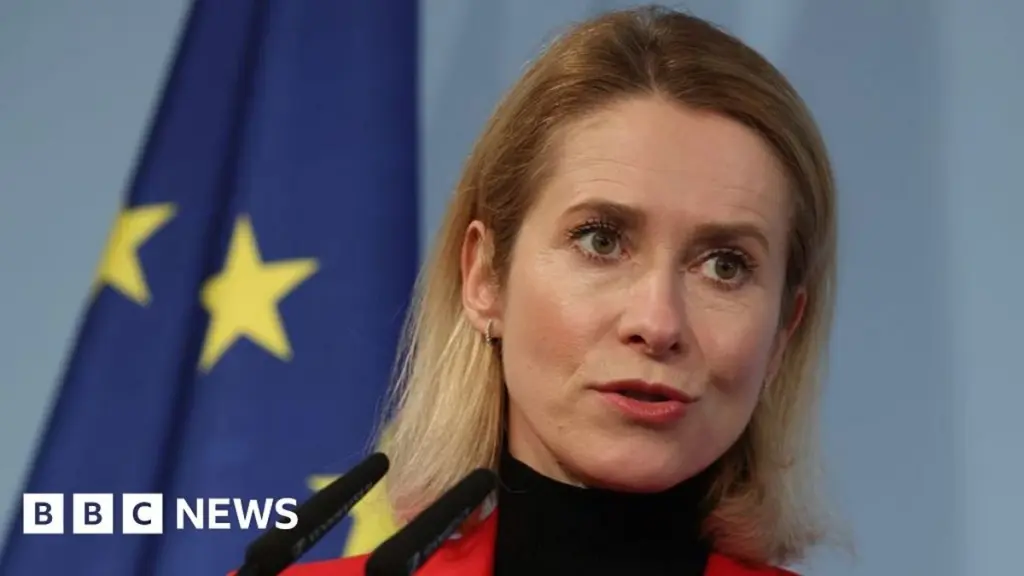
The European Union’s top diplomat, Kaja Kallas, has issued a stark warning, calling for urgent action to bolster Europe’s defense capabilities. She emphasized the necessity for the continent to become more self-reliant, asserting that the United States has fundamentally altered the transatlantic relationship. While acknowledging the U.S. will remain a partner and ally, Kallas stressed that no major power has ever successfully outsourced its survival and endured.
Tensions in the U.S.-Europe relationship were notably amplified when President Donald Trump made propositions regarding the semi-autonomous Danish territory of Greenland. These concerns surfaced shortly after NATO leader Mark Rutte faced criticism for suggesting European lawmakers should abandon the idea of European defense independence without U.S. support. French Foreign Minister Jean-Noël Barrot responded to Rutte’s statement, asserting that Europeans possess both the capacity and the imperative to secure their own safety, referencing the “European pillar of NATO” as a recognized contribution.
Kallas articulated that during the Trump administration, Europe ceased to be Washington’s primary focus, necessitating a cultural shift from nationalistic thinking towards unified European action. The EU’s foreign policy chief characterized this U.S. pivot away from Europe as a sustained, structural change rather than a fleeting development. She highlighted a particular responsibility for the 23 nations that are members of both the EU and NATO to synchronize their efforts. Echoing Barrot, Kallas pointed to the value a distinct European defense structure could provide.
The Greenland Incident and Shifting Dynamics
The recent U.S.-European disagreement concerning Greenland underscored what Kallas described as a “tectonic shift” in their alliance. This occurred after Trump threatened punitive tariffs against his closest European allies who opposed his plans for the Arctic island. Mark Rutte was credited with de-escalating tensions between Trump and European leaders, as the U.S. president withdrew his threat during discussions with the NATO chief on the sidelines of the Davos forum. Trump indicated he was exploring a potential agreement regarding Greenland, though specifics remain undisclosed.
NATO Spending and European Autonomy
Last year, under pressure from President Trump, NATO member states committed to increasing their collective defense spending to 5% of their Gross Domestic Product by 2035. However, a portion of these funds could be allocated to national infrastructure projects. Rutte informed the European Parliament that if Europe were to pursue complete defense autonomy, it would require an expenditure of 10% of its economic output (GDP) and the development of its own nuclear capabilities. He further posited that distancing from the U.S. would mean relinquishing the “ultimate guarantor of our freedom, which is the U.S. nuclear umbrella.”
Increasing European Responsibility
Addressing the same conference in Brussels where Kallas spoke, EU Defence Commissioner Andrius Kubilius stated on Wednesday that the U.S. now anticipates Europeans to assume greater responsibility for their security as American presence on the continent is expected to decrease. Kubilius described Europe as a “sleeping giant” that requires awakening, emphasizing the urgent need for “rapidly build[ing] our independence. Independence in defence: without delays and without excuses.”
NATO’s Origins and Modern Challenges
Established in Washington in 1949, NATO’s primary mandate was to safeguard the security and freedom of its members against the threat posed by the Soviet Union, a Soviet-dominated Communist bloc that dissolved in 1991. Russian President Vladimir Putin has consistently voiced concerns about NATO’s eastward expansion, viewing it as a security risk to Moscow. He has framed Russia’s full-scale invasion of Ukraine in 2022 as a direct response to these perceived threats.
Despite these Russian grievances, an increasingly assertive Russia has prompted two EU members, Sweden and Finland, to join the NATO alliance following the 2022 invasion. The Kremlin has signaled its demand that Ukraine be prohibited from joining NATO as part of any future peace settlement. While joining the European Union and NATO is enshrined in Ukraine’s constitution, the prospect of Kyiv becoming a NATO member in the immediate future is considered unlikely.