
The initial three-way peace discussions involving Russia, Ukraine, and the United States, held in Abu Dhabi, have concluded without any discernible progress, occurring as fighting continues. Ukrainian President Volodymyr Zelensky suggested the possibility of a subsequent meeting as early as the following week. Concurrently, an American official indicated that a new round of talks would commence on February 1st.
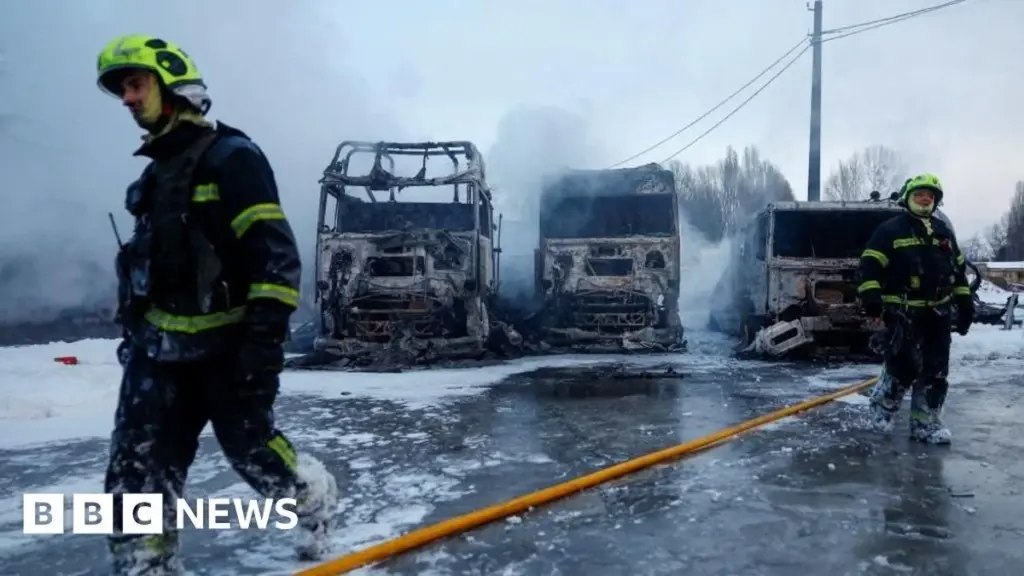
These two-day discussions concluded shortly after a series of Russian airstrikes targeted Ukraine’s already compromised energy infrastructure. Ukrainian officials reported that these attacks resulted in one fatality and injuries to 35 individuals. In response, Russia alleged that Ukraine had attacked an ambulance within Ukrainian territory under its control, leading to the deaths of three medical personnel. Subsequently, Russia reported a Ukrainian missile strike on energy facilities in Belgorod. The BBC was unable to independently verify these claims.
Context of the Abu Dhabi Discussions
The meetings in Abu Dhabi marked the first trilateral engagement since Russia initiated its full-scale invasion of Ukraine in 2022. President Zelensky stated on X that the “central focus of the discussions was the possible parameters for ending the war.” He expressed his high regard for the shared understanding regarding the necessity of American monitoring and oversight throughout the process of ending the conflict and ensuring genuine security.
Zelensky added that all parties had agreed to “report back to their capitals” and to coordinate subsequent actions with their respective leaders. An unnamed U.S. official informed reporters that “the next round begins next Sunday in Abu Dhabi again.” This official also characterized the decision to hold further talks as a “good sign,” noting that “a lot of work” had been accomplished during the two days of negotiations.
Russia’s state news agency, Ria-Novosti, reported that Moscow remained amenable to continued dialogue with both Ukraine and the United States.
Impact of Airstrikes on Ukrainian Infrastructure
The mayor of Ukraine’s capital, Kyiv, Vitali Klitschko, reported that one person had died and four were wounded as a result of Russian airstrikes on Friday night. In the city of Kharkiv, the mayor indicated that 31 people had sustained injuries. Klitschko further stated that Kyiv’s critical infrastructure had been damaged, leaving 6,000 buildings without heating. This occurred as temperatures in parts of Ukraine had dropped to approximately -12°C (10.4°F). President Zelensky remarked that the energy infrastructure had been the “main target of the Russians.”
In Kharkiv, Mayor Ihor Terekhov reported damage to a maternity hospital and a hostel accommodating displaced individuals. Ukrainian Foreign Minister Andrii Sybiha described the “brutal” Russian attack, which he characterized as being “cynically” ordered by President Vladimir Putin, as having “hit not only our people, but also the negotiation table.” He asserted that this “barbaric” overnight assault demonstrated that “Putin’s place is not at the board of peace, but at the dock of the special tribunal.”
Allegations of Attacks on Medical Personnel and Infrastructure
Meanwhile, Russia accused Ukraine of perpetrating a “barbaric crime against the civilian population” in the Kherson region, which is partially under Russian control. Maria Zakharova, a spokesperson for the Russian foreign ministry, alleged that a clearly marked ambulance carrying a medical team from the Oleshky central district hospital was attacked by a Ukrainian drone at the entrance to the village of Hola Prystan. She stated that all three medical professionals inside were killed and emphasized that “attacks on civilian medical transport are prohibited by international humanitarian law.”
On Saturday evening, the governor of Belgorod, Vyacheslav Gladkov, reported that Ukraine had conducted its largest bombardment to date on the city, which is situated across the border from Kharkiv. Gladkov noted that energy infrastructure sustained damage but confirmed that no casualties occurred.
Territorial Disputes and Potential Security Guarantees
Last week, U.S. President Donald Trump stated that Putin had accepted an invitation to join his Board of Peace, an organization focused on conflict resolution. Putin has not officially confirmed this. Russia currently occupies approximately 20% of Ukraine, including portions of the eastern Donbas region. The Kremlin seeks Ukraine’s cession of significant territory, a demand that Ukraine has rejected.
Speaking in Davos, Zelensky commented, “It’s all about the land. This is the issue which is not solved yet.” He also mentioned reaching an agreement with Trump concerning future U.S. security guarantees for Ukraine should a settlement be achieved. While Zelensky provided no specific details, he indicated that such an agreement would require review by the U.S. Congress and the Ukrainian parliament before finalization.
The day preceding the Abu Dhabi talks, U.S. special envoy Steve Witkoff and Trump’s son-in-law, Jared Kushner, met with Putin in Moscow. Following this four-hour meeting, Kremlin aide Yury Ushakov conveyed that “Vladimir Putin has emphasised Russia’s sincere commitment to settling the Ukraine crisis by political and diplomatic means.” However, Ushakov also stated that “bringing about a lasting settlement would be unlikely without addressing the territorial issue based on the formula as agreed in Anchorage.”
Last August, Trump and Putin reportedly met in Anchorage, Alaska, to discuss ending the war. This meeting resulted in an agreement that would permit Russia to claim the Donbas region and maintain control over the Crimean peninsula, which it annexed in 2014. Zelensky has firmly ruled out surrendering the Donbas, comprising the Luhansk and Donetsk oblasts, much of which is currently occupied by Russia.