
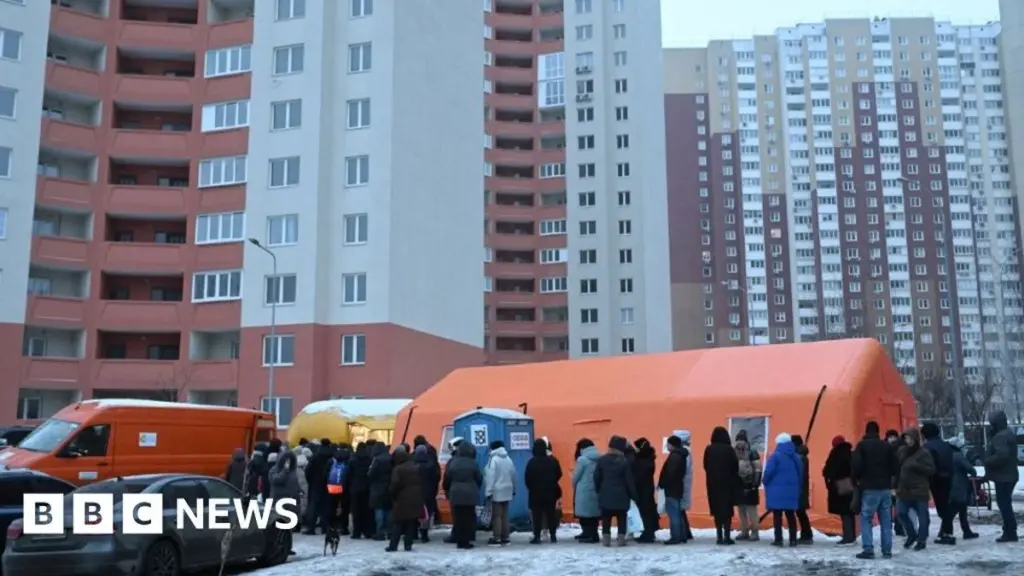
Ukraine is currently enduring its most challenging winter in recent memory. As January temperatures consistently drop below -15°C, Russia has been deliberately targeting the nation’s energy infrastructure. This strategic assault has left approximately one million Ukrainians without vital heating.
The capital city, Kyiv, stands as the primary objective for these attacks. Following a significant Russian bombardment that occurred overnight leading into January 24th, nearly 6,000 apartment buildings found themselves without heat, according to official statements from Mayor Vitaly Klitschko. This marks the third such coordinated Russian assault on Kyiv’s heating systems in just over two weeks. Previous strikes on January 9th and 20th similarly plunged hundreds of thousands of residents into freezing conditions within their homes.
Life in Kyiv has become notably unpredictable, with one resident describing it as a daily gamble. “If you have heating and gas, you often lack electricity and water,” she explained to the BBC. “Conversely, if electricity and water are available, heating is absent.” The simple act of returning home now involves a daily guessing game: “Will I be able to shower or enjoy a hot cup of tea, or will I have neither? And, of course, missiles and drones only add to this.” This resident noted the necessity of wearing a hat and multiple layers of clothing even when going to bed.
A significant factor exacerbating Ukraine’s challenges and, conversely, simplifying Russia’s strategy is the widespread reliance on communal central heating systems. In these setups, water is heated at a central location and then distributed to radiators throughout numerous apartment buildings. Ukrainian heating plants are consequently large-scale operations, and their targeting by Russian forces affects vast numbers of people. Ukraine has reported that all such major heating plants have now been hit.
While these attacks also disrupt electricity supplies, and portable generators or battery packs can offer some respite in such situations, addressing heating issues is far more complex. This is especially true when the absence of electricity prevents the operation of electric heaters.
The Soviet Legacy of Centralized Heating
Kyivteploenergo, the sole provider of heating and hot water services in Ukraine’s capital, confirmed that “the absolute majority” of Kyiv’s residential buildings depend on its services. The company cited security concerns as the reason for not disclosing exact figures.
In Zaporizhzhia, a frontline city with a population of 750,000, nearly three-quarters of its residents rely on central heating, as stated by Maksym Rohalsky, the head of the local association of apartment block dwellers. Prior to Russia’s full-scale invasion in 2022, an estimated 11 million households across Ukraine depended on central heating, compared to seven million with autonomous heating systems, according to Ukrainian energy expert Yuriy Korolchuk.
The urban landscapes of cities throughout the former Soviet Union, including those in Ukraine, were profoundly shaped by extensive construction programs initiated in the 1950s. These initiatives focused on the mass production of affordable housing.
Prominent features of these former USSR cities include ubiquitous nine-story residential buildings constructed from pre-fabricated concrete panels, commonly referred to as “panelki.” Alongside these are smaller five-story apartment blocks known as “khrushchevki,” named after Soviet leader Nikita Khrushchev, who oversaw their development during the 1950s and 1960s.
The heating for these buildings is supplied by large facilities known as TETs. This acronym, standing for “heat and electricity centrals” in Ukrainian, reflects their dual function of generating both electricity and heat. Individual, detached houses, typically occupied by a single family and often found in rural areas, are comparatively rare within urban settings in Ukraine.
“Ukraine inherited the Soviet heating system, and its fundamental structure remains unchanged, largely centralized,” Korolchuk explained. He added, “These heating plants were not originally engineered to withstand attacks from missiles or drones, which has brought these inherent vulnerabilities to the forefront during the conflict.”
According to Korolchuk, this represents a new tactic employed by Russia. “There were no such strikes directed at the heating system during previous winters,” he noted. “They occurred only sporadically and did not specifically target heating plants.” He suggested that ongoing peace negotiations might also be a factor, describing the attacks as “a form of pressure.”
While large, centralized installations offer efficiencies in scale, their vulnerability to aerial attacks means that disruptions can have devastating consequences for hundreds of thousands of people. The Ukrainian government is actively addressing this weakness. Plans are underway to mitigate this vulnerability by mandating individual heating points for apartment blocks.
However, effectively reversing decades of Soviet urban planning and its embedded infrastructure presents a substantial and protracted challenge.