
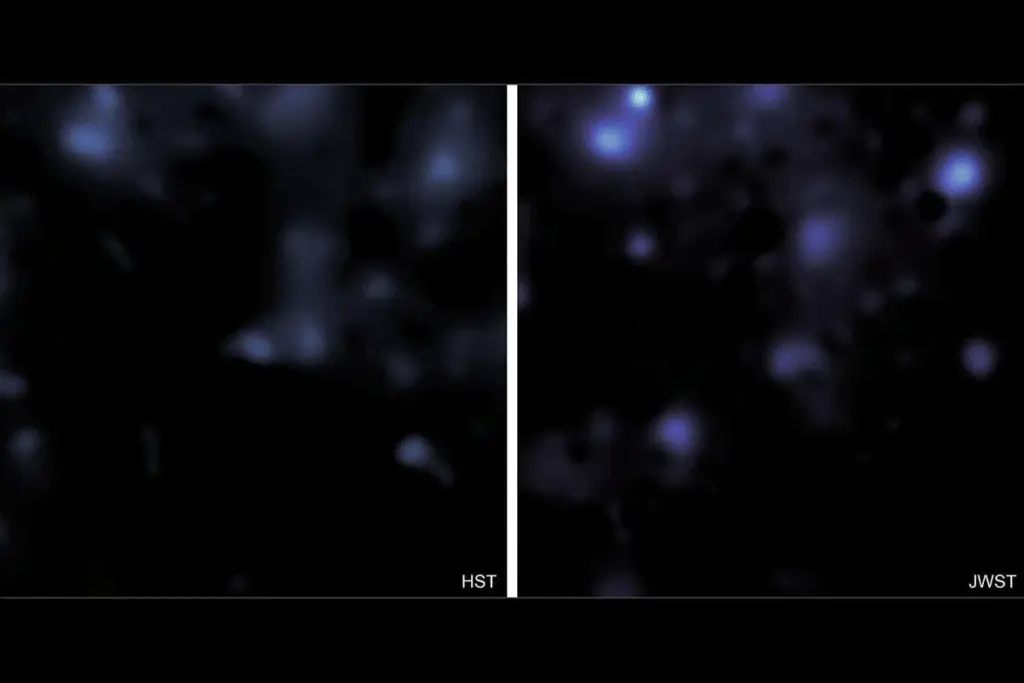
Scientists have achieved a groundbreaking feat in cosmic cartography, constructing the most precise map of dark matter to date. This intricate depiction was rendered possible by analyzing the subtle distortions observed in the shapes of approximately 250,000 galaxies. The insights gleaned from this endeavor hold significant promise for unraveling some of the universe’s most profound enigmas.
Dark matter, by its very nature, presents an immense mapping challenge. As its name suggests, it does not emit detectable light. Its influence is primarily exerted through gravitational interaction with ordinary matter, a force researchers leverage to pinpoint its location. Jacqueline McCleary, based at Northeastern University in Massachusetts, and her team employed the advanced capabilities of the James Webb Space Telescope (JWST) for this precise task. Their observations focused on a sector of the sky that spans a region slightly larger than the apparent size of the full moon.
According to McCleary, the result is “a very high-resolution picture of the scaffolding of this little corner of the universe.” The map’s clarity surpasses previous efforts made with the Hubble Space Telescope, offering resolution double that of earlier surveys. Furthermore, it encompasses celestial structures situated significantly farther from Earth.
The creation of this detailed map involved the meticulous examination of the shapes of around 250,000 galaxies. It is not their inherent forms that are of primary interest. Liliya Williams of the University of Minnesota, who was not directly involved in this research, commented that these galaxies essentially serve as “the cosmic wallpaper.” The crucial element is how the gravitational influence of dark matter, positioned between the telescope and this “wallpaper,” distorts the light emanating from these distant galaxies. This phenomenon is known as gravitational lensing. The more a distant galaxy’s average shape deviates from a perfect circle, the greater the amount of dark matter situated between it and the observer.
By scrutinizing these observed shape variations, the researchers have successfully charted vast formations of galaxy clusters. They have also identified filaments that constitute the cosmic web, the large-scale structure that interconnects these clusters. Certain identified structures did not align with existing observations of regular, or luminous, matter, suggesting their composition is dominated by dark matter. Williams noted that “gravitational lensing is one of very, very few techniques, and definitely the best,” for identifying these numerous structures across an extensive area.
This detailed mapping is of considerable importance, given that dark matter constitutes approximately 85 percent of the total matter content in the universe. Its distribution is fundamental to the evolutionary trajectory of not only galaxies and galaxy clusters but the cosmos as a whole. Developing an accurate map of its presence may offer critical clues to its behavior and its fundamental composition, Williams explained.
McCleary highlighted the dual significance of the findings: “Not only is it an observational coup, but in turn it’s going to enable a lot of other analysis – cosmological parameter constraints, the connection between galaxies and their dark matter haloes and how they grow and evolve over time.” These cosmological parameters include metrics like the strength of dark energy, the enigmatic force responsible for the universe’s accelerating expansion.
Provisionally, the JWST map appears consistent with the current standard cosmological model, known as lambda-CDM. However, McCleary cautioned that substantial in-depth analyses of the data are yet to be conducted, which are expected to yield novel insights. “Although at a glance it’s a match for lambda-CDM, I’m not giving up yet – I’m withholding judgment until our analysis is finished,” she stated.
Journal reference: Nature Astronomy DOI: 10.1038/s41550-025-02763-9