
Spanish rail authorities have enacted a temporary reduction in speed limits along a segment of the high-speed line connecting Madrid and Barcelona. This measure follows the detection of a track fault, prompting a reassessment of operational safety.
Óscar Puente, the Transport Minister, reported that a crack was identified on Sunday night. The flaw was located on the track approximately 110 kilometers (68 miles) west of Barcelona, specifically between the towns of Alcover and l’Espluga de Francolí, within the Catalonia region.
This development occurs only days after a high-speed train collision in southern Spain resulted in 45 fatalities. Concurrently, the country’s northeastern regions are experiencing considerable disruption to their local rail services.
The transport ministry has stated that the identified track issue does not present an immediate danger to trains operating on the line, assuring that services will continue to run. This is the most significant of several speed limit adjustments implemented on high-speed routes in recent days, following the fatal accident in Adamuz, Andalusia, earlier this month.
The speed limit for the affected section of track will remain at 80 km/h (50 mph) indefinitely. This contrasts sharply with the normal operational speeds of up to 300 km/h for high-speed trains on the Madrid-Barcelona route, which is one of Spain’s busiest long-distance rail corridors.
The previous week saw temporary speed reductions to 230 km/h on various parts of the Madrid-Barcelona line. These earlier adjustments were made after train drivers reported experiencing vibrations or other anomalies along the route. The limits were later restored to 300 km/h after technical inspections were completed.
Similarly, some sections of the Madrid-Valencia line also experienced temporary speed limit decreases, with limits lowered to 160 km/h and 200 km/h respectively.
Broader Rail Disruptions in Catalonia
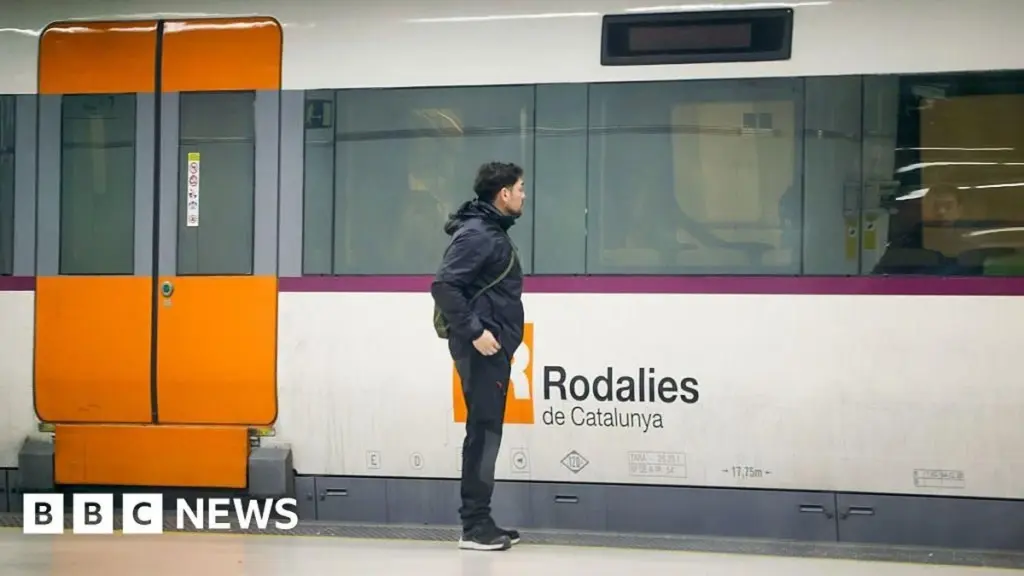
Meanwhile, the local Rodalies rail service in Catalonia has been experiencing significant operational disruptions.
Last week, a trainee driver lost their life when a train collided with a collapsed wall. The Rodalies service was consequently halted as drivers voiced demands for enhanced safety assurances, and operational lines underwent thorough reviews. On Monday, two separate incidents further complicated the situation in the region, leading to renewed suspensions of the service before operations were partially reinstated later in the day. The Spanish government has indicated that the causes of these incidents are unknown, though a cyberattack has not been ruled out.
The Catalan Republican Left (ERC) party attributes the issues within the Rodalies network to “decades of lack of investment.”
Ramon Talamàs, president of the Chamber of Commerce of Terrassa, commented that the reputational damage incurred is “as bad as or worse than the economic losses.”
Prime Minister Pedro Sánchez is scheduled to address Congress on February 11th to respond to questions regarding the ongoing rail crisis.
Investigation into the Adamuz Crash Continues
These recent measures coincide with the ongoing investigation into the high-speed crash in Adamuz. In that incident, the rear carriages of a northbound train bound for Madrid derailed on a straight section of track, leading to a collision with an oncoming train.
Investigators are currently examining a roughly 40 cm (16 inch) section of track that detached, reportedly just before the derailment occurred.
The transport ministry has indicated that the line where the accident took place had undergone renovation and recent technical assessments. However, it has since emerged that the damaged rail section, manufactured in 2023, was welded to an older section, reportedly produced in 1989. The point of connection between these two segments appears to be where the crack developed.
Iñaki Barrón, who heads the independent commission investigating the crash, stated that “everything appears to suggest that” the separation of these two welded track pieces was the cause of the tragedy.
Opposition politicians are now calling for the resignation of Óscar Puente, accusing him of providing misleading information to the public following the incident.