
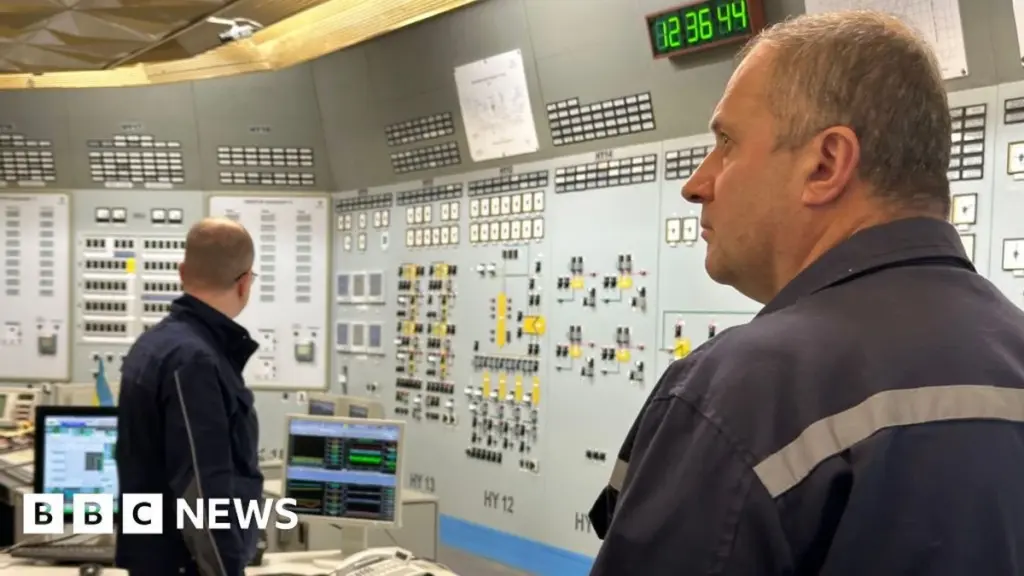
In the control room of Ukraine’s Khmelnytskyi nuclear plant, a dedicated team of technicians diligently oversees a complex array of screens and indicators. This expansive facility in western Ukraine has become a cornerstone of the nation’s energy infrastructure and a critical asset in its ongoing conflict.
Ukraine is presently confronting a severe energy deficit, a direct consequence of sustained Russian assaults on its vital infrastructure. A substantial portion of the country’s electricity, at least 60%, originates from the massive turbine halls housed within Khmelnytskyi and two other nuclear power stations.
A Nation Under Threat
Pavlo Kovtonyuk, head of Energoatom, Ukraine’s National Nuclear Energy Company, guided a rare tour of the facility. He emphasized the tangible and constant danger these installations face from Russian aggression. “Russia is presently targeting substations that link nuclear power plants to the grid, aiming to disrupt nuclear energy supply,” Kovtonyuk explained. He characterized these actions as “nuclear terrorism,” highlighting that the integrity of the connection between these systems and the nuclear plant is paramount for their safe and reliable operation.
Nuclear power stations are inherently secure and sensitive environments. Access for individuals not directly involved in their operation is strictly limited. The BBC was granted exceptional permission to visit the plant, offering a glimpse into how Ukraine is navigating Russia’s intense attacks.
Under nightly bombardments, involving hundreds of missiles and drones, Ukraine alleges that Russia is systematically targeting its critical energy infrastructure. President Volodymyr Zelensky contends that Moscow is deliberately exploiting the harsh winter conditions, plunging tens of thousands of Ukrainians into darkness and depriving them of heating and running water.
The majority of the country’s conventional power plants have sustained damage or been rendered inoperable by Russian aerial strikes. Consequently, nuclear plants such as Khmelnytskyi are now shouldering the responsibility of meeting the nation’s primary energy demands.
The Shadow of Zaporizhzhia
Ukraine’s largest power plant, situated on the southern banks of the Dnipro River near Zaporizhzhia, has been under Russian occupation since the commencement of the war. This facility is not only the largest in Ukraine but also stands as Europe’s most substantial nuclear power station, possessing the capacity to power a nation the size of Portugal. However, Zaporizhzhia is currently in a “dormant” state, producing no electricity, with Russian technicians and military personnel in control.
Consequently, the future of the Zaporizhzhia site has emerged as a pivotal element in any prospective peace negotiations between Ukraine and Russia. Recent reports indicate Ukraine’s desire for a joint management arrangement with the United States, potentially sharing the plant’s energy output.
Personal Accounts of Occupation
During the visit to the Khmelnytskyi complex, some staff members were introduced who had previously worked at Zaporizhzhia before the Russian occupation began. Among them were Dariia Zhurba, a technician, and her husband, Ihor, an engineer. Reflecting on the night of March 3, 2022, Dariia recounted, “It was scary. It was really frightening when they occupied. We were at home that night.” Ihor added, “We heard explosions, shooting… so we hid in our corridor, as the gunfire and explosions continued. In the morning, we realized we were occupied.”
The couple continued their work at the plant for several weeks, but the situation became “unbearable” as Russian control gradually tightened. They eventually managed to depart, undertaking a lengthy journey through occupied Ukraine, Russia, Belarus, and Poland. During this arduous transit, all their possessions, including their phones, were subjected to intense scrutiny by their Russian captors.
“They checked everything on our phones, connecting them to special devices so they could search our contacts, all social media, even the things we’d ‘liked’,” Dariia shared, now residing in a modest modular home provided by the Swedish government near her new workplace. She also noted the interrogations about their relatives and potential military service. Tragically, their escape was not shared by all. “We know cases where people were taken to the ‘basement’ where they were interrogated and things like that,” Ihor stated, referring to the grim reality of torture in occupied territories. He added, “There were also cases when other people were taken and then went missing. I knew some of them – not close friends, but we worked at the same station.”
Workers Under Duress
Contact has also been established with Ukrainian workers who remain at the Zaporizhzhia plant, operating under Russian direction. Communicating via encrypted social media, these individuals describe a chaotic environment where “maintenance work on the equipment is practically not happening.” Russian soldiers are reportedly present, and military equipment is being stored within the complex, according to these sources.
Critical Safety Concerns Amidst Occupation
A significant concern for plant workers, Energoatom management, and the wider international community is the potential scenario where the Zaporizhzhia nuclear plant remains under Russian control, even in the event of a ceasefire. Although currently non-operational, the plant’s nuclear reactors require ongoing maintenance and cooling to prevent overheating and the escalation of radiation levels. However, electrical substations vital for the plant’s cooling systems have been damaged during the conflict. Energoatom officials also report that the ponds supplying water for cooling have, at times, been allowed to reach dangerously low levels by the Russian occupying forces.
Adding to the complexity, four of Zaporizhzhia’s energy blocks utilize American-made fuel systems, a transition initiated by Ukraine in previous years. Ukrainian officials assert that Russian technicians are neither trained nor equipped to operate these systems should the plant restart.
Conflicting Narratives on Maintenance
Alexei Likhachev, head of Russia’s Rosatom nuclear agency, maintains that Russia is actively maintaining the plant, citing Russian law which prohibits any other entity from operating it. He states, “It is currently ensuring the plant’s safe operation under the most difficult combat conditions.”
International Atomic Energy Agency (IAEA) officials do, on occasion, access Russian-occupied territory to inspect the Zaporizhzhia plant. Under temporary ceasefire agreements, the IAEA reports supervising repair work on damaged power lines and the maintenance of critical cooling systems. In a recent statement, the IAEA confirmed sending a team from Vienna to assess the latest repair efforts. IAEA Director General Rafael Grossi highlighted the direct implications of Ukraine’s power grid deterioration due to military activity on the nuclear safety of its facilities, emphasizing the agency’s priority to assess the functionality of critical substations.
Conversely, Ukrainian officials express grave concerns about Russia’s alleged neglect of the site, warning of a potential repeat of the Chernobyl nuclear disaster.
Echoes of Chernobyl and Future Risks
The Chernobyl disaster on April 26, 1986, resulted from a reactor explosion during a test, dispersing nuclear contaminants across Europe and necessitating the construction of a containment dome. Energoatom director Pavlo Kovtonyuk remarked, “In my view, it could be much worse than Chernobyl, because at Chernobyl there was an explosion of a single reactor unit with fuel.” He elaborated on the frightening prospect, stating, “If Russia brings the situation to the point of core melting and melting of fuel in the spent fuel pools, the contamination could be greater [than Chernobyl]!… It would not be explosive, and it could be stretched out over time, but the contamination could be greater!”
This sobering prospect underscores the immense contentious nature surrounding the immediate and long-term future of the Zaporizhzhia nuclear complex. Evidence suggests Russia has begun constructing power lines diverting from Zaporizhzhia towards occupied territories and Russia itself, in anticipation of a potential restart of the plant under Moscow’s control. Ukrainian leaders and nuclear officials strongly oppose this scenario, deeming it unacceptable.
Not only is Ukraine’s energy independence intertwined with the Zaporizhzhia plant’s functionality, but a nuclear accident, as projected by some experts, would have far-reaching implications extending beyond national borders.
Additional reporting by Firle Davies and Anastasia Levchenko.