
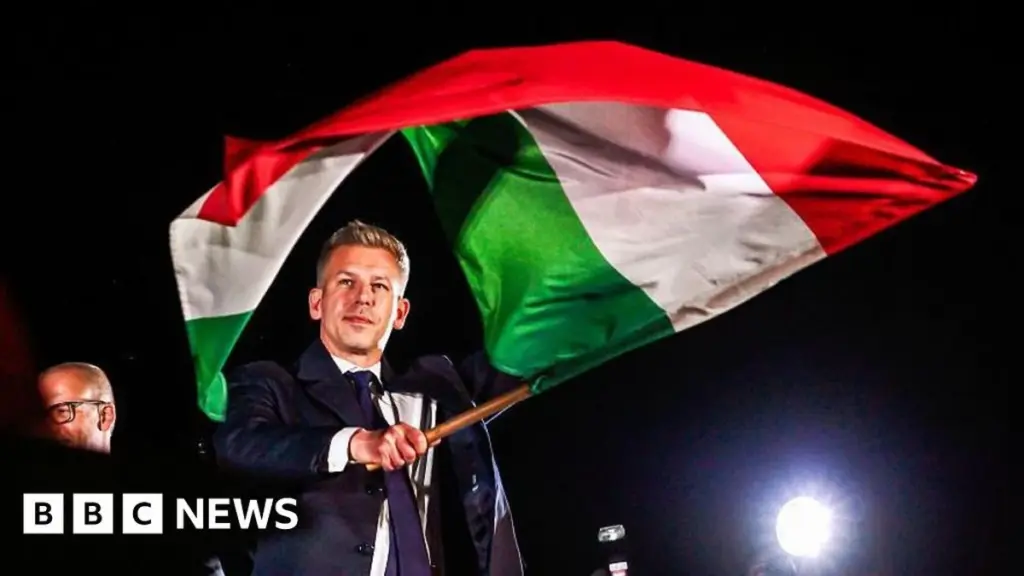
The era of Viktor Orbán’s leadership has concluded swiftly, with Péter Magyar and his triumphant Tisza party moving with remarkable speed to orchestrate the handover of power in Hungary. Their decisive victory last Sunday, a dramatic landslide against Orbán’s long-standing authority, has set a new political trajectory for the nation. The Tisza party secured an impressive 52% of the vote, effectively ending Fidesz’s 16-year continuous grip on power and positioning them to command up to 140 seats in the 199-seat National Assembly. In stark contrast, Orbán’s Fidesz party has seen its representation plummet from approximately 135 seats to roughly 55.
The final vote count, encompassing recounts in closely contested constituencies and ballots cast from abroad, is scheduled for Saturday. Magyar has already secured an important commitment from President Tamás Sulyok: the formation of the new parliament will be accelerated to commence the week of May 4th. This adjustment will subsequently allow for the election of the new government.
Magyar has also engaged in robust interviews with public service television and radio outlets, entities that have largely either disregarded or actively opposed him over the preceding two years. His administration has pledged to enact legislation that will suspend their current news programming. This measure is intended to remain in effect until impartial editors can be appointed to oversee their operations.
These significant changes will, of course, require time to implement fully. Possessing a formidable “super-majority” exceeding two-thirds of parliamentary seats, Magyar’s party also intends to introduce legislation, retroactively applied, that will limit a prime minister to two terms in office. Viktor Orbán has already completed five terms. Should this proposal pass, it would effectively preclude any possibility of his future return to power.
Orbán’s Concession and Fidesz’s Future
It was not until late Thursday, following Sunday’s significant electoral defeat, that Viktor Orbán broke his public silence. In an interview featured on the Patrióta YouTube channel, he acknowledged the conclusion of his long tenure. “This is the end of an era,” Orbán stated, accepting the defeat with a call for dignity. He conveyed sentiments of “pain and emptiness” regarding the outcome, taking personal responsibility for the events. However, he offered minimal analysis of his campaign’s primary missteps, aside from mentioning the stalled progress on the Russian-designed Paks 2 nuclear power station, which is now six years behind its projected schedule.
A crucial meeting of Fidesz’s senior leadership is slated for April 28th, preceding a party congress scheduled for June. During his interview, Orbán indicated his intention to remain at the helm of Fidesz should he be re-elected, but concurrently emphasized the party’s need for “complete renewal.”
Of the remaining 55 seats Fidesz will hold in the incoming Parliament, only 12 currently represent individual constituencies, with the majority stemming from party lists. Orbán suggested that many of the new deputies selected from these party lists were not ideally suited for opposition roles and should be replaced. Within the party, where public dissent is seldom voiced, there have already been nascent calls for internal change.
“I don’t believe [Orbán] needs to resign immediately,” commented András Cser-Palkovics, the Fidesz mayor of Székesfehérvár. “He should await the national caucus, then begin evaluating the results. Following that, we should hold a leadership election.”
Currently, there appears to be no clear successor to Orbán within Fidesz, nor anyone possessing his distinct ability to reconcile diverse viewpoints and ambitions. Advisors from the United States and Britain had reportedly voiced criticism regarding Fidesz’s primary campaign slogan, “the safe choice,” suggesting it might alienate younger voters. However, a source speaking to the BBC noted the inherent difficulty for a party in power for an extended period to effectively present itself as an agent of change.
In an effort to counter this, two younger ministers, Foreign Minister Péter Szijjártó (47) and Transport Minister János Lázár (51), were frequently featured alongside Orbán at rallies. Rather than injecting renewed energy into the party, their perceived dynamism inadvertently made their leader appear older and weary. Orbán will turn 63 next month, and the cumulative impact of 38 years in front-line politics is evident even to his most steadfast supporters.
A Climate of Fear and Calls for Accountability
A palpable atmosphere of apprehension and internal blame pervades the governing party. Rumors of impending arrests for corruption are circulating widely in Budapest. On social media platforms, supporters of Tisza are vociferously demanding accountability for individuals who allegedly amassed wealth illicitly during the previous administration.
Péter Magyar is at the forefront of this movement. “My message to the Fidesz leaders and their cronies: It’s futile to play innocent now, pretending nothing has occurred,” he posted on Facebook. “We are fully aware of the damage inflicted upon our homeland and the Hungarian people. Rest assured, you will face the consequences of your actions.”
Throughout downtown Budapest, a significant number of Fidesz campaign posters have been vandalized. Many bear the spray-painted word “Vége” – the end – while others have been torn and defaced with strong expletives. The party’s precipitous fall from public favor, even among some former supporters, has been remarkable.
Strategic Moves and Anti-Corruption Measures
The unyielding posture adopted by the incoming Tisza leadership appears to be both an emotional reaction and a tactical maneuver. They are seeking retribution for what they perceive as a campaign of vilification orchestrated by the government-controlled Central European Press and Media Foundation (Kesma). This foundation, which encompasses 476 publications, including approximately 50 primary news outlets, has targeted Tisza and Magyar personally.
One of the initial challenges confronting Tisza is to prevent capital flight by businessmen closely associated with the outgoing ruling party. Dubai is frequently cited as a preferred destination for Hungarian oligarchs. Another immediate priority is to safeguard against the destruction of evidence pertaining to corruption, particularly within government ministries. While some offices are reportedly shredding documents, two individuals with insider knowledge of Tisza have informed the BBC that officials are offering digital copies of information on USB drives, in exchange for job security or immunity from prosecution.
In the week leading up to the election, as opinion polls consistently predicted a substantial opposition majority, Tisza alleges that dozens of contracts were finalized with favored companies. These agreements reportedly commit the state to future expenditures in areas such as IT, research, and construction.
With their newly acquired two-thirds majority, Tisza will be empowered to enact legislation aimed at reinstating checks and balances that were eroded or dismantled by Fidesz over the past 16 years. In his campaign, Magyar committed to establishing an office dedicated to the recovery of stolen state assets. This week, he reiterated his pledge to join the Luxembourg-based European Public Prosecutor’s Office (EPPO).
Such a move would signal to the European Union his commitment to combating corruption, though EPPO’s jurisdiction is limited to investigating the misuse of EU funds. Magyar has also engaged in discussions with Zsolt Hernádi, the CEO of MOL, Hungary’s energy conglomerate. MOL operates two refineries vital to both Hungary and Slovakia.
Energy Security and Shifting Alliances
The urgent restoration of oil supplies via the Druzhba (Friendship) pipeline, which originates in Russia and traverses Ukraine, represents one of the few policy areas where Magyar and Viktor Orbán find common ground. The pipeline has been non-operational since late January. However, Ukrainian President Volodymyr Zelensky indicated this week that oil flow could resume by the end of the month.
Hungary’s incoming prime minister has expressed a desire to diversify the nation’s oil sources, particularly by enhancing the utilization of an alternative pipeline extending from the Croatian island of Krk. Approximately three-quarters of Hungarians aged 18 to 29 are estimated to have supported Tisza. Réka Szemerkényi, a former Hungarian ambassador to the United States under Orbán’s administration, shared with the BBC that she was particularly impressed by the messages conveyed by Hungary’s younger generation to their new leaders.
“‘Ria, Ria Hungaria,’ signifying our love for our country,” was one common sentiment, according to Szemerkényi, who is now affiliated with the Equilibrium Institute in Budapest. “This was followed by chants of ‘Europa,’ and a third message I repeatedly heard was ‘Russians go home.’ These three elements collectively outline a clear foreign policy agenda.”
On Friday, a high-ranking delegation from the office of European Commission President Ursula von der Leyen arrived in Budapest for preliminary discussions with Tisza officials, led by Péter Magyar. To regain access to €17 billion (£15 billion) in EU funds that were withheld from the Orbán government, the new administration will be required to meet 27 specific criteria. These benchmarks pertain to judicial independence, efforts to combat corruption, and the liberation of media from government control.
Hungary’s economy is currently experiencing a significant downturn, and Magyar and his team recognize the imperative to act decisively from the outset.