
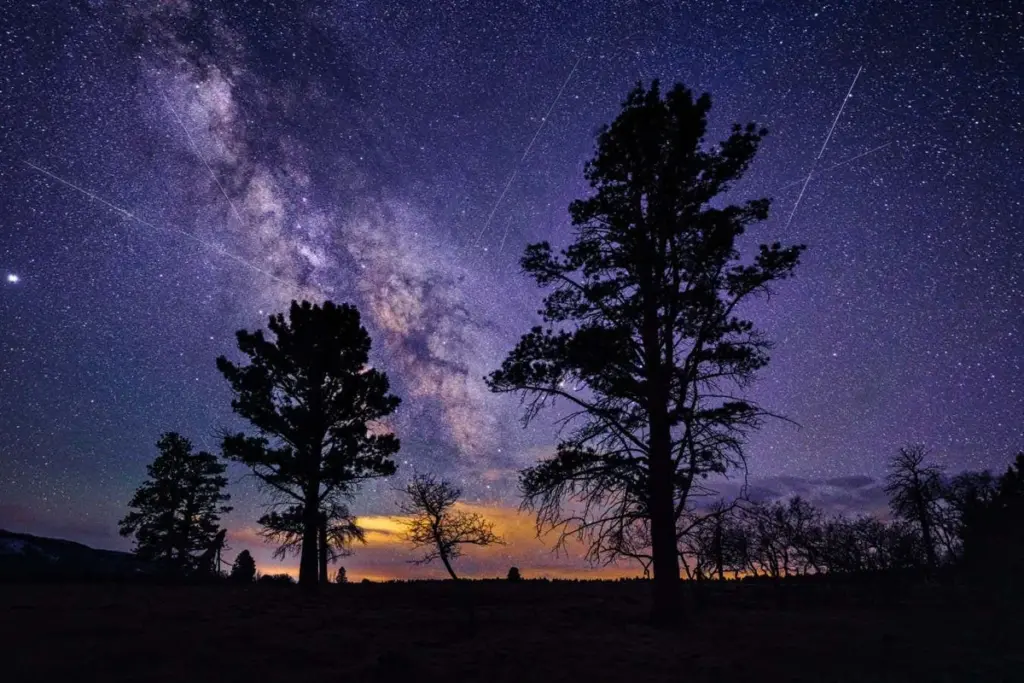
The Lyrid meteor shower is set to reach its zenith on the evening of April 22nd, extending into the early hours of the 23rd. However, observers have a broader window of opportunity, with the shower visible anytime between April 16th and April 25th. For guidance on what to watch for, New Scientist’s stargazing resource offers expert advice. The accompanying audio is accessible below or within the podcast feed of “The World, The Universe, and Us.”
Meteors originate from high-velocity debris from space impacting Earth’s atmosphere. These minuscule particles of dust or rock enter our atmosphere at such tremendous speeds that atmospheric friction causes them to ignite, producing a fleeting streak of light across the sky.
As Earth traverses its annual orbit around the sun, it encounters numerous clouds of dust and debris. These remnants, often shed by comets or asteroids, lead to an observed increase in meteor activity. This phenomenon explains the consistent timing of specific meteor showers each year.
The Lyrid meteor shower’s origin is traced back to the long-period comet C/1861 G1, also identified as Thatcher. First discovered in 1861, comet Thatcher requires 415 years to complete a single orbit of the sun. Its next anticipated return to our solar system’s vicinity is projected for approximately the year 2278.
Viewing a meteor shower does not necessitate focusing on a particular section of the sky. Yet, each shower derives its name from the celestial region from which its meteors appear to emanate, or radiate. In the case of the Lyrids, this region is the constellation Lyra in the northern hemisphere, which hosts the prominent star Vega.
For those situated in the northern hemisphere, the constellation Lyra can serve as a reference point. While Lyra will not be observable from the southern hemisphere, meteors traverse the sky in all directions. Consequently, some shooting stars may still be visible to observers in the south, particularly when looking towards the east.
From the northern hemisphere, Lyra becomes visible in the eastern sky shortly after sunset. As the night progresses, it climbs higher in the sky, offering improved viewing conditions for meteors. However, proximity to sunrise brings an increasingly brightened sky, which can diminish visibility.
An effective method for locating Lyra involves identifying the pattern of stars known as the Summer Triangle. This asterism is defined by three bright stars forming a triangle. In the northern hemisphere during summer, it appears directly overhead around midnight. During late April, at the stroke of midnight, these three bright stars will be positioned near the eastern horizon. Vega, the highest of these stars, resides within the constellation Lyra.
Under clear and dark sky conditions, observers at the peak of the shower could potentially witness between 10 and 18 meteors per hour.