
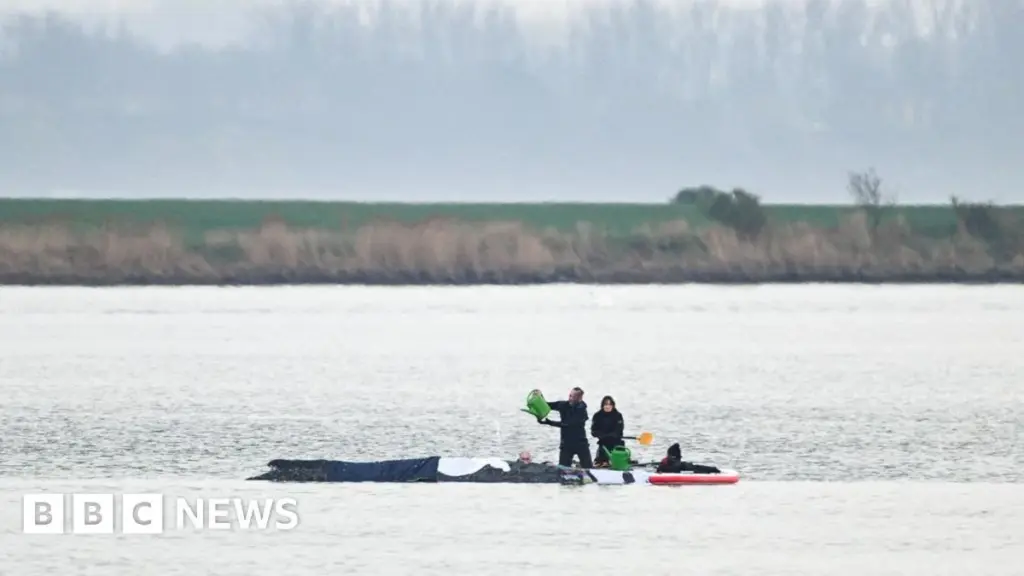
Rescuers are preparing to employ inflatable air cushions in a novel attempt to liberate a humpback whale that has been stranded off Germany’s northern coast for several weeks.
This particular whale, affectionately nicknamed Timmy by local media outlets, was first observed in the Baltic Sea in early March. This location is a significant distance from its natural migratory paths. Currently, the animal is lodged in a shallow coastal zone near the island of Poel.
The new rescue plan involves a private company. Their proposed method is to lift the injured mammal from the seabed by its flippers and position it onto a tarp. This tarp would then be attached to a tugboat, according to official statements.
The state of Mecklenburg-Western Pomerania has characterized this operation as “minimally invasive.” However, wildlife experts have cautioned that any intervention carries inherent risks, especially following the unsuccessful outcomes of prior rescue efforts.
Previous Attempts and Shifting Strategies
Earlier assessments had concluded that the whale’s chances of survival were exceedingly low. Despite these grim prognoses, the German state’s environment minister, Till Backhaus, indicated that a recent reassessment had identified a less intrusive strategy as potentially viable.
The air cushions, described as similar in function to inflatable armbands, are intended to help the weakened whale ascend to the surface. From there, it could potentially be guided around Denmark’s coastline and into the North Sea, with the possibility of continuing further into the Atlantic Ocean.
The whale, though injured, is still exhibiting signs of life. However, reports confirm it is severely debilitated. The state of Mecklenburg-Western Pomerania has reiterated that the prognosis remains critical, though a slim possibility of survival cannot be entirely dismissed.
“Against this background, it is justifiable to allow this attempt, and I thank the initiative for it,” Backhaus stated. This indicates a willingness to pursue the new approach despite previous doubts.
Authorities had previously acknowledged the difficult decision to allow the “majestic animal to go in peace,” reflecting the challenges faced.
Public Attention and Protective Measures
The whale’s predicament has garnered international media attention. In response, the state government has issued warnings against “wild conspiracy theories and misinformation” circulating online regarding the situation.
An exclusion zone has been established around the whale’s location to prevent interference and ensure the safety of both the animal and any personnel involved in the rescue operations. Reports have surfaced of individuals attempting to get too close, necessitating intervention by authorities.
The outpouring of public sympathy for the whale’s plight has been significant. Backhaus commented on this, stating, “The outpouring of sympathy shows how deeply the animal’s fate moves people.” He simultaneously urged for respect for the work of emergency services and adherence to the protective measures in place.
Underlying Causes of the Stranding
The whale is believed to have become entangled in fishing net before eventually grounding itself on a sandbank. Compounding its difficulties, it is also suffering from a skin condition, likely exacerbated by the lower salinity levels of the Baltic Sea.
Previous rescue attempts involved excavators to create a channel, aiming to permit the whale to swim freely. However, efforts to guide it toward the North Sea proved unsuccessful, as it repeatedly veered back toward shallower waters.
Greenpeace Germany, an organization involved in earlier rescue initiatives, has voiced its non-support for this latest attempt, citing concerns over the whale’s severely compromised health condition.
Wildlife experts from the German Oceanographic Museum and the Institute for Terrestrial and Aquatic Wildlife Research have provided further details on the whale’s injuries. They described visible skin detachments and indicated the presence of considerable internal injuries, likely resulting from the sustained pressure of its own body weight on its internal organs over several days.
These experts also noted that the injuries suggest the whale may have had contact with a ship’s propeller and a fishing net. The exact circumstances leading the whale to enter the Baltic Sea remain unclear.