
On February 24, 2022, as Russian forces crossed the Belarusian border into Ukraine, Lyudmila Dyblenko, the head of the Chernobyl Meteorological Station, instructed her team to evacuate with their belongings. However, by the time she had completed this directive, her own opportunity to leave had vanished, as Russian troops had already secured the exclusion zone surrounding the plant.
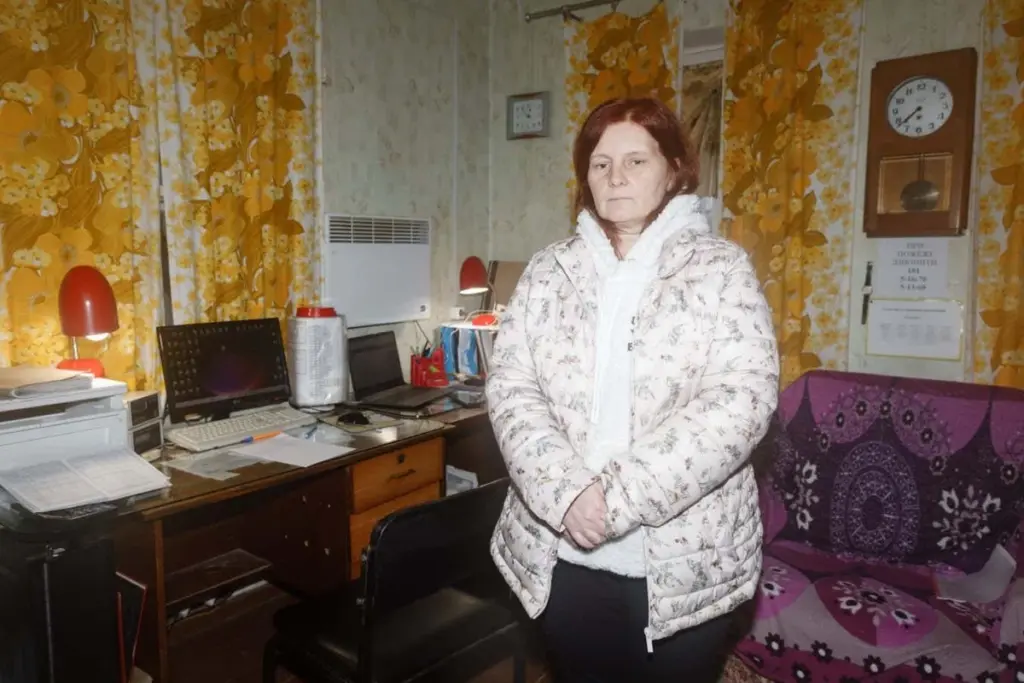
“I began gathering monitors and equipment, and then it was far too late,” Dyblenko recounted, speaking from the modest cottage that serves as the weather station. Despite having no option but to remain, she made the courageous decision to continue collecting crucial measurements of radiation, temperature, wind, rain, and other environmental factors essential for scientific monitoring within Chernobyl.
She stated, “I opted to persist with my work. I genuinely cherish my profession and deeply love my country.”
While the task of recording and transmitting these readings is typically automated, Dyblenko’s electricity supply was cut off by March 9. This rendered her equipment inoperable and made essential activities like heating and cooking nearly impossible. During a winter visit, her cottage was the warmest location in Chernobyl, thanks to a persistent fire that made her small workspace comfortable. The situation was starkly different during the period of occupation.
Dyblenko meticulously observed the patrol patterns of the Russian soldiers. She ascertained their timings and began discreetly venturing out to take measurements manually. Subsequently, she transmitted this data using an older mobile phone, which she found possessed a more effective antenna than contemporary smartphones.
The meteorological station is situated on higher ground within Chernobyl. Dyblenko identified two nearby locations—a truck stop and a church—where she could establish a weak but usable signal to transmit her collected data.
“I possess software that automatically compiles and dispatches data upon input, but this became unfeasible without power,” Dyblenko explained. “Consequently, I was compelled to perform the task manually.”
During Dyblenko’s diligent efforts, the Russian soldiers became progressively more audacious. On one occasion, a soldier forcefully entered her dwelling, demanding cognac. Dyblenko responded by treating him as a disobedient student, sharply asking, “Is this a restaurant?” Fortunately, her bold approach was effective, and the soldier departed in apparent dejection.
Eventually, she became aware that a persistent surveillance had been established. This realization came when she noticed a faint red pinpoint of light emanating from the bushes on the far side of the clearing where the scientific instruments were situated. She chose to ignore it and continued her routine.
Because of her persistent actions, there is no interruption in the data records. This ensures that scientific analysis of the Chernobyl exclusion zone can be comprehensive and accurate, without any missing data during the period of occupation. Ukraine’s President, Volodymyr Zelenskyy, recognized her bravery with a medal, an honor that, quite fittingly, she speaks of with evident pride. This may very well be the sole medal a meteorologist receives during the ongoing conflict.