
The United Kingdom has stated that three Russian submarines recently conducted a clandestine operation targeting cables and pipelines in waters north of the UK. Defence Secretary John Healey announced this, detailing the deployment of British naval and air assets to counter what he described as “malign” activity by Moscow.
Healey asserted that while the operation was observed, there is currently no indication of damage to UK infrastructure located in the Atlantic. Addressing Russian President Vladimir Putin directly, he issued a stern warning: “We see you. We see your activity over our cables and our pipelines, and you should know that any attempt to damage them will not be tolerated and will have serious consequences.”
The Russian embassy in London has, however, denied these allegations. According to Russia’s state news agency Tass, the embassy stated that Russia is “not threatening underwater infrastructure, which is truly critical to the UK. We are not using aggressive rhetoric in this regard.”
UK’s Dependence on Subsea Networks
The UK relies significantly on its extensive network of undersea cables and pipelines for both data transmission and energy supply. Approximately 60 undersea cables connect to the UK coastline at various points, with a notable concentration in East Anglia and South West England. These vital conduits facilitate over 90% of the UK’s daily internet traffic.
Details of the Observed Russian Activity
During a press briefing, Mr. Healey elaborated that one Russian Akula class submarine acted as a diversionary tactic while two GUGI (Main Directorate for Deep Sea Research) spy submarines conducted surveillance of the critical undersea cables. The Akula class submarine reportedly departed UK waters and returned to Russia after being monitored. The two GUGI vessels, however, remained in the vicinity.
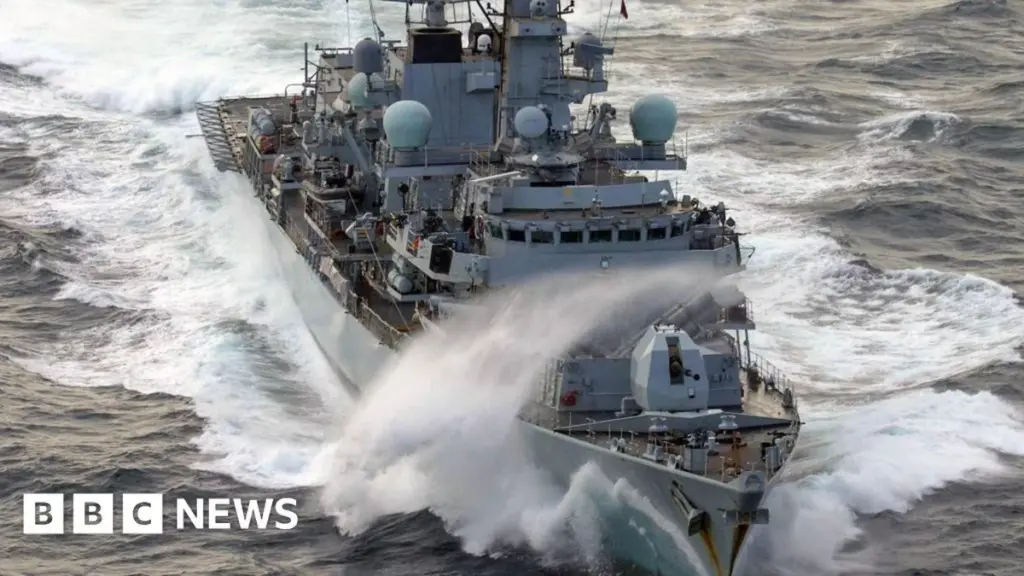
To track these Russian submarines, the Royal Navy deployed the frigate HMS St Albans, the fuel tanker RFA Tidespring, and anti-submarine Merlin helicopters. The UK was not alone in monitoring this activity; other nations also participated, with Norway being the only one explicitly mentioned by Healey.
“Our armed forces left [Russia] in no doubt that they were being monitored, that their movements were not covert, as President Putin planned, and that their attempted secret operation had been exposed,” Healey stated. He added, “We watched them, we were able to track them, we dropped sonar buoys to demonstrate to them that we were monitoring every hour of their operation.”
Understanding Russia’s GUGI
The Russian Main Directorate for Deep Sea Research, known by its acronym GUGI, presents a significant challenge to Western nations. While part of the Russian navy, GUGI operates with extreme secrecy, reporting directly to the defence minister and the president. Its operations are headquartered in St. Petersburg, with an Arctic base enabling deployment from Olenya Bay on the Kola Peninsula, which also serves as the home for Russia’s strategic nuclear submarine fleet.
GUGI’s specialization lies in underwater surveillance, sabotage, and reconnaissance. It possesses capabilities for operating military equipment at extreme depths, a capacity rivaled only by the United States. This includes specialized miniature, uncrewed submarines that Russia is believed to have used in its operations over Britain’s data cables in the North Atlantic.
These “mini-subs” can be deployed covertly, often at night, from spy vessels. Concerns exist that these submarines could be used to cut cables or, significantly, to intercept data streams, allowing Russia to monitor the information passing through them. This strategy falls under the umbrella of “hybrid warfare,” involving hostile acts that stop short of overt, attributable lethal attacks.
Strategic Implications and Security Concerns
A primary concern for Britain and NATO is that Russia’s covert surveillance of Western undersea cables and pipelines aims to establish a strategic advantage should hostilities arise. In such a scenario, Russia could seek to sever or disrupt a substantial portion of Britain’s data flow, potentially by activating pre-positioned devices.
Mr. Healey also suggested that President Putin may have sought to exploit global distractions, such as the war in the Middle East, to advance Russia’s agenda, identifying Moscow as the “primary threat to UK security.” He expressed confidence in the UK’s ability to track and monitor future Russian activities, thereby exposing any covert operations that might threaten vital interests.
Prime Minister Sir Keir Starmer emphasized the government’s determination to protect the British public from the repercussions of Russian aggression, stating that the UK would “not shy away from taking action and exposing Russia’s destabilising activity that seeks to test our resolve.”
Following Mr. Healey’s announcement, Kemi Badenoch, leader of the Conservative Party, called on Sir Keir Starmer to “publish the Defence Investment Plan now,” arguing that clarity on domestic spending is essential for posturing strength abroad. Reform UK leader Nigel Farage commented on reports of Russian oil tankers being escorted by the Russian navy through the English Channel, suggesting it highlighted a severe deficiency in the operational capacity of the UK’s Royal Navy.
A former UK defence attaché in Moscow noted that the current rhetoric surrounding these threats might be becoming repetitive, questioning the effectiveness of existing countermeasures. Retired Royal Navy officer John Foreman stated, “We’re well aware of the Russian threat. The question is whether we’re doing something about it,” highlighting the UK’s perceived difficulty in maintaining its security and citing the decommissioning of two tankers.
Global Critical Infrastructure and GUGI’s Capabilities
Undersea cables and pipelines represent a critical component of global infrastructure. Over 600 undersea cables, spanning approximately 870,000 miles, connect the world, transmitting electricity and information. These cables often make landfall in discreet locations.
Dr. Sidharth Kaushal, a sea power researcher at the Royal United Services Institute (RUSI), explained that Russia’s GUGI unit utilizes deep-diving mini-submarines, supported by larger “mothership” vessels. These submarines are designed for stealth, minimizing noise and displacement to evade detection by magnetic sensors. Kaushal suggested that despite being monitored, these Russian submarines likely managed to gather data on the UK’s undersea cable network.
He noted that the UK’s ability to restrict such operations during peacetime is “limited,” as monitoring activities in international waters is legally permissible for both military and private organizations. However, he added that monitoring the operation could yield vital intelligence for the Royal Navy, offering insights into what Russia is mapping, its tactics, and potentially allowing for the recovery of any deployed surveillance assets.
Energy Infrastructure and Hybrid Warfare Context
The UK also depends on a network of underwater gas pipelines, primarily situated in the North Sea, which supply essential energy from the UK and Norwegian Continental Shelves. The Langeled pipeline, stretching 724 miles between Norway and the UK, is a key example, delivering approximately 77% of the UK’s gas imports from Norway.
Previous reporting indicated that Russia has been engaging in “hybrid warfare” against the UK and Western Europe, with the objective of deterring or punishing Western nations for their military support of Ukraine. Hybrid warfare involves anonymous, deniable attacks, often under suspicious circumstances, that fall short of being clearly attributable acts of war.