
Feedback, a popular recurring segment in New Scientist that offers a different perspective on recent science and technology news, invites readers to submit amusing items via email to [email protected].
Exploring the Unconventional
The planet Earth, substantial in size and densely populated, allows for the expression of even the most specialized interests. Feedback harbors a particular fondness for the unusual tourist destinations found along America’s extensive highway systems. One such example is Nebraska’s “World’s Largest Collection of the World’s Smallest Versions of the World’s Largest Things,” a gloriously literal attraction.
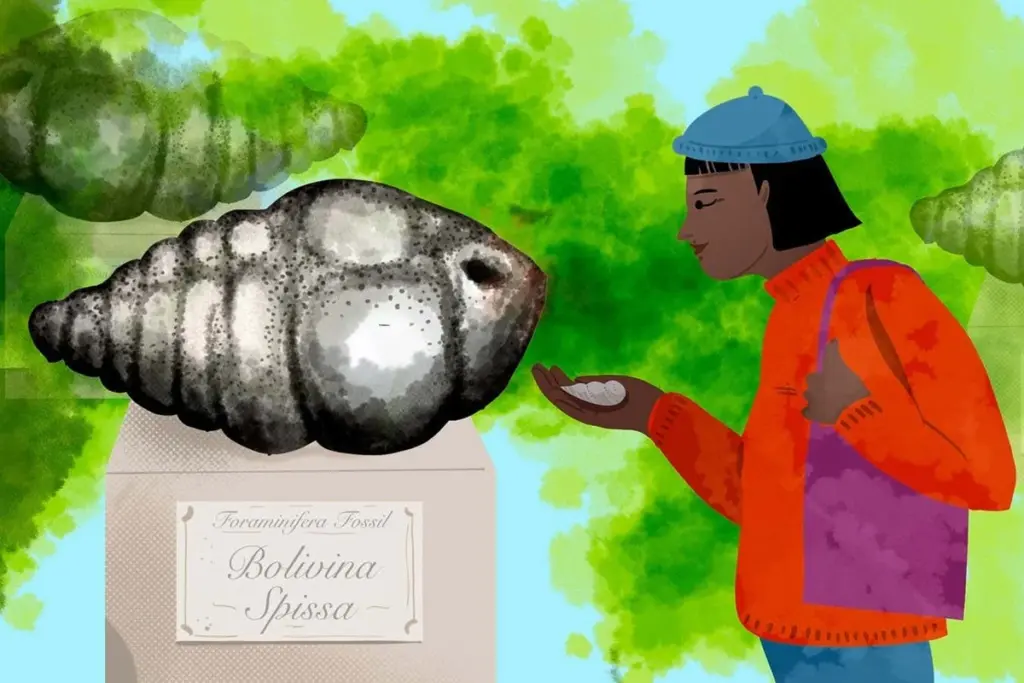
However, science historian Richard Fallon recently brought to light what appears to be the world’s sole sculpture park dedicated to foraminifera. Foraminifera are single-celled marine organisms, typically possessing a hard outer shell, known as a test. The extensive fossil record of these tests provides an extraordinarily detailed account due to their abundance in fossilized form.
The sheer diversity in the shapes of these tests is the reason behind the existence of the Foraminiferal Sculpture Park. Located in Zhongshan, China, it was established in 2009. Feedback acknowledges a significant delay of 17 years in reporting this discovery, conceding it to be a less-than-ideal response time.
Set on a hillside park, the attraction features 114 large-scale sculptures of foraminifera, which visitors can freely explore. Describing these sculptures accurately without in-depth knowledge of three-dimensional geometric terminology proves challenging. However, one might approximate them as vaguely similar to Barbara Hepworth’s more rounded works, though this comparison remains imperfect.
Following a path similar to Fallon and Feedback, a review on TripAdvisor for the Foraminiferal Sculpture Park shows a 5-star rating. Upon closer examination, this rating is derived from a single review by a user named Eudyptes. It is reasonable to surmise that Eudyptes, whose name is the taxonomic designation for crested penguins, might possess a predisposition to appreciate a sculpture park focused on foraminifera.
Feedback desires more user feedback on this attraction. Unfortunately, an editorial decision prevented a trip to China solely to assess the park. A proposal to combine this visit with a trip to the Sulabh International Museum of Toilets in New Delhi, India, was also turned down.
Feedback’s more immediate request to its readership is to identify any scientific tourist attractions that are even more niche. To preempt anticipated submissions, the Icelandic Phallological Museum and the UK’s Vagina Museum are considered too widely known. The inquiry seeks examples like a museum exclusively for mosses, or an art gallery displaying only Western blot images.
Unconventional Academic Abstracts
It is not uncommon for academics to incorporate humorous elements or references in their paper titles. However, it appears to be a rarer practice for them to adopt a more informal tone within their abstracts. These introductory sections typically summarize the study’s core findings in approximately 200 words. Depending on the author, they can be paragons of conciseness or dense with jargon.
Physicist Leonard Susskind, however, takes a different approach. In March, he submitted a paper to arXiv under the title: “Is time reversal in de Sitter space a spontaneously broken gauge symmetry?” Susskind’s conclusion, found toward the end of his abstract, is affirmative, with a caveat: “Time-reversal is indeed a gauge symmetry; but it is hidden by spontaneous symmetry breaking.”
While physicists may decipher this statement, Feedback’s interest lies in the initial portion of Susskind’s abstract. He begins by acknowledging ongoing discussions with Daniel Harlow and Edward Witten, subsequently noting, “but frankly in both cases I can’t tell whether they agree with me or not.” Susskind also mentions his frequent accusations of imprecision, particularly in his papers’ concluding sections when he expects readers to have grasped his points. This time, he states, he “tried to maintain a level of conceptual if not mathematical rigor throughout,” because he is “now almost 86 and I can’t wait” for readers to understand.
This abstract has been added to Feedback’s compilation of favored abstracts. Another notable contender, highlighted in a LinkedIn discussion regarding Susskind’s work, dates back to 2011. Readers with keen memories might recall the significant attention given to an experiment that suggested neutrinos could travel faster than light. This led to considerable debate before a resolution was found, attributed to faulty wiring.
Among the extensive literature on that subject, one paper was published under the title: “Can apparent superluminal neutrino speeds be explained as a quantum weak measurement?” The abstract for this paper consisted of a mere two words: “Probably not.”
A Cheesy Realization
Feedback extends a sincere and apologetic acknowledgement. An oversight occurred, involving an idea so straightforward that its omission remains surprising. A few weeks prior, Feedback examined the ongoing work by accounting firm PwC to forecast the future economic scale of the moon. On March 21st, Feedback had expressed slight skepticism regarding the concept of monetizing the moon.
However, amidst this dismissive stance, the notion put forth by reader Alex Collier was not considered: that all this lunar entrepreneurial activity implies the moon is, in fact, made of cheddar cheese.
Contribute Your Findings
Share your discoveries with Feedback by sending them via email to [email protected]. Please include your home address. This week’s and past Feedback entries are available on our website.