
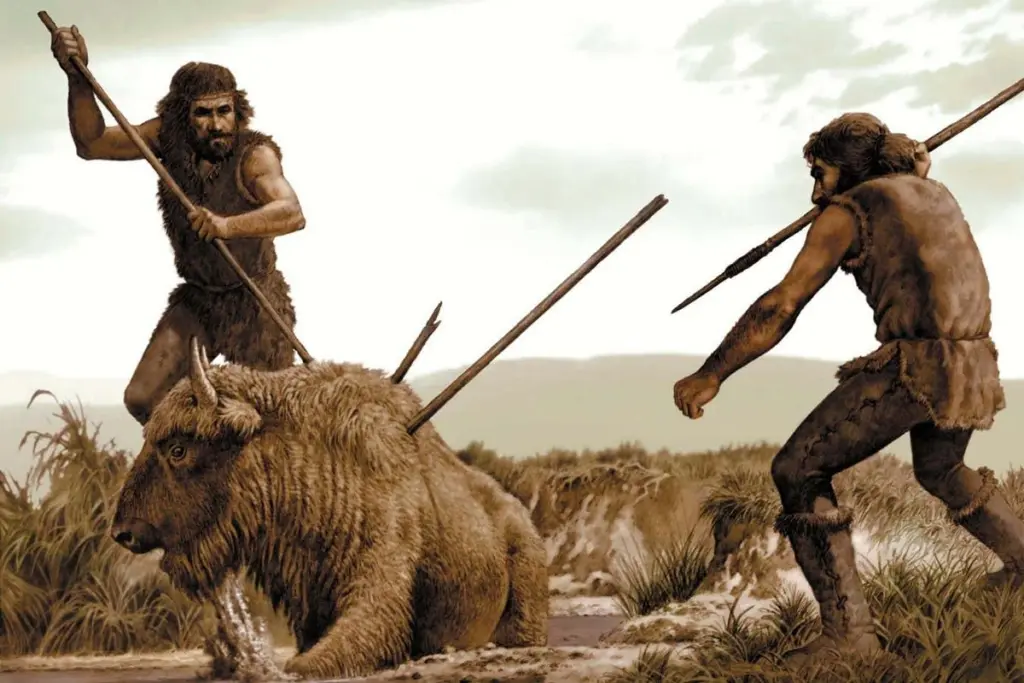
Approximately 200,000 years ago, a noticeable decrease in the population of large animals may have prompted early humans to transition from using heavy stone tools for hunting megafauna to employing lighter toolkits more suited for smaller game. This evolutionary shift, according to a recent study, could have been a significant factor in the development of increased intelligence in our ancestors.
For over a million years, various early human species consistently utilized robust stone implements, including axes, cleavers, scrapers, and stone balls. Archaeological evidence strongly suggests these tools were primarily employed for the processing of large herbivorous animals, such as extinct relatives of elephants, hippopotamuses, and rhinoceroses. These massive prey animals provided a substantial food source.
However, between 400,000 and 200,000 years ago, the archaeological record indicates a gradual introduction of smaller, more refined tools, coexisting with the continued use of heavier implements. It was within this period that our own species, Homo sapiens, first emerged.
Strikingly, around 200,000 years ago, the use of heavy-duty tools effectively vanished from the archaeological landscape of the Levant. Concurrently, there was a marked increase in the presence of small, lightweight stone toolkits. These newer tool assemblages, featuring blades and precision scrapers, were not only more sophisticated but also exhibited greater diversity in form and function.
A new investigation led by Vlad Litov at Tel Aviv University in Israel, alongside his research team, has identified a compelling correlation between this apparent change in stone tool technology and a pronounced decline in the availability of large herbivorous mammals during that era. The researchers suggest that overhunting might have significantly diminished these megafauna populations.
The study involved meticulously cataloging archaeological findings from 47 recognized sites across the Levant, spanning the vast duration of the Paleolithic period, which stretched from approximately 3.3 million to 12,000 years ago. By cross-referencing dated stone tool artifacts with accompanying animal remains from each site, an illuminating pattern began to surface.
The researchers observed that after the 200,000-year mark, coinciding with the disappearance of heavy-duty technologies, there was a statistically significant reduction in the relative abundance, specimen count, and contribution to overall biomass of megaherbivores weighing over 1000 kilograms. Simultaneously, the presence and availability of smaller prey animals increased, mirroring the rise in the number and complexity of small toolkits.
Further reinforcing the connection between tool types and prey availability, the team highlighted findings from prior studies. These studies indicated that heavy-duty tools remained in use until around 50,000 years ago in other regions, such as southern China, where large prey species were still abundant.
Previous hypotheses had posited that the shift in technology was a byproduct of emergent human intelligence and innovation, possibly driven by unidentified evolutionary pressures or beneficial genetic mutations. However, Litov and his colleagues advocate for a different interpretation, one they have advanced previously: that the increasing dependence on smaller prey species was the catalyst for the evolution of larger brains in modern humans.
Litov explained, “As megaherbivores declined, humans increasingly relied on smaller prey, which required different hunting strategies, more flexible planning, the use of lighter and more complex toolkits. These challenges selected for enhanced cognitive abilities, meaning cognition evolved as part of this new adaptive system rather than driving it from the outset.”
Ceri Shipton of University College London offers a nuanced perspective, suggesting, “I would argue there is more to it than just prey size.” He points to research indicating that cognitive advancements and more elaborate planning were already underway during the Middle Paleolithic, with some preliminary evidence supporting the large-scale hunting of medium-sized ungulates like horses and bison.
Nicolas Teyssandier from the French National Centre for Scientific Research also expressed reservations. “If humans adapted to new fauna, this reflects adaptation rather than pure intelligence,” he stated. “It was equally intelligent to produce and select heavy-duty technologies for hunting and consuming large megaherbivores.”
Litov acknowledges that his and others’ earlier work does suggest significant cognitive capacities were present in earlier stages of human evolution, particularly in Homo erectus, which appeared approximately two million years ago. Nevertheless, he maintains that the transition from large to small prey had a profound impact on human development. He notes that a single elephant carcass could have sustained a group of about 35 hunter-gatherers for several months, implying that the disappearance of such high-calorie resources necessitated a shift to smaller animals, yielding less per hunt.
Litov elaborated on the resource management aspect: “From an energetic standpoint, they had to acquire dozens of smaller ungulates, such as fallow deer, to compensate for the loss of a single elephant.” This dietary change, he proposes, could have fostered a cascade of cognitive and behavioral transformations. These might include more coordinated hunting of elusive prey, the creation of more sophisticated tools, and enhanced social cooperation and planning.
“These demands,” Litov continued, “may have contributed to the selection for larger brains in later species, including Neanderthals and Homo sapiens.”
Shipton shared his speculative view: “My personal view is that a decline in the large prey that hominins were used to may have increased competition between groups. In reality, it was probably an iterative process where decline in larger prey drove cognitive change, which, in turn, enabled access to smaller prey.”
Journal Reference
Quaternary Science Reviews DOI: 10.1016/j.quascirev.2026.109872