
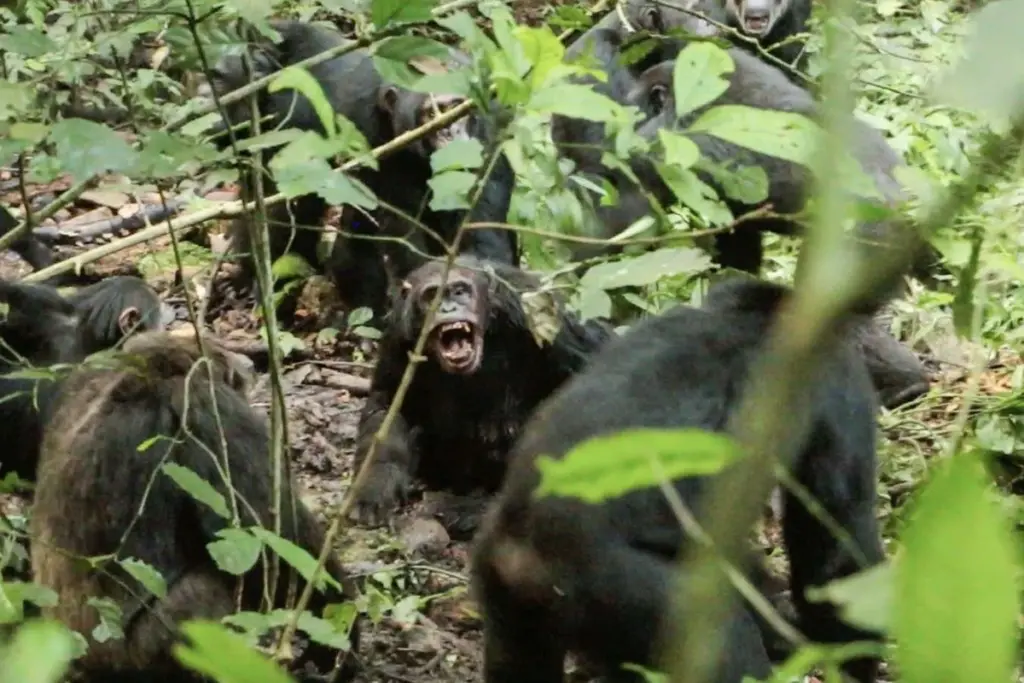
A once cohesive wild chimpanzee community has fractured into two distinct factions, sparking persistent conflict and intensifying violence. Researchers posit that this division suggests human warfare is an intrinsic aspect of our nature, rather than a recent development stemming from cultural complexity.
Aaron Sandel from the University of Texas at Austin, alongside his research team, meticulously analyzed two and a half decades of social network data, a decade of GPS tracking for territorial range, and thirty years of demographic information concerning chimpanzees (Pan troglodytes) residing in Uganda’s Kibale National Park.
“We aim to be particularly careful with our terminology,” Sandel explained. “These are chimpanzees. Terms like ‘war’ and ‘civil war’ carry specific weight for humans. What we observed doesn’t constitute civil war. However, it exhibits significant parallels. Notably, the shifting group identities are foundational to the lethal conflict.”
Chimpanzees are widely documented for their capacity for extreme aggression towards one another. Typically, this violence is directed at individuals outside their immediate group or at infants born to rival males. The Ngogo chimpanzee community, with a substantial population fluctuating between 150 and 200 individuals, was once recognized as one of the largest known groups of these primates. Alongside bonobos (Pan paniscus), chimpanzees are humanity’s closest living relatives.
From 1995 through 2015, the scientists noted that this collective was perceived as unified. They operated as a cooperative entity, exhibiting “fission-fusion dynamics.” This behavior, common among all chimpanzee populations, involves the formation of temporary alliances throughout the day as individuals roam within a shared territory before regrouping in the evening.
Generally, female chimpanzees disperse from their natal groups during adolescence, while males remain with their group throughout their lives. Prior to 2015, the adult males at Ngogo maintained affiliations within mixed-sex groups, engaging in collective hunting and cooperating on territorial patrols.
The turning point occurred on June 24, 2015. Members of the group convened in the central area of their territory. One faction, identified as the “central group,” expelled the other, designated the “western group.”
Following this event, the group’s cohesion began to erode. By 2018, the two groups had permanently separated. Between 2018 and 2025, the western group initiated 24 attacks, resulting in the deaths of at least seven adult males and 17 infants belonging to the central group.
Sandel indicated that the instigator of the conflict remains unclear, despite the central chimps being the first to pursue the western chimps. “Both the western and central groups actively participated in territorial actions as the new groups consolidated and the split finalized,” Sandel stated. “However, the western group assumed the role of aggressor and is solely responsible for all fatal encounters.”
The researchers propose several contributing factors to the group’s disintegration. Initial disputes may have centered on food scarcity. Subsequently, the deaths of five significant adult males and one female in 2014 likely weakened social bonds. This period was followed by a change in the leadership, specifically the alpha male. The final impediment to peace was an outbreak of respiratory illness.
This illness led to the demise of 25 Ngogo chimpanzees in January 2017. Among the deceased were the last two males who had previously served as a link between both the western and central groups. It was in the aftermath of this tragedy that the last vestiges of hope for reconciliation appeared to vanish.
Sandel and his team suggest that the unfolding of this conflict could offer insights into the evolutionary origins of human conflict. Contemporary human conflicts, often characterized by polarization and warfare, are typically attributed to ethnic, religious, or political divisions. However, an exclusive focus on these cultural elements may overlook fundamental social dynamics also present in our closest animal relatives, the researchers noted.
“In certain instances, opportunities for peace may be found within the small, everyday acts of reconciliation and reunion between individuals,” the research paper states.
Maud Mouginot at Boston University in Massachusetts observes that speculation regarding the evolution of human warfare generally falls into two main schools of thought. The first posits that war is a relatively recent cultural innovation, emerging with sedentary agriculture and the development of nation-states. The opposing view argues that warfare’s origins extend far deeper into human evolutionary history. “I believe the Ngogo data provide a substantial contribution to the ‘deep-rooters’ perspective,” Mouginot remarked.
“This study demonstrates that the social dynamics inherent in group fissioning and subsequent conflict can occur independently of the cultural markers we commonly associate with human warfare – such as differences in beliefs, language, religion, or attire,” added Luke Glowacki, also from Boston University.