
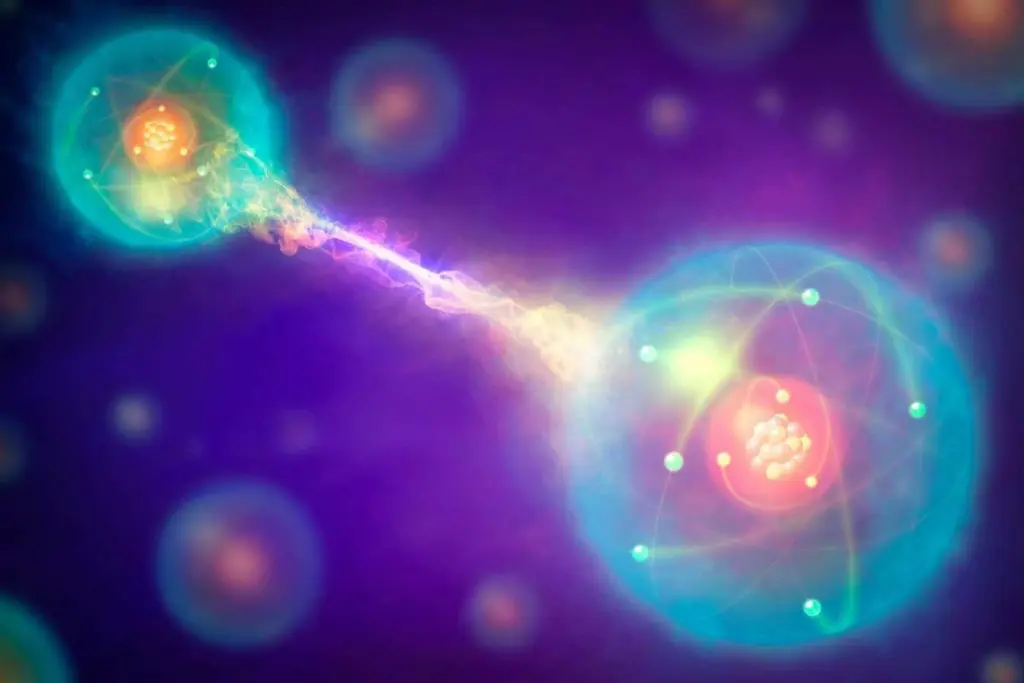
A novel technique now allows for the measurement of quantum entanglement within solid materials. This development holds significant potential for advancing both quantum technology and fundamental physics research.
Quantum entanglement, a phenomenon that links quantum particles in such a way that their behaviors remain correlated regardless of distance, has historically been challenging to study experimentally in bulk materials. While methods like the Bell test can confirm entanglement between individual particles, and quantum computers routinely create entanglement among multiple objects, assessing the presence of entanglement throughout a solid sample presented a considerable hurdle.
This capability is particularly crucial for the development of new and improved devices for quantum computing and quantum communication, both of which depend heavily on entanglement. For over half a decade, a team led by Allen Scheie at Los Alamos National Laboratory in New Mexico has been dedicated to developing a method to address this challenge. Their work has now culminated in a successfully functioning technique.
“We have definitively established that it works, 100 percent, and we are now defining the necessary procedures for its application to different materials,” Scheie stated. The team’s approach involves directing neutrons at a material sample and subsequently collecting them with a detector. Researchers have understood since the 1950s that analyzing neutron properties can provide insights into the arrangement and behavior of quantum particles within a material.
Scheie and his colleagues utilized this principle to calculate quantum Fisher information (QFI). This numerical value indicates the minimum number of entangled quantum particles within the material that would be necessary to produce the observed effect on the detected neutrons. The researchers validated their method on a variety of magnetic materials. Among these was a well-characterized crystal composed of potassium, copper, and fluorine.
According to Pontus Laurell, a team member from the University of Missouri, the findings for this specific crystal could be directly cross-referenced with a computer simulation of its quantum properties. This comparison served to verify the efficacy of the new measurement method. Laurell noted that there was “a remarkably close agreement between the experimental and theoretical curves.”
Laurell further explained that while other researchers have previously investigated QFI and similar metrics as potential experimental indicators of entanglement, his team is the first to establish a method that is both clear, reliable, and broadly applicable. Significant effort was invested in refining the precise details of the technique, which has now paved the way for researchers to explore a wide range of materials, including those suitable for constructing future devices.
A notable advantage of the team’s method is its independence from the existence of a precise mathematical model for the material being studied. It remains effective even when dealing with imperfect samples. “That’s the remarkable aspect of it. You can measure quantum Fisher information regardless of other factors,” Scheie commented. He presented his team’s findings at the American Physical Society Global Physics Summit in Denver, Colorado, on March 17.
The researchers plan to advance their technique further by measuring the QFI of a material as it approaches a phase transition. This is akin to the point where water transforms into ice. Theoretical models frequently encounter limitations at such critical junctures or predict extreme increases in entanglement. Scheie suggested that this scenario presents an opportunity for genuine quantum discovery.