
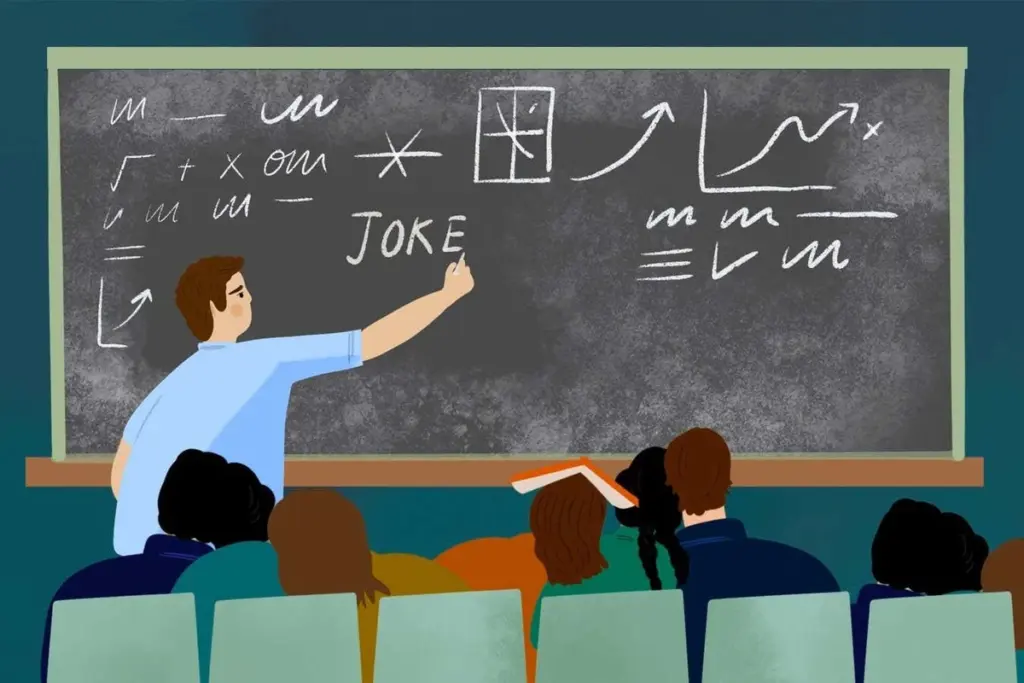
Academic writing is often characterized by its serious and deliberate tone, adhering to strict norms that can render papers and monographs dense and tiresome to navigate. This pursuit of rigor can, at times, lead to a stylistic rigidity that mirrors rigor mortis, making the content feel exhaustive rather than engaging.
However, moments of welcome exceptions occasionally surface. One such instance came with a paper published in March in the Proceedings of the Royal Society B. Described by a colleague as “pure Feedbacknip,” the article opens by acknowledging a common phenomenon at scientific conferences: a palpable shift in audience energy, particularly as lunchtime approaches. The authors observe that as caffeine levels wane and attention spans shorten, even the most visually appealing graphs can fail to capture the collective fatigue. It is often in this lull that a speaker might interject humor, which can then seemingly revive the room’s engagement.
The Science of Laughter in Academia
This observation forms the basis of the study titled “Statistically significant chuckles: Who is using humour at scientific conferences?” authored by Stefano Mammola of the Water Research Institute in Verbania, Italy, and his associates. Mammola, a biologist whose primary research focuses on subterranean fauna and arachnids, embarked on this side project as a means to “combat the tedium of long conference sessions.”
The researchers posit that humor serves as a vital tool for maintaining audience attention and enhancing speaker presence. Despite this, they note a conspicuous underutilization of humor in academic presentations. This creates what Mammola describes as a paradox: “Why do so many scientific talks have the energy of a sedated sloth? Where are the jokes, the puns, the playful delivery? Or, as Ewers bluntly put it: why are most scientific talks so boring?”
The reference to Ewers points to a 2018 study by Robert Ewers at Imperial College London, which investigated whether unengaging speakers indeed prolong their presentations. Ewers meticulously observed 50 presentations, each allotted 12 minutes. He concluded whether a talk was boring within the initial 4 minutes. His findings indicated a correlation: “The 34 interesting talks lasted, on average, a punctual 11 minutes and 42 seconds. The 16 boring ones dragged on for 13 minutes and 12 seconds… For every 70 seconds that a speaker droned on, the odds that their talk had been boring doubled.” Ewers’ advice to speakers centers on “focus[ing] on pertinent information,” a directive that the authors of the humor study humorously note might be at odds with their own detailed preamble.
Returning to Mammola’s work, the team analyzed 531 presentations across 14 biology-focused conferences. Their findings revealed that nearly half of the speakers, numbering 223, did not include any jokes. The incidence of speakers telling more than five jokes was exceptionally low. A substantial 367 of the jokes presented were situational, often referencing immediate circumstances like technical difficulties with projectors. The study also noted a low success rate for these attempts at humor: “Jokes eliciting whole-room laughter were rare (9 per cent), while the majority fell flat or landed mildly, earning mostly quiet chuckles (67 per cent).” The researchers suggest that concluding a presentation with a well-timed joke could be beneficial, positing that “a well-placed closing joke serves as the cherry on top, leaving the audience with a positive lasting impression.”
Technological Intrusion: AI and Compensation
The pervasive integration of artificial intelligence into various facets of modern life appears to be extending to compensation structures. Companies operating within the AI sector are reportedly exploring novel compensation models that may include allocating engineers time on AI servers as part of their remuneration packages.
More specifically, these proposed compensation packages would incorporate “tokens.” In the context of generative AI, tokens represent the most granular units of text that the system can process. For instance, a word like “darkness” might be parsed into two tokens: “dark” and “ness.” Users are typically charged on a per-token basis for utilizing AI models.
Jensen Huang, the chief executive of Nvidia, recently highlighted this evolving trend. He suggested that AI firms might offer an annual token budget as a component of salary. For highly skilled engineers, this could mean a significant monetary salary supplemented by compensation in tokens, potentially reaching roughly half the monetary value. This approach signifies a potential strategy for employers to invest in top engineering talent by providing substantial access to AI tokens, thereby enhancing their productivity—a widely desired outcome in any employment scenario.
This development has drawn a comparison to a brewery compensating its staff with barrels and yeast, a notion that strikes a chord with its perceived novelty and the direct link between the compensation and the core operational elements of the industry.