
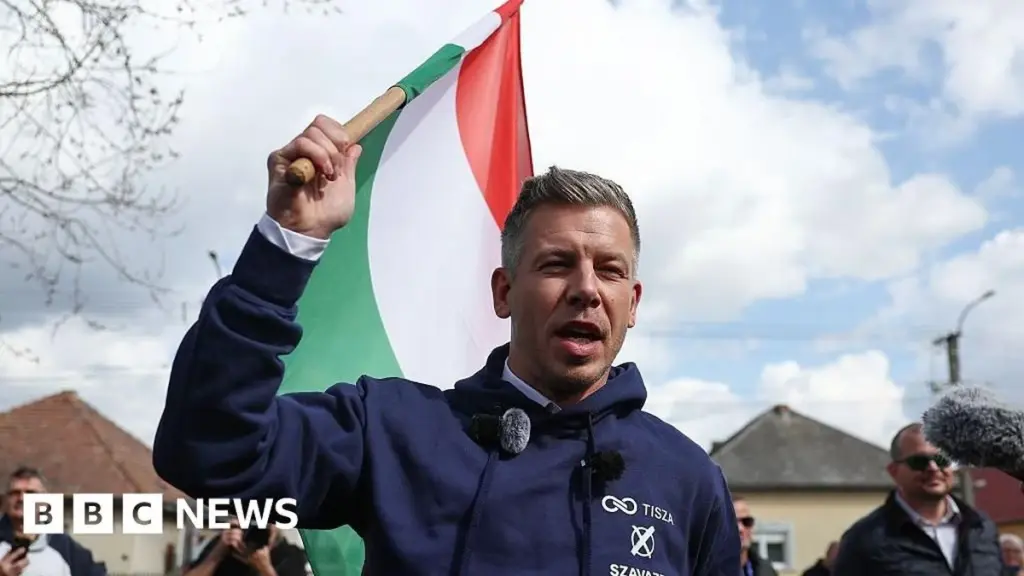
In a fervent campaign that has resonated nationwide, Peter Magyar has declared “Now or never” to the Hungarian people. His message, honed through over a hundred stops across the country, underscores the urgency leading up to the April 12 elections. Opinion polls suggest a potential victory for Magyar, who, at 45 years old and a former insider of Viktor Orbán’s Fidesz party, now presents the most significant challenge to Orbán’s seemingly unshakeable grip on power since his initial electoral triumph in 2010.
Magyar’s initial campaign slogan directly evoked a 19th-century revolutionary poet’s call to arms for the homeland. However, the urgency of his message has been distilled to simply “Now,” with the words “or never” strategically crossed out, amplifying the immediate need for change and action. His exhaustive itinerary has included visits to all 106 of Hungary’s constituencies, often delivering four, five, or even six speeches daily. This relentless touring over the past two years has cultivated a robust support base, reaching into the small towns and villages where Fidesz has traditionally held sway.
Last year, Magyar undertook a significant 300-kilometer walk from Budapest to the Romanian border. This initiative, framed as an effort to “reunite” the nation, aimed to draw natural Fidesz voters towards his platform. His policy promises encompass tackling rampant corruption, revitalizing the economy, and actively engaging with Hungary’s disadvantaged Roma community. Furthermore, Magyar has pledged to unblock billions of euros in European Union funds, currently frozen due to concerns over Hungary’s adherence to the rule of law.
Conversely, Orbán has attempted to discredit Magyar, portraying him as a mere “puppet” controlled by the EU and Ukraine. This narrative has led Magyar to adopt a cautious stance regarding overt ties with Brussels, instead promising voters that his movement represents “the real party of peace.” His capacity to project such confidence appears to stem from an intimate understanding of the political adversary he is facing.
A Meteoric Rise from Within the Fidesz Ranks
Until February 2024, Peter Magyar was an integral part of the Fidesz political family. His journey began at university when he joined the party. His personal life became intricately linked with Fidesz’s ascent when he married Judit Varga, herself a rising figure within the party, with whom he shares three children.
The political landscape shifted dramatically for Hungarians when Magyar made a surprise appearance on Partizán, a YouTube channel known for its opposition leanings. In a country with a population of 9.6 million, an astonishing one million viewers tuned in as a somber Peter Magyar articulated his disillusionment with his own party. “Everyone warned me against it, friends, family, people I know,” he shared with presenter Márton Gulyás, acknowledging his long-standing immersion in the Fidesz system.
This pivotal moment coincided with a national scandal involving President Katalin Novák, who had granted a pardon to an individual involved in covering up sexual abuse at a Hungarian state-run children’s home. The fallout from this incident led to Novák’s resignation and, significantly, that of Magyar’s ex-wife, Judit Varga. As the former Minister of Justice, Varga had co-signed the pardon, and her departure, along with President Novák’s, left two prominent Fidesz women to bear the repercussions.
Varga’s career was poised for significant advancement within Fidesz; she had even relinquished her ministerial duties to lead the party’s European election campaign. However, this trajectory was abruptly halted. With Varga no longer an active participant in the Fidesz apparatus, Peter Magyar perceived this as his opportune moment. He publicly declared via Facebook, “I do not want to be part of a system in which the real people in charge hide behind women’s skirts.”
Towards the conclusion of his interview on Partizán, Magyar expressed his aspirations for political transformation, albeit with a pragmatic recognition of the formidable challenge posed by Orbán’s continued leadership. He criticized the existing opposition as entirely ineffectual, positing that genuine change would necessarily originate from within. He predicted that when change did occur, it could unfold with remarkable speed.
His YouTube appearance achieved widespread viral reach. Magyar later informed the BBC that the decision to participate was unplanned. “My mother called me not to go, but I did the opposite. Everybody knew the situation in Hungary – it’s not very safe to go against this government.”
From Fidesz Insider to Political Challenger
Magyar’s high-profile marriage within political circles had dissolved in 2023. Despite this, he remained a figure of importance within Fidesz, even if he was not widely known to the general public. His political orientation aligned naturally with Orbán’s socially conservative base. The son of two lawyers, his mother having served as a senior judge, Peter Magyar also boasted a former Hungarian president as his godfather, fostering an early and keen interest in politics.
Magyar attended an elite Catholic boys’ high school in the heart of Budapest. He subsequently pursued law at a Catholic university in the capital during Orbán’s first term as prime minister, from 1998 to 2002. Magyar joined Fidesz in the aftermath of Orbán’s electoral defeat. His future wife, Judit Varga, was also destined for Fidesz success, ultimately becoming Minister of Justice in 2019, nine years after Orbán’s return to power.
Magyar himself embarked on a diplomatic career, serving at Hungary’s permanent mission in Brussels. He later headed Orbán’s team that liaised with the European Parliament. His professional path continued with appointments to the boards of state-owned companies.
His growing disaffection with the party evolved gradually. “After a while I became more and more critical, openly and just among friends,” he explained. “I can tell you that the Fidesz we see today is very, very different from the one I joined in 2002.” He further elaborated to the BBC’s Budapest correspondent, Nick Thorpe, that while politicians frequently cited the necessity of retaining power, a sentiment he accepted for a period, “the turning point was in 2024.”
For a time, Magyar harbored doubts about his decisions. “I have three kids, I love them very much and I was very much worried about their future as well,” he admitted.
The Catalyst: A Scandal and a Bold Move
If the YouTube interview marked a turning point, the subsequent significant event occurred on March 15, 2024, a national holiday commemorating Hungary’s failed revolution of 1848. While Orbán delivered a speech from the steps of the National Museum in Budapest, condemning the EU and calling for the “occupation of Brussels,” Peter Magyar addressed an estimated 10,000 attendees, leveling accusations of corruption and economic mismanagement at the highest levels of government.
He announced the formation of a new political party, with mere weeks remaining before Hungarians cast their votes in the European elections. Magyar intensified his corruption allegations by releasing a secret recording from a 2023 conversation with his ex-wife, in which she discusses a high-profile trial. Judit Varga expressed dismay at Magyar’s actions, accusing him of abuse, assertions he denied.
He also experienced a falling out with a former associate, Orbán’s minister Gergely Gulyás, who characterized Magyar as someone who “first betrays his family, then betrays his country as an agent of Brussels.” When asked about his new challenger, Orbán’s response to the BBC was succinct: “He left Fidesz, that’s all.”
Building Momentum and Challenging the Status Quo
By this juncture, Varga’s former husband was making substantial political strides and forging new alliances, including a friendship with popular actor Ervin Nagy. Magyar took control of a dormant party named Tisza and secured 29.6% of the vote, earning seven seats in the European Parliament. While Tisza lagged behind Orbán’s ruling Fidesz, which garnered 44.8%, Magyar’s performance delivered a powerful statement of intent.
By the autumn of 2024, Magyar’s nascent party had surpassed Fidesz in opinion polls. He sharply criticized Orbán’s close ties with Russia during rival marches commemorating Hungary’s 1956 uprising against the Soviet Union. Orbán’s administration labeled Tisza as “warmongers” engaged in a “Brussels war march.” In contrast, Magyar taunted the prime minister as the very individual who, in 1989, had called for Russian troops to depart Hungary but now disregarded the legacy of 1956, acting as “the most loyal ally of the Kremlin.” He directly questioned, “Mr. Prime Minister, why won’t you say ‘Russians go home’ any more?”
Magyar identifies himself as distinct from the liberal political spectrum. He has openly expressed disdain for the liberal opposition parties that previously attempted to challenge Orbán, only to witness the Fidesz leader secure the two-thirds majority necessary to reshape the constitution. A crucial element of his strategy has been the dismantling of these fragmented, established opposition parties. He views former Socialist leader Ferenc Gyurcsány as no more favorable than Orbán.
He has also confronted the pro-Orbán media outlets that largely dominate Hungary’s media landscape. Earlier this year, he alleged that he had been the target of an attempted “Russian-style” smear campaign involving a sex tape. Journalists had reportedly received a black-and-white surveillance image appearing to show illicit substances on a table near a bed. The implication was that further footage would surface, prompting Magyar to preemptively address the situation.
Magyar acknowledged having consensual sexual relations with a former girlfriend but maintained he had not interacted with anything on the table. He asserted that he was lured into a “honey trap” orchestrated by the secret services. “My conscience is clear,” he stated, later adding that he underwent a drug test on March 22 to confirm his abstinence from any drug consumption in recent months, and noting that he had undergone similar negative tests previously.
To date, none of the accusations or criticisms directed at Peter Magyar have gained lasting traction. As a former Fidesz adviser, he believes this familiarity provides him with a strategic advantage. “I know them, I know their tricks. I know they’re very much frightened,” he remarked. He concluded by emphasizing, “This is a once-in-a-lifetime opportunity, not for Peter Magyar but for the country.”