
As dusk settles, a monumental migration of biomass silently unfolds across Earth’s oceans, largely passing unnoticed. Trillions of often microscopic beings—zooplankton, krill, and lanternfish—ascend synchronously from the ocean’s depths. This vertical movement is driven by blooms of phytoplankton concentrated in the uppermost water layers. They feed throughout the night, seeking refuge from predators that rely on sight, and then descend again as dawn breaks.
The cyclical rhythm of the sun and moon governs the behavior of numerous marine organisms. However, in recent decades, extensive ocean surface areas have been observed to be mysteriously darkening. Tim Smyth, a marine scientist at the Plymouth Marine Laboratory in the United Kingdom, along with his colleagues, were the first researchers to identify this oceanic pattern in the open ocean last year. Since then, he has continued to investigate how oceans are responding to global warming, in conjunction with alterations in land use, and the critical role light plays within these aquatic environments.
Smyth shared insights with New Scientist regarding the origins of ocean darkening, its potential repercussions for marine ecosystems, and possible interventions to enhance light penetration into the ocean’s surface layers.
Uncovering the Trend: A Satellite’s Revelation
Thomas Lewton: How did you first identify that significant portions of the ocean were darkening?
Tim Smyth: Our initial approach to this issue stemmed from an unexpected avenue. For the past decade, I collaborated with Tom Davies, a marine conservation scientist at the University of Plymouth, to comprehend the impacts of artificial light pollution at night. As part of this research, we analyzed two decades of global satellite data to monitor alterations in the ocean’s optical properties. To our considerable surprise, we detected consistent patterns of darkening, indicating that the surface waters are becoming less transparent to incoming light. Rather than forming scattered, random patches across the global ocean, these changes manifested as large, interconnected regions. In total, we found that approximately one-fifth of the world’s oceans have experienced some degree of darkening.
The Causes of Ocean Darkness
Coastal Darkening: Rivers and Land Use
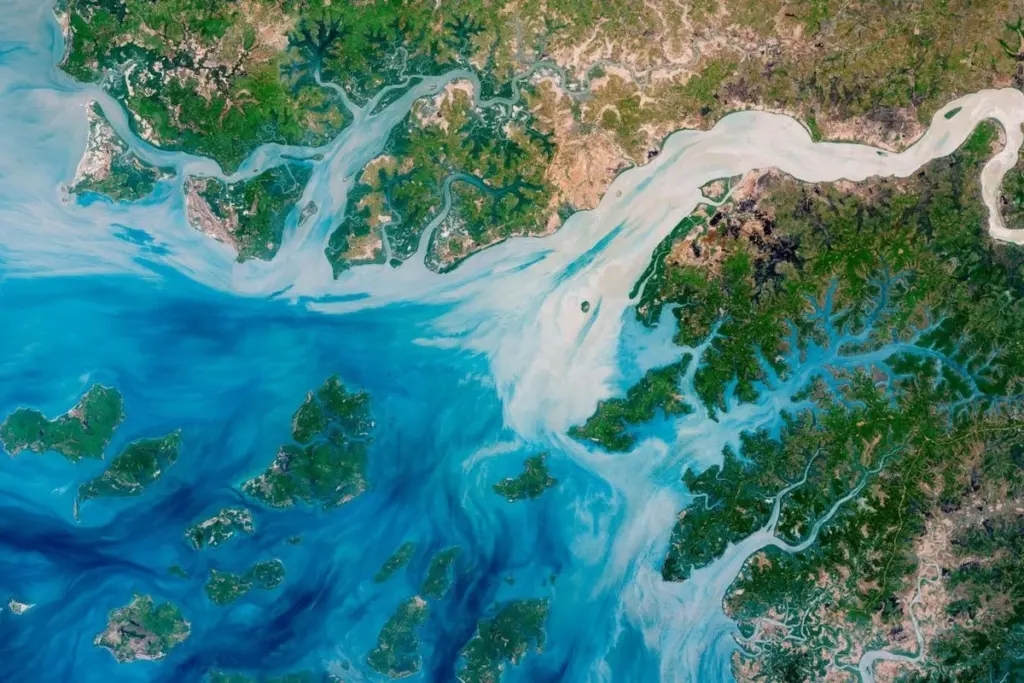
In coastal areas, ocean darkening is intrinsically linked to changes in the rivers that flow into the sea. Along coastlines, alterations in land use influence the materials that dissolve or remain suspended in the water, thereby modifying the optical quality of the water entering the ocean. For instance, when a landscape transitions from forest to agricultural land, it affects how materials are transported into rivers. During flood events, rivers carry substantially more suspended particulate matter and elevated levels of dissolved colored organic matter, the very substances that impart that characteristic “steeped tea” hue to river water.
Another significant factor contributing to coastal ocean darkening is nutrient enrichment. Fertilizers employed in industrial agriculture are washed into rivers, stimulating an increase in phytoplankton growth. As phytoplankton blooms proliferate, they diminish the depth to which light can penetrate the water column. While it has been recognized for some time that coastal waters are darkening, our recent findings reveal that these changes extend beyond immediate coastlines, with a broader darkening observed in the open ocean.
Open Ocean Darkening: Climate Change’s Influence
These phenomena in the open ocean may be connected to shifts in phytoplankton blooms directly influenced by climate change. Globally, we are witnessing rising ocean temperatures, more frequent marine heatwaves, and changes in salinity across various regions. Collectively, these environmental shifts impact large-scale ocean circulation patterns.
Phytoplankton blooms themselves are contingent upon a confluence of factors: light availability, nutrient levels, temperature, and the vertical stratification of the water column. Typically, during winter, the open ocean is thoroughly mixed by surface storms. However, as spring progresses, more stable surface layers begin to form. These stratified layers impede vertical mixing, concentrating light and nutrients in the upper ocean where phytoplankton can flourish most effectively. Therefore, it is suspected that we are observing a complex interaction between altered global circulation patterns and more localized weather shifts, such as sunnier conditions and increasingly stable surface waters. All these elements collectively promote phytoplankton growth and contribute to the widespread darkening of the open ocean.
Ecological Repercussions of Darker Oceans
Disruption of Diel Vertical Migration
To comprehend the impact of ocean darkening on marine ecosystems, it is helpful to consider the different trophic levels within the ocean. At the base are the primary producers, the phytoplankton, which, ironically, can be a cause of darkening. The next level consists of zooplankton, such as Calanus copepods, which serve as a food source for fish. Calanus copepods are particularly crucial as they occupy a central position in this initial segment of the food web. They undertake what is known as diel vertical migration, traversing hundreds of meters up and down the water column daily.
During daylight hours, they descend to depths of 200 to 300 meters, where light levels are significantly reduced, posing a challenge for visual predators. At night, they ascend to the surface to feed. This daily movement constitutes the largest migration of biomass on Earth. When contemplating seasonal species migrations, one might immediately recall documentaries depicting the wildebeest herds of the Serengeti. Approximately two million wildebeest migrate across the Serengeti annually. In contrast, the oceanic migration of zooplankton is vastly larger—though largely unseen—and dwarfs the wildebeest migration in scale. Several gigatons of zooplankton, numbering around 10 quintillion individuals, participate in this daily phenomenon.
Consequently, what might be the fate of these organisms if light penetrates less deeply into the water? The overarching implication for regions experiencing darkening is a vertical compression of usable habitat within the ocean’s surface layers, potentially by tens or even hundreds of meters—akin to confining London’s population within the confines of Hyde Park. When the capacity for organisms to grow, move, hunt, communicate, reproduce, and photosynthesize is squeezed into a smaller area, competition for resources intensifies dramatically. In the short term, it may become easier for certain species to hunt prey, as they expend less energy in pursuit. These changes have cascading effects on food webs and global fisheries, although the full extent of these broader consequences remains unknown.
Impacts on Visually Oriented Predators and Primary Producers
Fish that rely on sight for hunting, ranging from small schooling species to larger predators like tuna, may also find their hunting grounds constricted closer to the surface. Meanwhile, phytoplankton – the microscopic, plant-like organisms that form the foundation of the marine food chain and produce approximately half of the oxygen we breathe – might experience a shift in the depths at which they can photosynthesize as the ocean becomes darker.
Nighttime Illumination: A Critical Signal
Ocean darkening remains a concern even after daylight hours. Daylight is not the sole factor. Researchers have also examined what transpires under moonlight. To the human eye, the ocean at night appears almost entirely black; however, for many marine animals, the faint glow of the moon holds considerable importance. It aids in navigating nightly migrations and signals when it is safe to ascend towards the surface to feed and when to retreat back into the darkness below.
Our lunar modeling suggests that as the ocean becomes more turbid, this faint light struggles to penetrate the water. The consequence could be a subtle yet significant alteration in the underwater nocturnal environment: the thin layer of ocean illuminated by moonlight may become shallower. For creatures reliant on these delicate light cues, this could compress their nocturnal world closer to the surface, potentially reshuffling ecological interactions in the dark.
Global Ramifications: Carbon Cycling and Beyond
Ocean darkening also has implications for processes like carbon cycling. If zooplankton do not descend to the same great depths to evade predation because light penetration is limited to the upper layers, their efficiency in sequestering carbon from the atmosphere diminishes. When zooplankton perish, they sink to the ocean floor, effectively locking away the carbon stored within their bodies. However, if they cease to venture to such depths, their capacity to transport carbon into the deep ocean is reduced. Consequently, a greater proportion of this carbon is likely to remain in the upper layers, where it can be respired back into the atmosphere rather than being stored for decades or centuries.
Nevertheless, accurately quantifying the export of carbon from the illuminated upper ocean layers to the sea floor presents a significant challenge. Satellites provide invaluable global-scale data, but primarily at the surface. In-field observations capable of measuring the downward flux of carbon from the upper water column to the seabed, over extended periods, are exceptionally scarce—limited to only a handful of sites.
Potential Solutions and Future Prospects
Addressing Coastal Darkening: Land Management
In certain locations, yes, interventions are possible. Coastal waters are particularly susceptible to terrestrial influences, notably agricultural practices. Fertilizers, soil, and organic matter washed from fields can enter rivers and subsequently the sea, thereby increasing the concentration of light-absorbing materials in the water. This implies that improving land management strategies could aid in restoring some degree of coastal clarity. One initiative addressing this is the AgZero+ program, orchestrated by the UK Centre for Ecology & Hydrology. This program unites scientists and farmers to develop low-pollution, climate-neutral farming systems designed to reduce runoff while simultaneously safeguarding soils, biodiversity, and water quality. The project is trialing approaches such as optimized fertilizer application, nature-based solutions like agroforestry, and enhanced management of river catchments to slow the movement of water—and the nutrients it carries—from land to sea. Such modifications could contribute to mitigating darkening in coastal waters.
Open Ocean Challenges: A Long Road to Recovery
In the open ocean, however, the underlying drivers are considerably more challenging to address. Even if global emissions were to reach net-zero levels tomorrow, the ocean would require decades, if not centuries, to exhibit a discernible response. The article also references external content on pinning extreme weather to climate change, highlighting advancements in climate science.
Hope for Oceanic Resilience
Absolutely. One of the most encouraging discoveries in recent years is the remarkable resilience of the ocean when provided with favorable conditions. Marine ecosystems can demonstrate surprisingly rapid recovery when critical species and habitats are afforded protection. Consider the kelp forests along the California coast. Following the intense marine heatwaves between 2014 and 2016, scientists observed that kelp situated within well-managed marine protected areas—regions designated to safeguard habitats and species—rebounded more swiftly than those located outside these boundaries. Where predators, grazing equilibria, and other ecological relationships remained intact, the underwater forests exhibited a greater capacity to recover.
This finding underpins the current global impetus to expand marine protected areas. When properly enforced, these areas function as ecological sanctuaries, enabling marine life to regenerate and ecosystems to re-establish their natural equilibrium. In an era of global warming, they may also assist ecosystems in withstanding climate-related shocks, such as heatwaves.
Therefore, yes—there are grounds for optimism. The ocean retains a significant capacity for self-healing. Providing marine ecosystems with adequate space to recover often results in surprisingly swift responses. This is of consequence to us all. Oceans cover approximately 70 percent of Earth’s surface, play a crucial role in climate regulation, and absorb vast quantities of carbon and heat. Their protection is not merely about preserving wildlife, but about safeguarding the planet’s fundamental life-support system.