
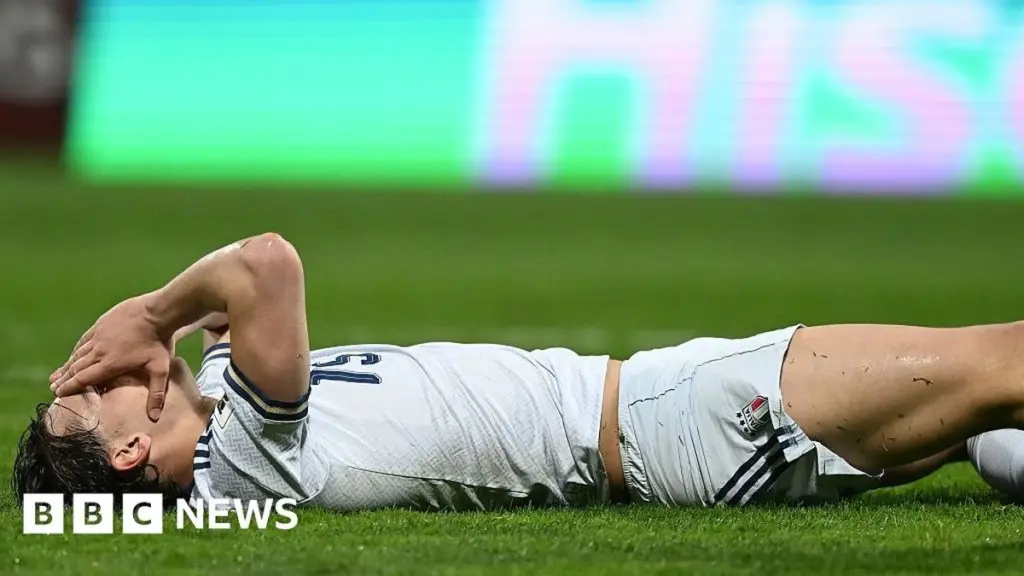
In Rome, the aftermath of another significant footballing failure is being met with a grim sense of resignation. Citizens are confronting headlines describing the situation as an “apocalypse” and “disaster” following Italy’s latest inability to qualify for the World Cup. Tommaso Silvestri, 65, observed the front pages near a newsstand, lamenting the team’s performance.
He commented, “We’ve really made a mess of it. We had players who couldn’t even find the target.” Silvestri added with a shake of his head, “The golden days of Italian football are well and truly gone.”
On Tuesday night, the four-time World Cup champions Italy failed to secure a place in the tournament for the third consecutive time. Their hopes were dashed after a 4-1 penalty shootout loss to Bosnia and Herzegovina. The match had seen Italy reduced to ten players before halftime.
Since their World Cup victory in 2006, the Azzurri have generally underperformed in international competitions. An exception was their unexpected win at the Euros in 2021, where they triumphed over England at Wembley.
“We are what our results say we are,” Silvestri stated. “When you shoot and can’t even hit the goal, you’re not going to go far. When it comes to taking the game home, Italy just doesn’t get there anymore.”
Political and Societal Reactions
The recent defeat elicited immediate and strong responses from across Italy’s political and social landscape. Ignazio La Russa, President of the Senate and a prominent member of Prime Minister Giorgia Meloni’s Brothers of Italy party, expressed his disappointment.
In a post on X, he wrote: “We’re not going to the World Cup. We supported them, we hoped, we even railed against a couple of questionable refereeing decisions… but deep down we feared it. In fact, we knew it.”
Roberto Saviano, the author of “Gomorrah” and an anti-mafia writer, also shared his views. He pointed to systemic issues within Italian football, citing problems with governance and youth development as contributing factors.
Saviano remarked in an Instagram post, “Clubs are corrupt and at the mercy of criminal organisations. True laundering vaults. No investment in young players, no care for second-generation talent. It’s easier to buy foreign players than to develop new athletes.”
Fan Disillusionment and Calls for Change
Across the nation, a country with a rich footballing heritage and a history of producing exceptional talent, many are questioning the reasons behind the decline. Giovanni Colli, 71, speaking at a café near the Pantheon, conveyed a sense of betrayal.
“Not going to the World Cup three times in a row, how on earth did it happen? What a huge disappointment,” he stated, rolling his eyes. “Everyone should resign. Give the young players a chance.”
The national team’s World Cup disappointment was visibly reflected in the emotional state of coach Rino Gattuso. He struggled to contain his feelings following the team’s defeat.
“We don’t deserve this, it’s not fair. I’m sorry I couldn’t make it happen,” Gattuso said, his eyes visibly glistening, before leaving the press area.
Gattuso, a celebrated midfielder from the 2006 World Cup-winning squad, had only taken on the coaching role last June. Despite the setback, he expressed pride in his players’ efforts.
“I’m proud of my boys and what they gave on the pitch,” he commented.
Match Details and Coach’s Reflection
The decisive match saw Italy reduced to ten men after Alessandro Bastoni received an early red card. Although Moise Kean’s goal provided a brief moment of hope, the team ultimately lost the penalty shootout. Gattuso acknowledged the team’s shortcomings.
“When you have chances and don’t take them, football punishes you,” he admitted.
Reflecting on the elimination, Gattuso added, “This hurts. We gave everything we could. It’s a real shock.”
Long-Term Challenges for Italian Football
Sport journalist Elisabetta Esposito of La Gazzetta dello Sport discussed the current difficult period for Italian football with the BBC. She suggested that overcoming the challenges would require significant time and that support for individual clubs was overshadowing national team allegiance.
“The risk is that this third consecutive failure to qualify will deepen young people’s disengagement from the Azzurri,” she explained. “The disappointment is profound, but the country is not only disappointed but almost disillusioned. It’s as if a new generation no longer knows what it means to cheer for their country.”
Esposito further commented on the technical aspects of Tuesday’s match, stating, “From a technical standpoint, everything went wrong. The team hasn’t worked together enough. Rebuilding will require a long-term strategy; chasing immediate wins with rushed decisions won’t succeed.”
On a busy street in central Rome, Teresa, 56, was walking her dog amidst the rush of commuters and tourists. When asked about the World Cup, she responded with surprise, “Oh, we are not going to the World Cup? I don’t know much about football, but that’s a bit of disaster, isn’t it?”