
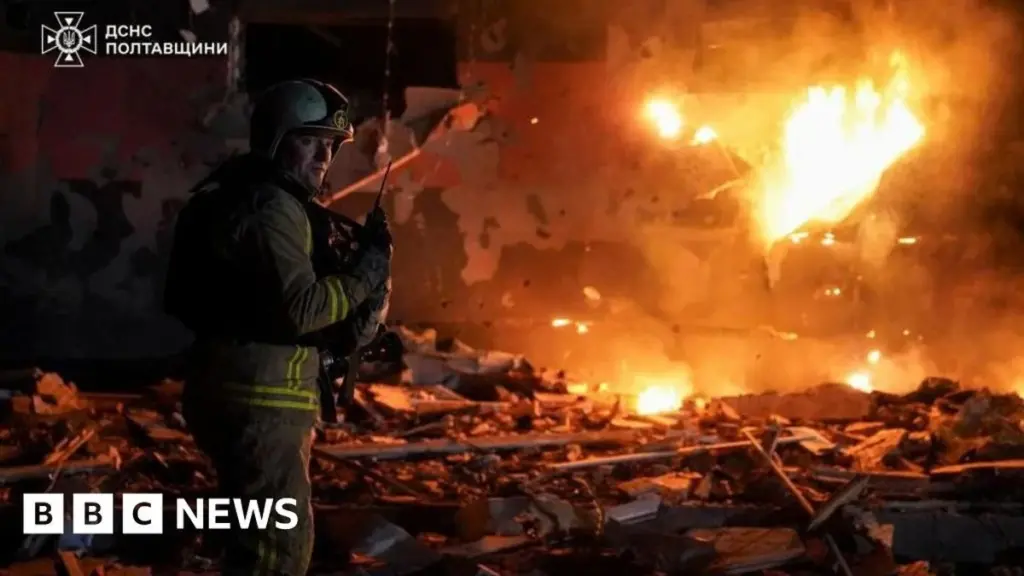
At least five individuals have lost their lives following a significant wave of Russian aerial bombardments that targeted multiple Ukrainian regions overnight.
Authorities confirmed that a 61-year-old woman died in Kharkiv when a drone struck an electric train. Additional fatalities were reported in the regions of Zaporizhzhia, Kherson, and Poltava. These attacks, described by officials as among the most severe in the preceding ten days, occurred just hours after Ukrainian President Volodymyr Zelensky had cautioned about an impending “massive strike.”
Impact on Energy Infrastructure and Neighboring Countries
The Russian strikes also impacted energy infrastructure, leading to the disconnection of Moldova’s primary power link with Europe. President Maia Sandu characterized the resulting situation as “fragile.” Sirens echoed across Ukraine on Monday night as Russia unleashed a barrage of missiles and drones. According to a statement from the Ukrainian Air Force on Telegram, the assault involved seven ballistic missiles, 23 cruise missiles, four air-launched guided missiles, and 392 drones.
Air defense units successfully intercepted 25 missiles and 365 drones. In a post on X, President Zelensky highlighted the necessity for increased protection to safeguard lives from Russian attacks, emphasizing the importance of continued support for Ukraine.
Such large-scale attacks have become a recurring event, happening approximately weekly or every ten days recently. Concerns had been growing in the past few days regarding the imminence of another wave of strikes.
“Please be attentive to air raid sirens tonight,” Zelensky had previously urged the nation in his Monday video address. “Intelligence indicates Russia may be preparing a massive strike.”
Regional Impact and Personal Accounts
This particular attack focused on areas outside the capital, Kyiv, with damage reported across eleven regions. The southeastern city of Zaporizhzhia was severely affected, experiencing strikes from six drones followed by six ballistic missiles. A residential high-rise building was hit, resulting in one fatality and nine injuries, according to local authorities.
Dymtro Zaiets, a resident of Zaporizhzhia, recounted to Reuters news agency being awakened by a “very loud explosion.” He described the scene: “We quickly gathered our things and ran downstairs, everything was on fire on our floor. There was smoke, and we took our three-month-old child and ran quickly to the underground shelter. My car is destroyed. All our windows were blown out.”
In the northeastern Poltava region, strikes on residential buildings and a hotel claimed at least two lives and injured twelve individuals, as stated by governor Vitaliy Dyakivnych on Telegram. A civilian in Kherson was killed when his home was hit by Russian shelling, reported Yaroslav Shanko, the head of the city’s military administration. Injuries were also reported in other regions, including a 75-year-old woman hospitalized after an attack on Dnipropetrovsk and a 65-year-old bus driver injured by a drone in Sumy.
International Ramifications and Strategic Context
Moldova’s government has condemned the strike on energy infrastructure in the Odesa region, which severed the Isaccea-Vulcanesti power line, crucial for Moldova’s electricity imports from Romania. President Sandu noted that while alternative routes are available, the situation remains delicate, placing sole responsibility on Russia. Moldova’s foreign ministry stated that these attacks “undermine regional energy security and endanger critical civilian infrastructure.”
The timing of Moscow’s overnight attack coincides with a significant slowdown in the pace of Russian advances in eastern Ukraine, where Ukrainian forces report localized counteroffensives. Russia’s defense ministry, conversely, claimed its air defense systems intercepted “55 Ukrainian fixed-wing unmanned aerial vehicles” over various regions during the night.
President Zelensky has previously expressed concerns that Russia might leverage the conflict in the Middle East to inflict greater destruction in Ukraine. He stated that air defense systems vital for Ukraine’s defense are being rapidly depleted due to the war involving the US and Israel against Iran. In a March interview with the BBC, Zelensky suggested that Russian President Putin desired a prolonged conflict in the Middle East, believing it would divert US resources and attention away from Ukraine.
He further elaborated that peace negotiations were being “constantly postponed,” attributing this solely to the “war in Iran.” Ukrainian and US officials recently held discussions concerning strategies to end Russia’s full-scale invasion of Ukraine, marking the first such talks since the US and Israel initiated strikes against Iran. Following these negotiations, Zelensky acknowledged that while US attention was clearly focused on Iran, the war in Ukraine must also reach a conclusion.
Previous US-mediated talks have been unsuccessful in halting the conflict or altering Russia’s maximalist demands. The decision by the Trump administration to ease sanctions on countries purchasing Russian oil earlier this month was met with approval from the Kremlin but has generated significant concern among Ukrainians.