
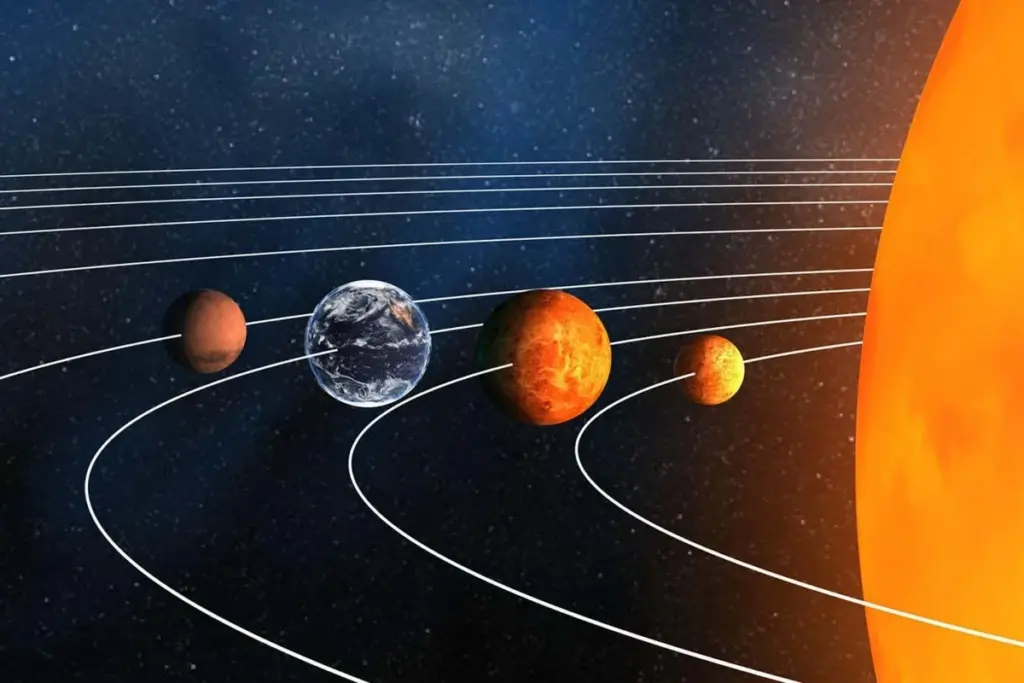
Our conventional understanding of the inner solar system’s formation may require significant revision. For decades, the prevailing scientific thought posited that the rocky planets coalesced from a single, continuous disk of dust and debris surrounding the early Sun. However, recent computational simulations suggest a more complex scenario, potentially involving two distinct reservoirs of material.
Earlier models that relied on a singular disk or ring of material around the nascent Sun frequently struggled to accurately reproduce key observable features of our current solar system. For instance, Earth’s geological composition appears to be a blend of two different rock types, a characteristic difficult to reconcile with an origin solely from a uniform disk. Furthermore, these single-ring simulations often resulted in Mercury and Mars being disproportionately large, Venus and Earth being positioned too closely together, and a concerning similarity in the material composition of Earth and Mars.
Bill Bottke, a researcher at the Southwest Research Institute in Colorado, alongside his colleagues, conducted a series of in-depth simulations designed to explore various methods of planet formation from a singular material source, followed by subsequent evolutionary processes. Despite their efforts, these persistent discrepancies remained. Bottke described the team’s experience: “We spent six months at the computer; nothing was working. So, we made a desperation play. We said, ‘Why don’t we try a second reservoir?'” he explained during a presentation at the Lunar and Planetary Science Conference in Texas on March 16th. “It turned out this model not only did a great job of making the terrestrial planets but also provided a rather good explanation for some things that had been bothering us.”
The simulation that yielded the most compelling results featured two separate disks of material. One disk was positioned approximately at half the current distance between the Sun and Earth, while the second disk resided at roughly 1.7 times that Sun-Earth distance. This dual-disk configuration successfully replicated the planets at their correct relative sizes and inter-planetary spacings. It also offered a satisfactory explanation for the material compositions observed in Earth, the Moon, and Mars.
Jan Hellmann of the Max Planck Institute for Solar System Research in Germany elaborated on this point during a separate presentation on the same day. “We believe that Earth predominantly formed from [inner solar system] material, and only the final portion came from the outer solar system,” he stated. Bottke’s model, which suggests Earth formed primarily from the inner disk with minor contributions from the outer disk, aligns with these expectations. Conversely, Mars appears to have formed predominantly from the outer disk, which effectively accounts for the compositional differences observed between the two planets.
A point of concern raised by some is the model’s apparent reliance on very specific initial conditions to accurately reconstruct the inner solar system. The exact reasons why these conditions would assume their required values are not yet fully understood. “Slight changes in the shape of the disk can lead to major differences in where the terrestrial planets end up,” Bottke noted.
The research team is presently engaged in refining their model and investigating its broader implications for the solar system. “We are dedicating substantial supercomputer resources to explore every plausible possibility,” Bottke commented. If validated, this new formation theory could provide answers to a range of solar system enigmas, from the origin of peculiar asteroids to previously unexplained rock samples discovered on the lunar surface.
Journal Reference: The Astronomical Journal, DOI: 10.3847/1538-3881/adf20a