
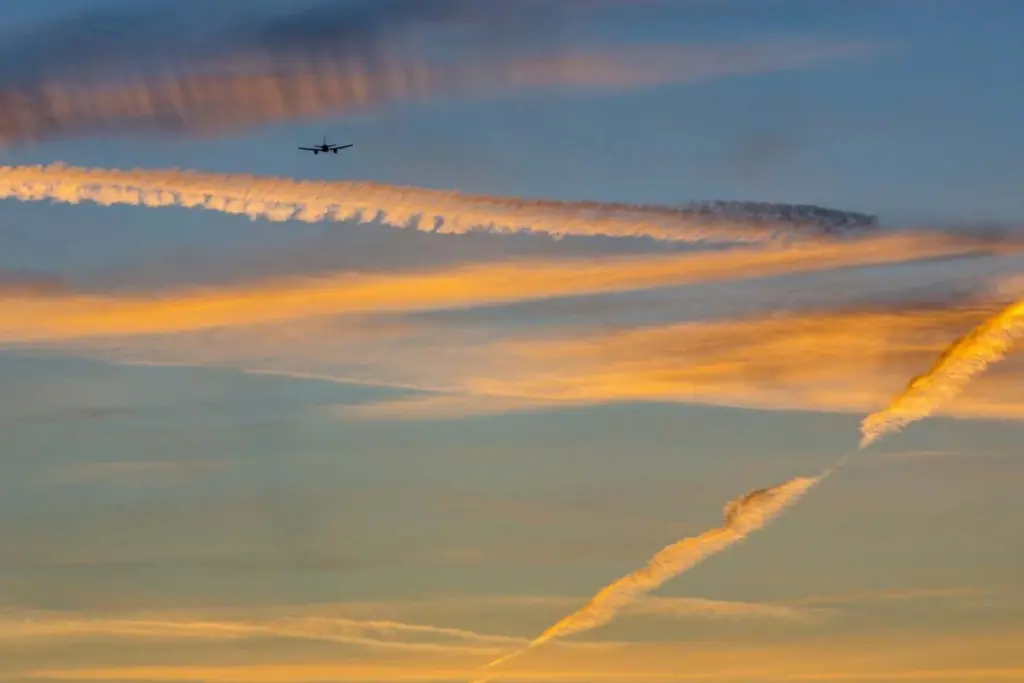
A large-scale trial involving thousands of flights between the United States and Europe has demonstrated that aircraft can produce fewer contrails when utilizing flight paths recommended by an artificial intelligence system. This AI guidance aims to reduce the global warming impact associated with these condensation trails.
Contrails, which are streaks of condensation formed by soot particles emitted from aircraft engines, are believed to contribute more significantly to warming than the carbon dioxide released by the same flights. Scientific research indicates that certain atmospheric regions, particularly those rich in ice crystals, are more prone to contrail formation when aircraft pass through them. AI has emerged as a tool capable of predicting the location of these sensitive areas by processing detailed weather forecasts.
Previous smaller-scale experiments had shown that rerouting aircraft through these predicted zones could lead to a reduction in contrail formation. However, implementing this practice on a commercial flight scale had not yet been widely adopted.
Large-Scale Trial with American Airlines
In a recent development, Dinesh Sanekommu from Google, leading a team of researchers, employed an AI contrail-forecasting tool to provide routing recommendations. This was tested in a randomized controlled trial encompassing over 2,400 actual American Airlines flights.
The trial focused on flights traveling eastward from the US to Europe over a period of approximately 17 weeks, specifically from January to May 2025. The eastward direction was chosen because these flights predominantly occur at night, a time when contrails have been observed to exert a more pronounced warming effect. In contrast, during daylight hours, contrails can sometimes have a cooling effect by reflecting solar radiation back into space.
Methodology and Results
For each flight route planned between two designated cities, the journeys were randomly allocated to one of two groups. In the first group, air traffic controllers were given access to an option within their flight planning software. This option allowed them to select an AI-optimized route designed to minimize contrail formation. The second group, however, did not receive any alternative route suggestions.
Despite the availability of the low-contrail route option for dispatchers in the first group, operational considerations such as cost and safety led to only 112 out of 1,232 flights in this group ultimately adopting the suggested alternative path, according to Sanekommu. The remaining flights in this group either followed their original, unoptimized routes or chose other variations.
An AI analysis of satellite imagery detailing the actual flight paths revealed a significant decrease. Flights that adhered to the contrail-optimized routes showed a 62 percent reduction in visible contrails. When accounting for all flights that had the option to take an optimized route, regardless of whether they did, the overall effective reduction in contrail formation registered at 11.6 percent when compared to the control group.
“It validated the thesis of, if we could figure out how to safely and correctly integrate into the flight planning process, then this is a scalable route to consider contrail avoidance across many flights.”
– Dinesh Sanekommu
The research team estimates that the warming effect of the flights was reduced by 13.7 percent across the entire group that received suggested routes. For the specific flights that took the optimized path, the reduction in warming impact was a remarkable 69.3 percent. Importantly, the trial found no discernible difference in fuel consumption between the two groups.
Expert Commentary and Implications
Edward Gryspeerdt from Imperial College London commented on the findings, stating, “This is probably the best you can do, at least with the tools we have at the moment. It does indicate that this is possible. The 62 per cent reduction in satellite-observed contrails that they see is unlikely to have happened by chance.”
However, Gryspeerdt also cautioned that the extent to which the 11.6 percent figure can be improved in real-world operations remains uncertain due to the complex nature of flight planning. He noted, “You can’t necessarily just scale this up to be a 60 per cent reduction in contrails from every flight everywhere, but even a 10 per cent reduction in contrails is still a non-negligible effect.” This suggests that while widespread implementation faces challenges, even modest reductions in contrail formation can contribute positively to climate mitigation efforts.