
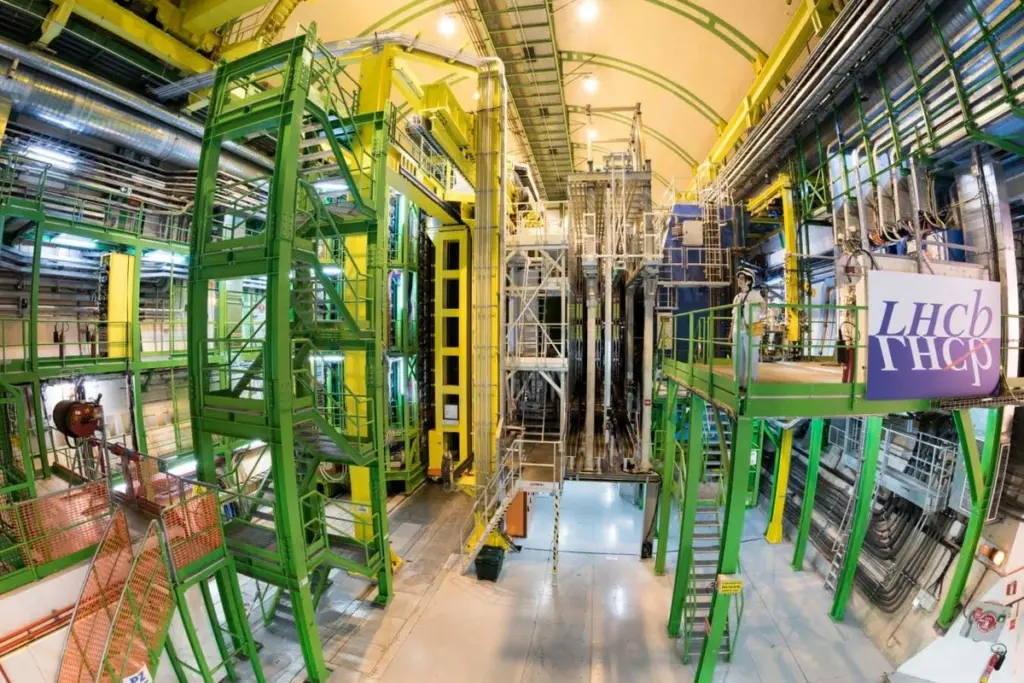
Physicists at CERN’s Large Hadron Collider have announced the detection of a novel particle. This newly observed entity is a baryon, similar in nature to a proton but possessing a greater mass and composed of two charm quarks.
Protons and neutrons belong to a broader category of particles known as baryons. Each baryon is constructed from three fundamental subatomic constituents called quarks, which exist in various forms, or “flavors.” A proton, for instance, is made up of two “up” quarks and one “down” quark.
Heavier types of quarks, such as charm quarks, can also aggregate to form baryons. However, these less common quark combinations tend to be significantly heavier and consequently less stable. Their existence is often fleeting, decaying into other particles within extremely short timescales.
In 2017, researchers associated with CERN’s LHCb experiment identified an unusual baryon. This particle, given the designation Xicc++, contained two charm quarks and one up quark. Its observable lifespan was a mere trillionth of a second. Now, scientists involved with the same LHCb experiment have successfully identified a closely related particle, the Xicc+. This new particle shares the characteristic of being composed of two charm quarks but substitutes the up quark with a down quark, thus presenting a heavier counterpart to the proton.
The Xicc+ was theoretically predicted to have a lifespan approximately six times shorter than its predecessor, the Xicc++. This characteristic made its detection considerably more challenging. Its discovery was only made possible following an upgrade to the LHCb experiment, which enhanced its sensitivity for detecting particles.
The significance of this finding is underpinned by a statistical confidence exceeding 7 sigma. Physicists employ this metric to quantify the certainty that an observed result is not a random occurrence. This level of confidence comfortably surpasses the 5-sigma threshold customarily required to declare a scientific discovery.
“Beyond the inherent interest in discovering this particle, which has been sought for a considerable period, it clearly demonstrates the impact of the upgrades implemented at the LHC,” stated Chris Parkes of the University of Manchester in the UK. “In a single year’s worth of data, we were able to observe something that eluded us over a decade of data from the previous system.”
Identifying this particle offers insights into the behavior of the strong nuclear force. This force governs how quarks bind together, and its influence on heavier quarks, beyond those found in protons and neutrons, is of particular interest. The discovery also addresses a mystery that has persisted for two decades.
In 2002, physicists conducting experiments at the SELEX facility at Fermi National Accelerator Laboratory in Illinois reported the potential detection of a particle resembling the Xicc+. However, this purported particle exhibited a substantially lower mass than predicted, with a confidence level of only 4.7 sigma. “We have now found it, but its mass is comparable to that of its partner, the Xicc++, which we identified several years ago, rather than aligning with the mass predicted by SELEX,” Parkes explained. The robustness of the new discovery effectively resolves the longstanding debate regarding this particle’s mass.
“While this is a highly intriguing measurement, the precise implications for our understanding are still uncertain,” commented Juan Rojo from Vrije University Amsterdam in the Netherlands. “There are no established principles within quantum chromodynamics that would preclude the existence of this hadron. However, its confirmed existence leaves us with limited new enlightenment.”
Rojo suggests that part of this uncertainty stems from the limitations of current theoretical models. These models struggle to accurately describe the interactions among heavier quarks within baryons or to precisely predict their masses. “For these types of particles, the experimental data is currently outpacing theoretical development,” Rojo observed. “It is plausible that within the next five years, this measurement could contribute to answering significant theoretical questions,” he added, referencing potential advancements in understanding the relationship between different quark combinations and particle masses.