
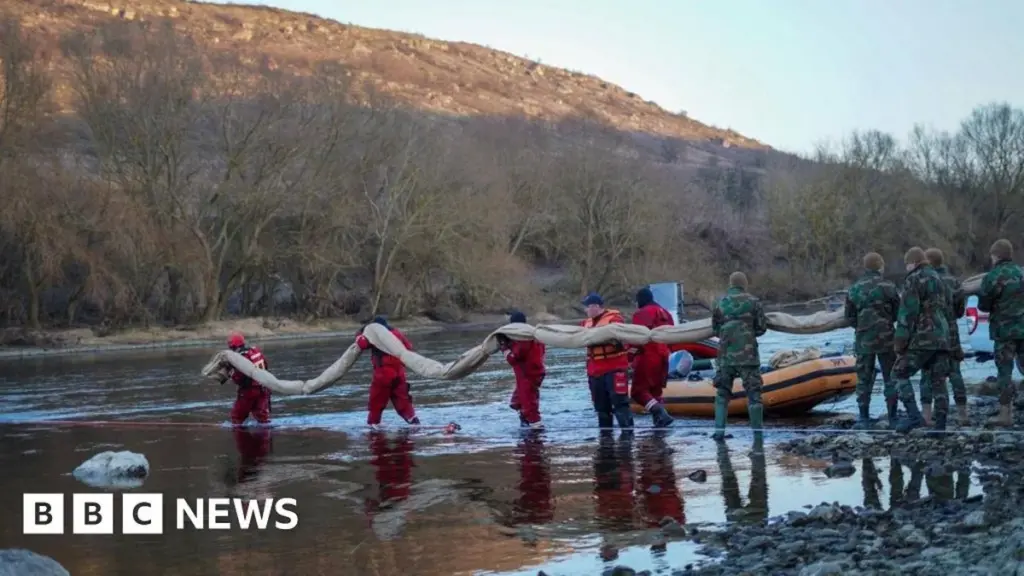
A significant oil spill, attributed to a Russian military action in Ukraine, has led to the contamination of a major Moldovan river. This environmental incident has prompted authorities to halt water supplies to Balti, a northern city, affecting thousands of residents.
Ukrainian officials reported that the oil spill originated after a Russian strike targeting the Dniester hydroelectric plant on March 7th. The first visible signs of pollution appeared three days later on the Dniester river. This waterway serves as a critical water source for a large portion of Moldova and for the Odesa region in southwestern Ukraine.
In response to the situation, Moldova declared a 15-day state of alert across the Dniester river basin on Monday. This precautionary measure aims to manage the potential impact of the pollution.
Diplomatic Reaction and Environmental Measures
Moldova’s Ministry of Foreign Affairs summoned Russia’s ambassador to lodge a protest regarding the incident. During the meeting, the ambassador was presented with a sample of cloudy water collected from the affected river. According to Moldovan media reports, the ambassador declined to comment to reporters upon his departure from the ministry.
Moldovan Environment Minister Gheorghe Hajder stated that water supplies would only resume once the oil concentration in the river dropped to the mandated limit of 0.1 milligrams per liter. He indicated that readings from Monday night were still too high to safely supply northern areas, including Balti, which is Moldova’s third-largest city. Further test results on Tuesday were expected to determine if the water could be recommenced for municipal use.
Beyond Balti, three additional towns in the northern region are also experiencing disruptions due to the water crisis stemming from the spill.
Wider Regional Impact and Contained Pollution Source
The environmental contamination has not exclusively affected Moldova. Ukrainian Deputy Minister Iryna Ovcharenko confirmed that water supplies in Ukraine’s Chernivtsi, Vinnytsya, and Odesa regions have also been impacted by the pollution.
Minister Hajder had previously been assured by Ukrainian officials that the source of the oil pollution had been successfully contained. This containment effort is crucial for preventing further spread of the contamination.
Community Response and Political Context
In Balti, schools have transitioned to online learning formats to allow local authorities to focus on providing drinkable water to the population via tankers. This logistical effort addresses the immediate needs of residents without access to tap water.
Maia Sandu, Moldova’s pro-European president, has been a steadfast supporter of Ukraine since Russia’s full-scale invasion in February 2022. She has consistently voiced her support for Kyiv, viewing its defense as vital for her own country’s security. President Sandu has clearly stated that Russia holds “full responsibility” for the oil pollution incident.
Relations between Moldova and Russia have been strained, with Russia having previously accused Sandu of “Russiaphobia.” She secured a second term as president in 2024, a victory that occurred despite what the European Union described as “unprecedented interference [in the election] by Russia.”
Geopolitical Considerations and Border Incidents
Moldova, with a population of 2.4 million, continues to host a Russian military base in its breakaway region of Transnistria. This region, predominantly Russian-speaking, runs along a significant portion of Moldova’s eastern border with Ukraine.
Local television reports have indicated sightings of oil in Transnistria. However, authorities within the breakaway region have stated they do not anticipate imposing restrictions on drinking water supplies there. Meanwhile, Moldovan police reported the landing of an “active” Russian drone, carrying an “explosive device,” approximately 500 meters inside the Ukraine-Moldova border in the village of Tudora. This incident underscores ongoing security concerns in the region.