
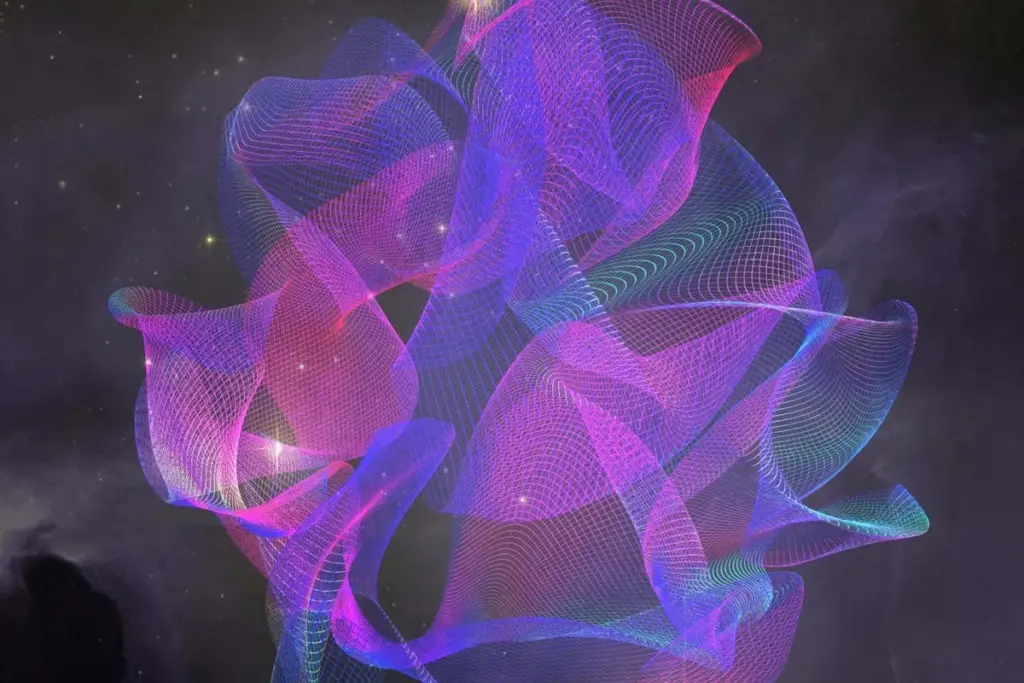
During a particularly memorable interview, I found myself at my desk, wrestling with a physicist over the concept of extra dimensions. The specific point of contention was understanding how an entire dimension could be considered “small.” After a prolonged discussion, I ventured, “Not small like a jellybean, though, right?” The unspoken laughter of a colleague nearby was almost palpable. The physicist’s response, predictably, was nuanced and complex.
The idea of “extra” dimensions appears with some frequency in physics, yet a clear, accessible explanation of their nature is rarely provided. These concepts often surface when discussing string theory, a theoretical framework proposing that all fundamental entities are minuscule vibrating strings. The way these strings vibrate, it’s suggested, dictates their properties, leading to what we perceive as atoms, electrons, and quarks. I approach string theory with a degree of caution, primarily due to the significant challenges in empirically testing its propositions, ranging from complex to virtually impossible. The theory’s reliance on extra dimensions to conceal these curled-up strings further complicates comprehension.
While a couple of well-known analogies exist, such as Edwin Abbott’s satirical 1884 novella “Flatland” and its subsequent educational adaptations, they primarily serve as allegories. These offer a conceptual bridge for understanding the sensory experience of encountering another dimension from a four-dimensional vantage point. However, they don’t deeply explain the underlying physics of additional dimensions themselves. When delving into the practical implications of extra dimensions, discussions often devolve into generalized explanations, a degree of bewilderment, and then move on to other topics.
The Potential of Extra Dimensions to Solve Fundamental Physics Problems
Despite the conceptual hurdles, the existence of extra dimensions, if proven true, holds the potential to resolve significant quandaries in physics and cosmology. A prime example is the force of gravity, which appears significantly weaker than other fundamental forces. The underlying reason for this disparity remains unknown. One hypothesis suggests that gravity might “leak” into these extra dimensions, thereby diminishing its effect within our observable universe. More recently, a similar concept has been proposed to explain evolving measurements of dark energy, which indicate it might be decreasing over time. If extra dimensions are expanding or contracting, this fluctuation could propagate into our familiar three spatial dimensions and one time dimension, subsequently altering the universe’s energy balance.
Furthermore, even with lingering questions about the likelihood of their existence, the very notion of extra dimensions is inherently fascinating.
Visualizing Higher Dimensions: The Flatland Analogy
The most readily understandable model of an extra dimension draws from the principles illustrated in “Flatland.” This narrative depicts geometric shapes inhabiting a two-dimensional world, confined to a flat plane and moving across it. From their limited two-dimensional perspective, they perceive other shapes solely as lines. A being from a higher dimension (say, three-dimensional) could observe these shapes from above or below, recognizing them not as lines but as actual two-dimensional forms with internal structures. In a three-dimensional existence, one could theoretically extract a shape from its plane, turning it on its side. To the remaining two-dimensional inhabitants, this would appear as a cross-section of the object’s interior intersecting their plane, rather than the familiar linear edge.
Extrapolating this to our reality, with its three spatial and one temporal dimension, a hypothetical being existing in an even higher-dimensional space could perceive our internal structures and potentially extract us from our familiar spacetime. For those remaining, this event would manifest as a shifting cross-section of our true, higher-dimensional form as the body moved.
Braneworld Hypothesis: Our Universe as a Boundary
A variation of this concept is the braneworld hypothesis. This theory posits that our universe represents the boundary, or membrane, of a larger, higher-dimensional cosmos. First introduced in 1999, this idea has regained prominence in recent years as one of the few plausible frameworks for reconciling our observable reality with the intricate requirements of string theory.
In one formulation of this hypothesis, the membrane defining our universe lies at the interface between a higher-dimensional space, termed “hyperspace,” and an absence of anything. This places our existence at the very edge of a cosmic void. Appropriately, this specific scenario is known as an “end-of-the-world brane.” Within this model, fundamental particles would be understood as the extremities of five-dimensional strings residing in hyperspace. However, we would remain perpetually unable to perceive the entirety of these strings, much like a triangle in Flatland could only ever discern shapes as simple lines.
Beyond Five Dimensions: Compactified and Non-Spatial Dimensions
While this discussion extends to five dimensions, the number of potential extra dimensions could be significantly greater. Moreover, they would not necessarily all possess a spatial character. One can envision dimensions where time might flow in multiple directions, not just forward and backward. Some of these dimensions could indeed be “small,” comparable to a jellybean in size, or even considerably more minute.
Imagine dimensions as a series of nested Matryoshka dolls. Access is typically limited to the dimension of one’s current existence—presumably four—and those contained within. The “jellybean” dimensions, characterized by their physical smallness rather than being merely lower-dimensional, are akin to small pockets or bubbles within this structure. Although seemingly distinct, these bubbles, much like the Matryoshka dolls, enclose spaces. These are simply very compact spaces, functioning as miniature pocket universes.
Detecting the Undetectable: The Search for Small Dimensions
Entering these pocket universes would likely require being incredibly small, perhaps akin to a photon, as these dimensions are theorized to be exceedingly tiny. Their minuscule size is the primary reason for our lack of direct observation; had they been larger, their detection would be far more feasible. Nevertheless, the possibility of detecting a small dimension is not entirely nil. Consider shining a light through nested glass dolls; any internal bubbles would cause distortions and reflections. An actual extra dimension would produce analogous effects.
For instance, if a gravitational wave were to traverse such a pocket within our universe, it would emerge with a slightly altered form. With sufficiently sensitive instruments, this distortion could be measured. Alternative detection methods involve examining subtle quantum phenomena and hypothesizing exotic particles that might only be produced within these extra dimensions.
The Ongoing Quest and its Implications
Researchers at gravitational wave observatories, particle colliders, and even conventional astronomical facilities are actively searching for these subtle indicators. To date, no definitive evidence has been found. However, the mere fact that a search for extra dimensions is scientifically viable might necessitate a re-evaluation of earlier assertions regarding string theory’s predictive limitations. Should evidence emerge, it could profoundly alter my perspective on string theory and, more broadly, our fundamental understanding of the cosmos.