
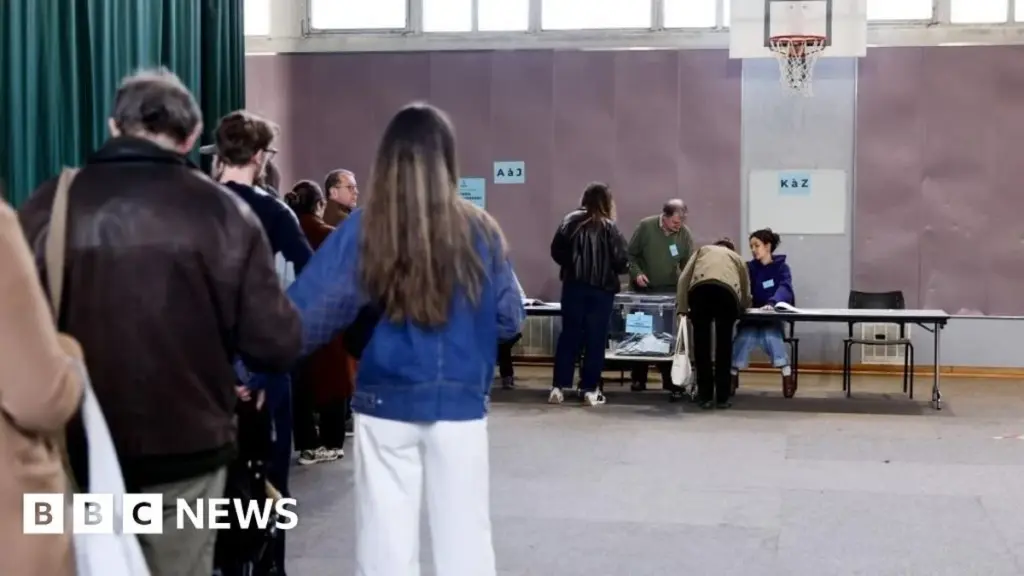
The growing influence of the far-left and far-right is presenting French centrist parties with awkward decisions following the initial round of mayoral elections.
In numerous substantial towns and cities, Socialist and center-right Republican parties face the temptation to form electoral pacts with their more extreme flanks. This strategy aims to defeat opposing candidates in the upcoming runoff elections scheduled for the following Sunday.
However, any alliances with the National Rally, positioned on the far-right, or France Unbowed, on the far-left, carry significant risks alongside potential opportunities.
Case Study: Marseille
Consider the situation in Marseille. Following the first round, the incumbent Socialist Mayor, Benoît Payan, holds a narrow lead over Franck Allisio, the National Rally candidate. Two additional candidates, Martine Vassal of the Republicans and Sébastien Delogu of France Unbowed, have also advanced to the second round, albeit with lower vote counts.
This scenario raises a critical question: Should the Socialists align with France Unbowed to secure Payan’s re-election? Conversely, should Vassal of the Republicans consider an arrangement with the National Rally to prevent a left-wing victory?
While such alliances might appear strategically sound from an electoral perspective, their potential to tarnish the reputation of mainstream parties is considerable. Associating with groups they typically denounce could lead to reputational damage.
Challenges in Paris and Beyond
In Paris, Emmanuel Grégoire of the Socialist Party achieved a strong performance in the first round. However, Sophia Chikirou from France Unbowed also qualified for the second round. Grégoire has publicly stated his refusal to form any pact with France Unbowed. This stance, while principled, could potentially cost him the election.
His opponent, the right-wing candidate Rachida Dati, has similarly ruled out an alliance with Sarah Knafo, the far-right candidate who narrowly secured a place in the runoff. Without Knafo’s support, Dati’s electoral position becomes precarious.
Historical Context and Shifting Alliances
Historically, such dilemmas were largely confined to the political right. The National Rally was considered outside the bounds of acceptable political discourse, meaning center-right parties faced significant opposition within their own ranks whenever they entered into tacit agreements with them to counter the left.
This year, however, the ostracism of the far-left France Unbowed represents a novel development in French political dynamics.
Under its leader Jean-Luc Mélenchon, France Unbowed had previously formed a coalition with the Socialist Party, the Greens, and the Communists, leading to a strong showing for the left in the 2024 legislative elections. Yet, this coalition has since fractured.
For many who oppose France Unbowed, a recent incident served as the final catalyst: the murder of a far-right student in Lyon the previous month. Allegations suggested that a far-left group, which included a parliamentary assistant from France Unbowed, was responsible.
Adding to this, Jean-Luc Mélenchon’s remarks, which appeared to make light of the name Jeffrey Epstein – the disgraced American financier and sex offender – by playing with its pronunciation to allegedly highlight its Jewish origins, were widely interpreted as antisemitic.
These events make any formal alliance with France Unbowed virtually impossible. It was within this context that Socialist Party leader Olivier Faure, on Sunday evening, declared the exclusion of any “national” pacts for the upcoming second round.
Significantly, Faure did not rule out “local” arrangements with France Unbowed. Indeed, in Toulouse, the Socialist Party and France Unbowed have already announced the merging of their electoral lists with the explicit aim of defeating the incumbent right-wing candidate.
Reactions and Political Polarization
From the perspective of the right, these developments suggest hypocrisy. The coming days are likely to see accusations of left-wing “double standards” filling the airwaves.
The left, in response, is expected to retort with calls for the right to address its own internal issues and cease its flirtations with what they term “fascists.”
If the political climate appears polarized, ill-tempered, and fractious, it accurately reflects the current state of affairs.
Across France, as in many other nations, political outcomes are increasingly dictated by movements and sentiments originating from the outer edges of the political spectrum.
This trend, evident in the current municipal elections, is likely to be even more pronounced in the presidential elections scheduled for the following year.