
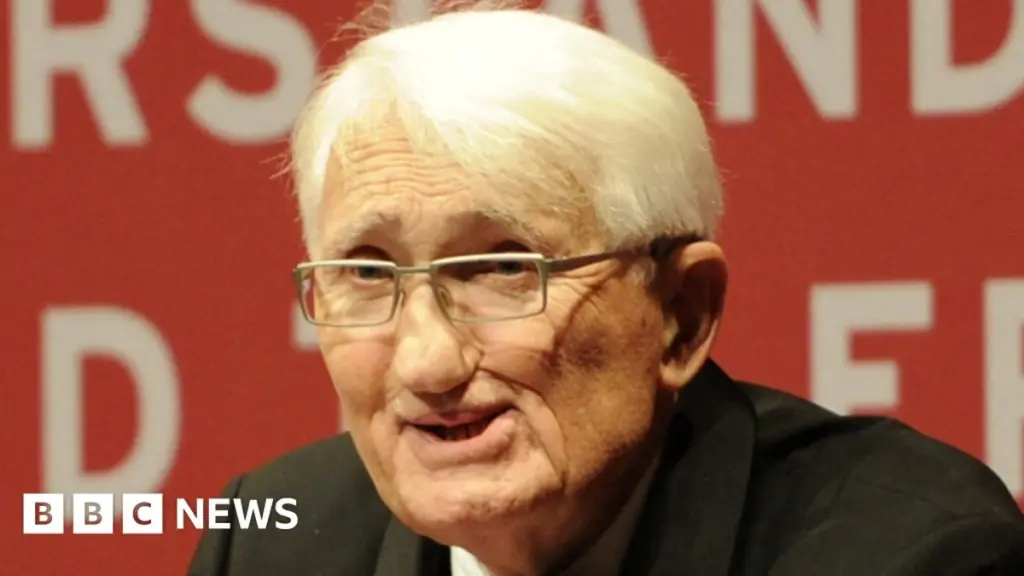
Jürgen Habermas, a towering figure in post-war German philosophy and public discourse, has passed away at the age of 96. His career, spanning decades, saw him contribute profoundly to our understanding of society, communication, and democracy.
Habermas began his academic journey in the 1960s, taking up positions in philosophy and sociology at the University of Frankfurt. During this period, he was a visible supporter of the student movements that swept through West German universities. This engagement marked him as an intellectual voice advocating for societal change.
He was a central figure within the “Frankfurt School,” a distinct intellectual tradition that offered critiques of capitalism from a “new left” viewpoint, diverging from orthodox Marxism. This school of thought sought to analyze and challenge societal structures.
Early Life and Historical Context
Born in Düsseldorf in June 1929, Habermas’s formative years were shaped by Nazi Germany. His father, who led the local chamber of commerce, became a member of the Nazi Party in 1933. While enrolled in the Hitler Youth, young Jürgen was too young to participate in the fighting of World War Two.
His experiences under the Nazi regime profoundly influenced his later work. In the 1980s, he engaged in a significant debate with conservative historians who questioned the uniqueness of the Holocaust as a German phenomenon, defending its singular historical importance.
Academic Career and the Frankfurt School
Following the war, Habermas pursued his studies in philosophy, earning a doctorate from Marburg University. He then joined the Institute of Social Research at the University of Frankfurt. It was here that he, alongside prominent thinkers like Max Horkheimer and Theodor Adorno, emerged as a key proponent of the Frankfurt School.
The Frankfurt School is widely recognized for its development of critical theory. This approach posits that capitalist societies, instead of fostering human liberation, tend to transform active individuals into mere passive consumers. This critique formed a cornerstone of Habermas’s intellectual output.
Critiques of Modern Society and Media
Habermas directed significant criticism towards what he identified as the “commodified” nature of mass media and entertainment. He argued that the pervasive spread of mass-produced culture had a detrimental effect, eroding the foundations of critical public debate. His theories highlighted the potential for media to shape rather than reflect public opinion.
Political Engagements and European Integration
In the period of German reunification in 1989-90, Habermas expressed reservations about the swift integration of East Germany into the West. He voiced concerns about a potential resurgence of nationalism, advocating instead for a more gradual process of unification. This stance reflected his enduring focus on democratic processes and national identity.
During the 1990s, Habermas became a vocal advocate for a united Europe. He viewed European integration as a crucial bulwark against the resurgence of historical nationalist rivalries that had plagued the continent. His vision emphasized cooperation and shared identity over nationalistic competition.
Key Contributions to Thought
His most seminal work, “The Theory of Communicative Action,” published in 1981, presented a compelling argument about the essential forces that bind human societies. Habermas posited that it is not primarily political or economic power, but rather humanity’s inherent capacity for rational dialogue that sustains social cohesion. This theory shifted focus towards the communicative basis of social order.
A personal experience notably shaped Habermas’s intellectual path. Born with a cleft palate, he underwent numerous operations as a child. He later reflected that this personal journey significantly influenced his thinking about the nature of language and the fundamental importance of communication.