
The question of mathematics’ most crucial number is, admittedly, a rather playful one. Faced with an infinite spectrum of possibilities, singling out a single champion is a challenge. While numbers like 2 or 10 might seem like strong contenders due to their common usage, elevating them above less familiar quantities feels inherently arbitrary. Nevertheless, a compelling case can be made for one number asserting its undeniable supremacy: zero.
Zero’s ascent to the highest echelons of the mathematical world mirrors a classic hero’s narrative, beginning with modest origins. Indeed, when it first emerged approximately 5,000 years ago, it did not function as a number in the conventional sense. The ancient Babylonians utilized a cuneiform script composed of lines and wedges for their numerical notation. These symbols bore resemblance to tally marks, with one specific mark representing quantities from 1 to 9, and another designated for 10, 20, 30, 40, and 50.
The Dawn of Placeholding
These Babylonian marks enabled counting up to 59. When the number 60 was reached, the system simply reset, employing the same mark for 1 as for 60. This base-60 numeral system proved advantageous due to 60’s divisibility by numerous other integers, facilitating calculations. This characteristic is partly why we still adhere to this system for timekeeping today. However, the inability to differentiate between 1 and 60 presented a significant drawback.
The innovative solution to this ambiguity was zero, or at least its precursor. The Babylonians introduced a space denoted by two angled wedges to signify the absence of a digit in a specific position. This innovation allowed for the correct placement of other numbers, mirroring the positional significance we assign to digits in modern arithmetic. For instance, 3601 in our contemporary system signifies three thousands, six hundreds, zero tens, and one unit. The Babylonians would have represented this as sixty sixties, zero tens, and one unit. Without their concept of a positional zero, the symbols for “one sixty and one units” would have been indistinguishable from this quantity.
Crucially, the Babylonians did not technically count these positional zeros as numbers. They served more as a form of punctuation or a cue to advance to the next numerical position. This placeholder concept of zero was adopted by various ancient civilizations over millennia, though not universally. The Romans, notably, lacked a zero because their numeral system was not positional; an ‘X’ consistently represented 10, irrespective of its location.
Zero as a Number: The Indian Contribution
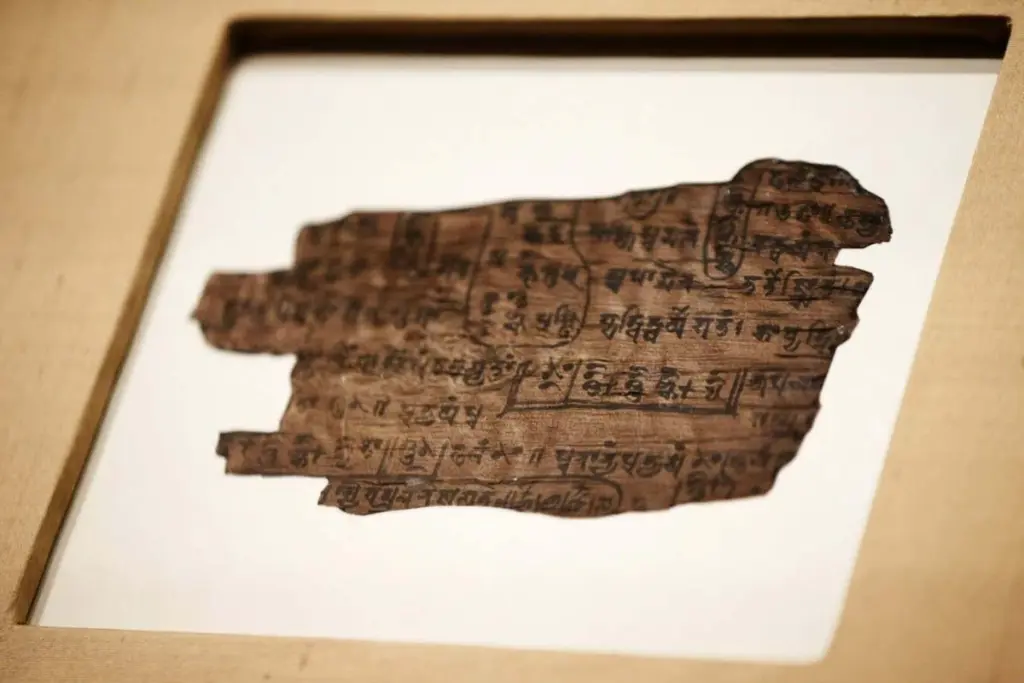
The subsequent significant development in the concept of zero did not materialize until the 3rd century AD, based on evidence from a manuscript discovered in what is now Pakistan. This document features hundreds of dot symbols functioning as positional zeros, a symbol that ultimately evolved into the ‘0’ we recognize today.
Yet, zero’s conceptualization as a distinct number, rather than merely a placeholder, required several more centuries. Its first documented appearance as a number in its own right is within the Brāhmasphuṭasiddhānta, a treatise authored by the Indian mathematician Brahmagupta around 628 AD. While many scholars prior to him acknowledged the anomalies of operations like subtracting 3 from 2, such calculations were typically disregarded as meaningless. Brahmagupta was the first to rigorously address these concepts, detailing arithmetic operations involving both negative numbers and zero. His exposition on manipulating zero closely aligns with our modern understanding, with one notable divergence: the outcome of division by zero.
Brahmagupta posited that 0 divided by 0 equals 0, but remained circumspect regarding the division of any other number by zero. A definitive resolution to this complex question would take another millennium and ultimately lead to one of mathematics’ most potent instruments: calculus.
Calculus and the Embrace of the Infinitesimal
Developed independently by Isaac Newton and Gottfried Wilhelm Leibniz in the 17th century, calculus is intrinsically linked to the manipulation of infinitesimal quantities – numbers that approach zero ever so closely without ever reaching it. In essence, infinitesimals provide a method to approach the concept of division by zero without directly engaging in the impossible operation. This technique has proven extraordinarily powerful.
To illustrate, consider a car accelerating. If its velocity is described by the equation $v = t^2$, where $t$ represents time, then after 4 seconds, its velocity would be 16 meters per second, starting from rest. Determining the distance traveled during this interval presents a challenge. A simple multiplication of final speed by time (16 m/s * 4 s = 64 meters) is inaccurate, as the car only reaches its maximum speed at the very end of the period. A more refined approach might involve dividing the journey into segments. For instance, approximating the first two seconds at 4 m/s and the next two at 16 m/s yields a distance of (4 m/s * 2 s) + (16 m/s * 2 s) = 40 meters. However, this method still overestimates because it relies on the top speeds within each segment.
To enhance accuracy, the time intervals must be progressively shortened, multiplying the precise speed at each instant by the infinitesimally small duration at that speed. This is where the concept of zero becomes critical. Graphing the velocity function $v = t^2$ and overlaying these estimations reveals their inaccuracies. To achieve the most precise measurement, the journey would need to be divided into timeframes of zero duration, and these segments summed. This paradoxically involves division by zero, an operation previously deemed impossible. Calculus, however, provides the means to circumvent this impasse.
Newton and Leibniz devised methodologies that allow for approximations to dividing by zero without directly performing the operation. While a comprehensive explanation of calculus is beyond the scope of this article, their techniques illuminate the solution for this car acceleration problem: the integral of $t^2$, which is $t^3/3$. This yields a distance of 21 and 1/3 meters. This result is also commonly understood as the area under the velocity-time curve.
Calculus’s applications extend far beyond calculating a car’s travel distance. It is fundamental to understanding any phenomenon involving changing quantities, spanning fields from physics and chemistry to economics. None of these advancements would be conceivable without zero and a profound comprehension of how to harness its immense power.
Zero as the Foundation of Number
Beyond its computational utility, zero’s most profound significance emerges in the late 19th and early 20th centuries, a period marked by an existential crisis within mathematics. Researchers probing the foundations of their discipline unearthed alarming inconsistencies. In their efforts to establish rigorous frameworks, they began formally defining mathematical objects previously considered self-evident, including numbers themselves.
The fundamental question arises: what precisely constitutes a number? It cannot be conveyed by a word like “three” or a symbol such as ‘3’, as these are merely arbitrary designations for the abstract concept of threeness. While pointing to a collection of objects – an apple, a pear, and a banana – and stating “there are three pieces of fruit” illustrates the quantity, it does not reveal its intrinsic nature. A more fundamental definition is required, something that can be counted abstractly and compiled into a collection designated “three.” Modern mathematics achieves this through the concept of zero.
Instead of collections, mathematicians employ sets. Thus, the fruit example would be represented as {apple, pear, banana}, with curly braces signifying a set. Set theory forms the bedrock of modern mathematical foundations. It can be likened to the “computer code” of mathematics, where all mathematical entities must ultimately be described in relation to sets to ensure logical consistency and prevent the foundational gaps previously identified by mathematicians.
To define numbers, mathematicians begin with the “empty set,” a set containing no elements. This is commonly notated as {} but is more effectively represented by ∅. Once the empty set is established, subsequent numbers can be defined. The concept of “one” is a set containing a single element. Thus, we can place the empty set within a set: {{}}, or more legibly, {∅}. The number “two” requires two elements. The first can be the empty set; for the second, we can utilize the previously defined set containing the empty set. This results in the set defining two as {∅, {∅}}. The number “three” is then constructed as {∅, {∅}, {∅, {∅}}}, a process that can be extended indefinitely.
In essence, zero transcends its role as merely the most important number; it is, in a profound sense, the sole number. By scrutinizing the fundamental structure of any number, one discovers that it is recursively built from zeros. This is a remarkable status for a concept once relegated to the status of a simple placeholder.