
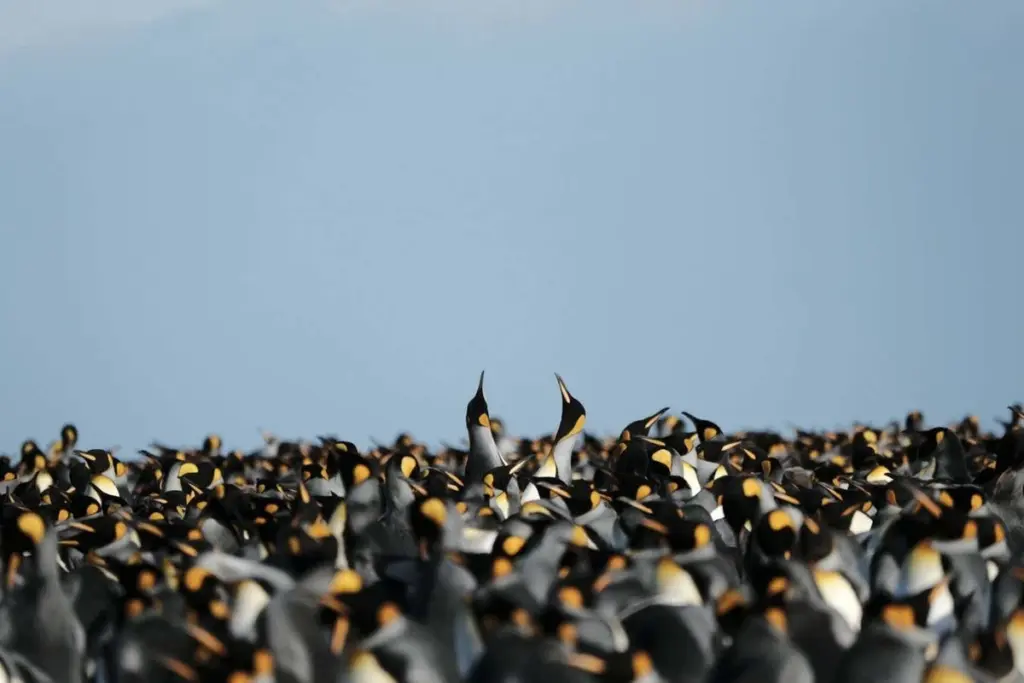
Recent observations indicate that king penguins (Aptenodytes patagonicus) inhabiting Possession Island, a French territory situated between Antarctica and Madagascar, are experiencing a significant boost in reproductive success. This resilience is occurring even as sub-Antarctic temperatures rise, with more of their chicks surviving to adulthood.
Research conducted by Gaël Bardon from the Monaco Scientific Center and his colleagues reveals a compelling shift. In 2023, king penguin pairs on Possession Island initiated their breeding cycle approximately 19 days earlier compared to the year 2000. This extended breeding season has directly contributed to an improved survival rate for their young. On average, 62% of chicks now reach maturity, a notable increase from the 44% survival rate recorded at the turn of the century.
“With king penguins, we can see that there are super-fast changes in the Southern Ocean that are good for them for the moment, but for the long term, we don’t really know,” Bardon stated, highlighting the complex interplay between immediate benefits and future uncertainties.
Penguin Life Cycle and Feeding Habits
King penguins are recognizable by their distinctive brilliant yellow-orange neck feathers. During the austral summer, a pair typically cares for a single egg. This egg hatches after about two months, yielding a fluffy brown chick. To sustain their offspring, parent penguins embark on arduous journeys, leaving the chicks on their home island. They swim hundreds of kilometers south to reach the polar front. This crucial area is characterized by the mixing of warm and cold ocean currents, which stirs up nutrients that fuel plankton growth.
These nutrient-rich waters support populations of small lanternfish. King penguins prey on these lanternfish, which themselves feed on plankton. The adult penguins then transport this vital food source back to their chicks. Unusually, the current warming trend in these waters appears to be beneficial for lanternfish populations.
Environmental Shifts and Breeding Success
The study suggests a strong correlation between the earlier breeding observed in king penguins and higher sea surface temperatures, coupled with lower plankton concentrations. This specific combination of environmental factors indicates an abundant supply of lanternfish in the penguins’ foraging grounds. The extended breeding period allows young chicks more time to build up reserves of fat through consumption of fish before the onset of the long, challenging winter months, thereby reducing the likelihood of starvation. Bardon elaborated that this enhanced chick survival has not yet led to an observable population increase on Possession Island itself, which seems to have reached its carrying capacity. However, he posits that more penguins may be colonizing other islands, contributing to the growth of those populations.
An Indicator of Rapid Environmental Change
Céline Le Bohec, also affiliated with the Monaco Scientific Center and a member of the research team, described the king penguins’ accelerated shift towards earlier breeding—a change that has occurred at a pace faster than in nearly any other polar species—as a critical “alarm call.” She emphasized that this phenomenon underscores the rapid rate at which the environment is transforming.
In prior years marked by unusual warmth, the polar front had shifted southward. This retreat forced king penguins to travel greater distances to find fish. Such extended foraging trips resulted in lower chick survival rates and, consequently, a decline in the penguin population on Possession Island. Given that there are no suitable islands further south for them to relocate, the penguins were compelled to extend their foraging ranges. Earlier research indicated that this population faced a projected decline in the coming decades if the polar front persisted in its gradual southward migration.
“This fast change, which increases the window for the breeding cycle, is positive, but once the food availability at the polar front will be… too far away from the colony, it will collapse,” Le Bohec cautioned. She added, “You will reach a tipping point.”
Differing Perspectives on Long-Term Viability
However, not all researchers share this level of concern. Lewis Halsey of the University of Roehampton in the UK, who observed the Possession Island penguins recover following a mini-tsunami in 2004, points to their adaptability. He noted that these penguins also consume other food sources, such as squid, found closer to the island. Halsey believes that while the population might experience a reduction, it is unlikely to face extinction, stating, “I don’t see a collapse, as I see them as inherently very flexible.”
Tom Hart from Oxford Brookes University in the UK remarked that scientists would have typically anticipated only a stable breeding pattern for king penguins as they adapted to climate change. Therefore, the observed improvement is considered a remarkably positive indicator. “This is a good news story, and sure, things could change, but when we’re looking at other penguins particularly, most of them as a whole family are in decline,” he observed. “This is a rare win.”
Journal reference: Science Advances DOI: 10.1126/sciadv.aea6342