
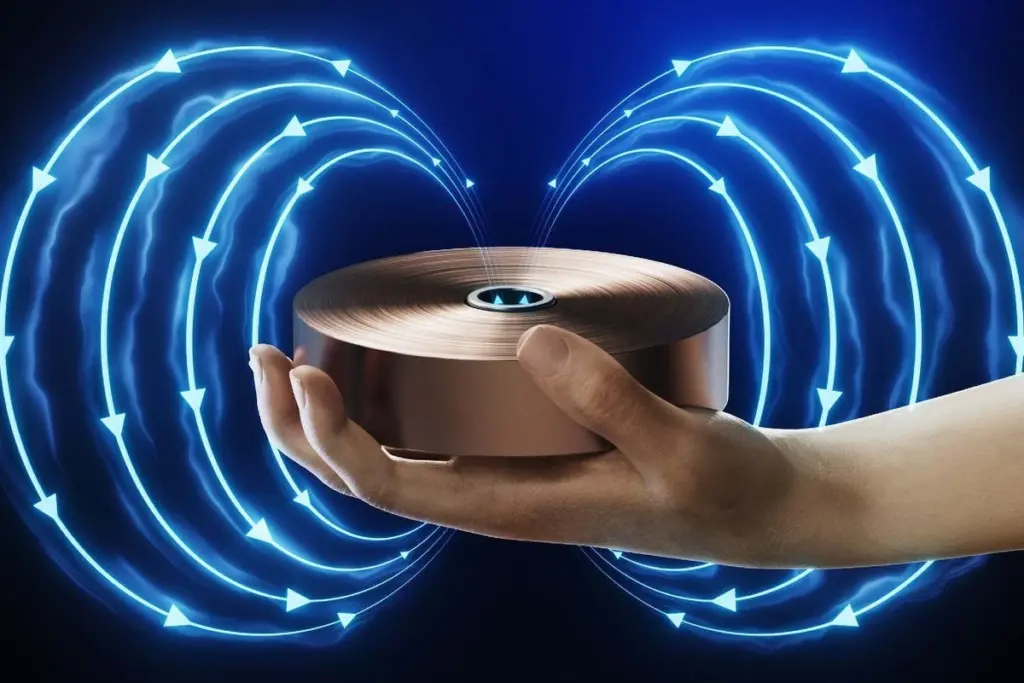
A magnet small enough to fit in the palm of a hand has, for the first time, achieved the same magnetic strength as some of the world’s most powerful superconducting magnets.
The Importance of Strong Magnets
Powerful magnets are integral to numerous scientific and technological advancements. Their applications span fields as diverse as medical imaging (MRI), particle accelerators used in fundamental research, and initiatives working towards nuclear fusion. The most potent magnets are constructed from superconducting materials, which exhibit near-perfect electrical conductivity.
Challenges of Current Superconducting Magnets
However, superconducting magnets that generate substantial magnetic fields are typically substantial in size. Smaller versions can be comparable in scale to the fictional robot R2-D2 from Star Wars, while the largest can rival the size of a two-story building, according to Alexander Barnes at ETH Zurich in Switzerland. This size limitation presents significant logistical and cost barriers.
Breakthrough in Compact Magnet Design
Barnes and his research team have developed a superconducting magnet that competes with these large-scale magnets in terms of strength, yet measures only 3.1 millimeters in diameter. Their achievement was realized by coiling a thin tape made from REBCO, a ceramic material that exhibits superconductivity when cooled to extremely low temperatures. The passage of electric currents through these coils produces magnetic fields.
Development Process and Iterations
The team sourced the REBCO tape from a commercial supplier. Their subsequent efforts focused on identifying the optimal magnet design. This involved an iterative process that included the creation and testing of over 150 different prototypes, as Barnes described. Their strategic approach was to embrace a methodology of frequent and rapid failure.
Achieved Strengths and Power Efficiency
The researchers ultimately selected a design incorporating either two or four “pancake” shaped coils made of REBCO. These configurations are capable of producing magnetic fields with strengths of 38 Tesla and 42 Tesla, respectively. By way of comparison, a common refrigerator magnet typically exerts a magnetic field of less than 0.01 Tesla. The two magnets currently holding the record for the world’s strongest steady magnetic fields operate at around 45 Tesla, weigh many tons, and consume up to 30 megawatts of power. In stark contrast, the magnet developed by Barnes and his team is palm-sized and requires less than 1 watt of power.
Potential Applications and Future Goals
Barnes indicated that their primary objective is to utilize this novel magnet for nuclear magnetic resonance (NMR). This experimental technique employs magnetic fields to elucidate the molecular structures of substances like drugs and industrial catalysts. He believes that the widespread adoption of this powerful technique is hindered by the current size and expense of magnets. The researchers are hopeful that their development will make NMR more accessible to a broader range of chemists. Initial testing of the magnet within an NMR setup has already commenced.
Expert Commentary and Remaining Challenges
Mark Ainslie, based at King’s College London, commented that generating magnetic fields exceeding 40 Tesla traditionally necessitates very large and costly infrastructure. Therefore, achieving comparable field strengths within such a compact device, utilizing superconducting tapes, is a significant advancement. He suggests this development indicates that extremely high-field magnets could become more readily available to a wider array of laboratories in the near future. However, Ainslie also noted that several questions remain pending before the magnet can attain widespread application. These include assessments of magnetic field uniformity and methods for managing and controlling the electromagnetic behavior of these coils.
Journal reference: Science Advances DOI: 10.1126/sciadv.adz5826