
Andy Weir’s novel, “Project Hail Mary,” plunges readers into a critical mission to avert the sun’s impending demise, brimming with intricate plotting and engaging elements. However, the reviewer found themselves setting the book aside, a mere hundred pages in, primarily due to protagonist Ryland Grace. Grace, a molecular biologist who transitioned to teaching and then to astronaut, awakens on a starship light-years from Earth, devoid of his memories and understanding of his purpose.
The reviewer’s initial reaction to Ryland was one of strong dislike, finding his immature and sardonic personality grating. The narrative voice, particularly Ryland’s use of phrases like “gentleman’s equipment” for his penis, proved to be a significant barrier. Despite the intriguing premise, hinting at grand questions such as the necessity of an interstellar mission to preserve the sun, the prospect of spending another five hundred pages immersed in Ryland’s internal monologue felt unappealing, leading to the decision to cease reading.
This decision, however, was a disservice. Had the reviewer persevered, they would have discovered a story rich in warmth and scientific detail, elements now fully accessible through the film adaptation of “Project Hail Mary.”
The Cinematic Revelation
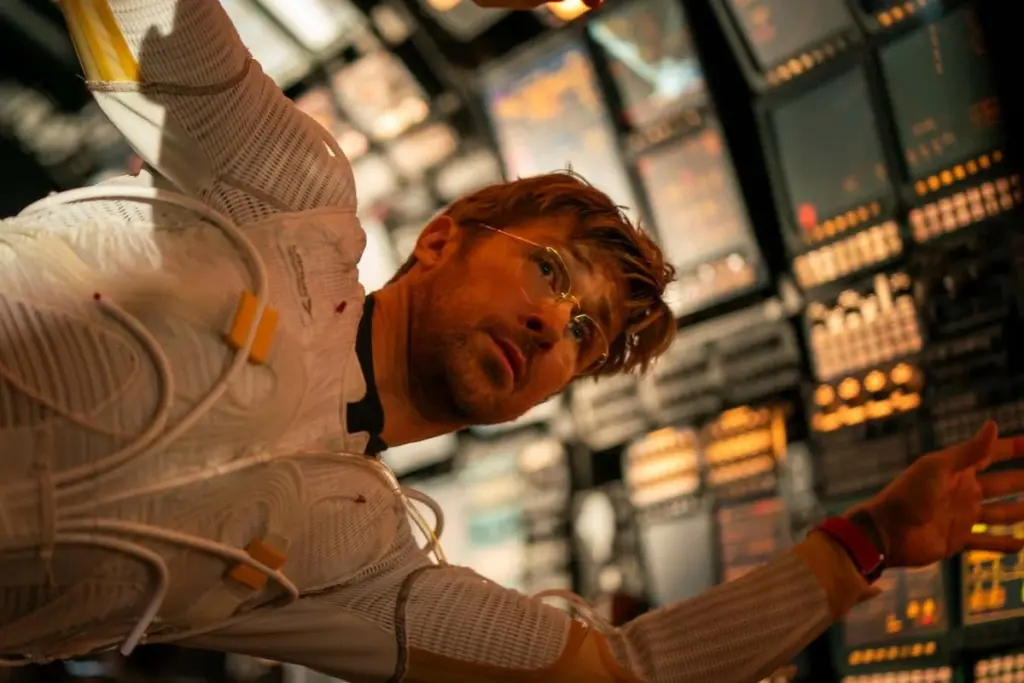
A sense of relief washed over the reviewer during the film’s very first scene. Here, Ryland Grace, portrayed by Ryan Gosling, is shown on the spacecraft after years in a coma. A robotic arm removes his breathing tube and other life support systems. While this transition is depicted as a lengthy affair filled with flippant asides in the novel, the film presents it concisely and effectively, stripping away the problematic interiority and presenting a stark, impactful moment.
Following this, Ryland, now bearded and disoriented, explores the ship with a raw intensity reminiscent of Gen X Tarzan, instantly drawing the viewer into the narrative. This scene exemplifies the film adaptation’s core strength: its ability to convey essential information without extensive exposition, trusting the actors to communicate the necessary nuances. Gosling skillfully embodies Ryland not just as an abrasive loner, exiled from academia for challenging prevailing theories on extraterrestrial life, but as a relatable everyman who possesses genuine comedic timing.
A Mission Against Extinction
The narrative gradually reveals that Ryland was recruited by Eva Stratt, a character portrayed with icily competent authority by Sandra Hüller. Stratt lays out the dire stakes: projections indicate the sun will dim by up to five percent over the next two decades. Such a drastic reduction in solar output would trigger catastrophic climate change on Earth, leading to widespread famine and the eventual extinction of humanity.
Hüller elevates what could have been a one-dimensional role, infusing Stratt with a palpable, tightly controlled emotional depth. The performances from Hüller, Gosling, and James Ortiz, in a role intentionally left unspoiled, contribute to a dynamic ensemble that elicits both laughter and profound empathy. The film masterfully balances these emotional beats.
The Pinnacle of Science Fiction
The scientific underpinnings of “Project Hail Mary” are a standout feature, living up to the expectations set by writer Drew Goddard, who also penned the adaptation of “The Martian,” another of Weir’s works. Similar to its thematic predecessor, “Project Hail Mary” centers on a solitary scientific mind confronting the vastness of space and the existential threat to Earth. However, this adaptation prioritizes expansive concepts in physics and biology over the granular details of survival that characterized “The Martian.”
Despite his perilous situation, Ryland is compelled to fully engage his formidable intellect. The journey has seen the demise of both the pilot and engineer, leaving him utterly alone in space and woefully unprepared to complete the mission. Faced with an abundance of time and immense pressure, Ryland devises ingenious solutions. These clever stratagems are sure to satisfy enthusiasts of hard science fiction, even if the film doesn’t meticulously explain every scientific principle at play.
Unraveling Life’s Mysteries
Without disclosing crucial plot developments, the film firmly establishes that the fundamental questions of existence and the meaning of life are central to the experience of “Project Hail Mary.” Not every aspect of the film achieves perfection. Mirroring its source material, it occasionally leans too heavily into Ryland’s more whimsical characteristics, veering into sentimentality at certain points.
Nevertheless, the pursuit of absolute flawlessness can detract from overall merit. Although Ryland might not be the reviewer’s ideal companion for an interstellar voyage, the film managed to evoke a surprising depth of care for his fate by its conclusion. “Project Hail Mary” is a visually stunning, genuinely charming adventure. For the reviewer, it served as a powerful reminder of the rewards of looking past initial reservations, prompting a consideration of revisiting the novel to see its story through to its intended end.