
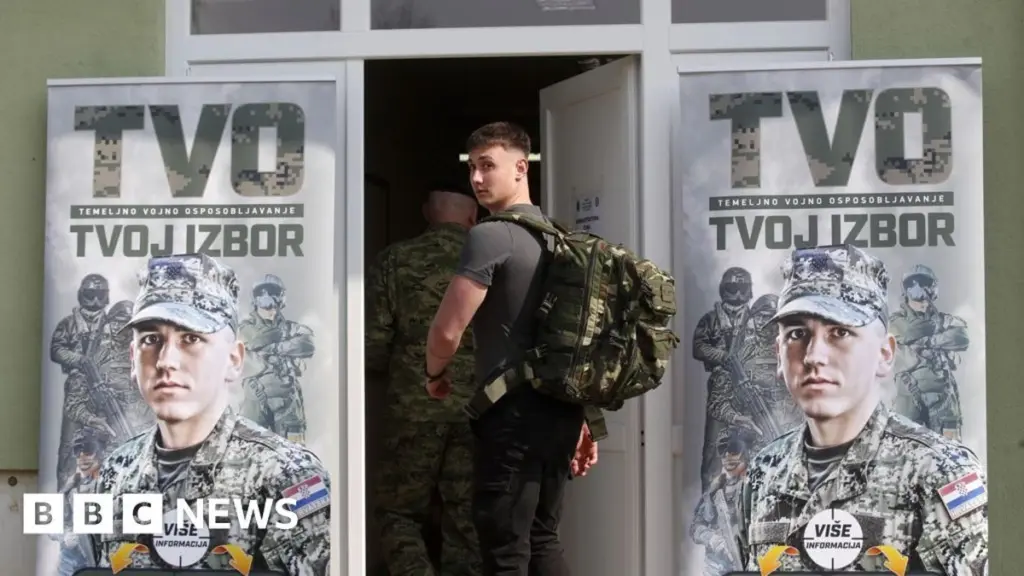
Hundreds of young Croatians have begun mandatory military training, marking the first time the country has required national service since it was abolished in 2008. This resurgence in conscription sees recruits reporting to barracks in three designated locations across Croatia, prioritizing facilities closest to their residences.
Upon arrival, new conscripts will be issued their military equipment and assigned dormitory accommodations. The initial two-month period will be dedicated to adhering strictly to military discipline, a significant shift from civilian life.
Tihomir Kundid, Chief of the General Staff of the Armed Forces of Croatia, acknowledged the abrupt transition, stating that recruits are “torn from the civilian environment.” However, he quickly sought to alleviate concerns of anxious parents, assuring them that their children would be managed with careful consideration. “We will acclimatize them step by step,” he added, “so that they do not experience too much stress.”
Mobile phone usage will see limited restrictions, primarily confined to times outside of active training sessions, a detail that may offer some comfort to the young men and women undergoing the program. The first cohort comprises approximately 800 individuals. Notably, over half of these recruits proactively volunteered for service, preceding their official call-up notices. Women are included in this intake, with one in ten conscripts being female, though their participation remains voluntary.
Croatian authorities have also highlighted that only ten individuals have so far officially registered as conscientious objectors. These individuals will undertake a four-month period of civilian service instead, receiving less than half the monthly allowance designated for military personnel, which amounts to €1,100 (£953; $1,273).
General Kundid described the upcoming program as “very dynamic, very interesting.” The curriculum is designed to encompass a broad range of skills, extending from traditional military competencies to more contemporary areas such as “basic drone control and drone protection skills” and advanced cyberwarfare techniques and their countermeasures.
Regional Security Concerns Drive Policy Shift
The decision to reinstate compulsory military service was directly influenced by the proximity and ongoing conflict in Ukraine. Croatia shares a border with countries involved in or affected by the situation, with Hungary being the only nation separating Croatia from direct involvement in the war.
Ivan Anusic, Croatia’s Defence Minister, shared that the region’s security landscape has dramatically changed. “The situation in Croatia and all around our neighbourhood was stable. Right now, it’s completely different,” he told the BBC. He further elaborated on the perceived threat, stating, “For four years now, we’ve been looking at not just the Russian aggression in Ukraine, but the proxies of Russia all around Europe doing their jobs.”
Wider Trend of Reintroducing Conscription
Croatia’s move may signal a broader regional trend. In Slovenia, the largest opposition party has been advocating for the return of conscription ahead of the nation’s parliamentary elections. Similarly, Serbia’s president, Aleksandar Vucic, has announced plans to reintroduce mandatory military service within the next twelve months. This development is accompanied by a significant increase in Serbia’s military expenditure.
These regional military developments have generated apprehension in Kosovo and Bosnia. In parallel, Serbia has expressed its concern regarding Croatia’s recent military alliance with Kosovo and Albania. James Ker-Lindsay, an analyst specializing in the Balkans and international conflict, commented on the volatile situation. “Any military development in the Balkans just makes the whole region far less secure because everyone reads it as being aimed against them,” he observed.
Ker-Lindsay also pointed to an escalating arms race dynamic. “The problem is that Croatia has been arming. And of course, when Croatia buys arms, then Serbia looks at it and thinks we need to as well.”
Future Plans for Conscription in Croatia
Croatia’s commitment to its conscription policy is already evident. The country plans for three additional intakes before the close of the current year. The long-term objective is to train a total of 4,000 recruits annually going forward.
Croatia now joins ten other NATO member nations that have reinstated mandatory military service. This group includes countries such as Greece, Turkey, several Scandinavian nations, and the Baltic states, indicating a growing regional emphasis on national defense preparedness.