
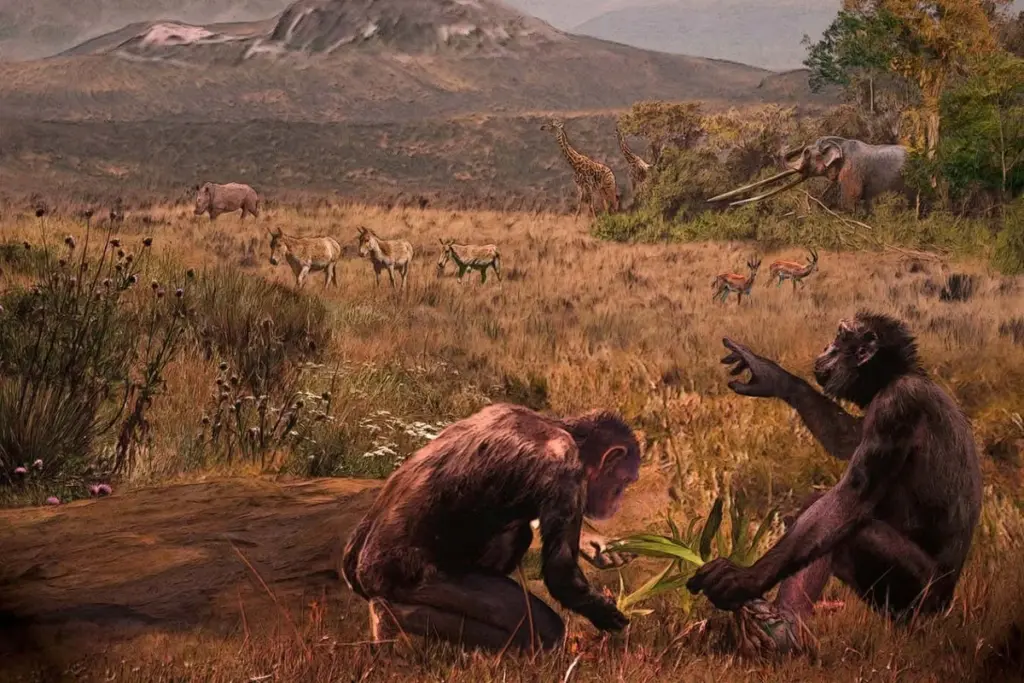
Evidence unearthed in Bulgaria suggests that apes may have walked upright as far back as 7.2 million years ago. Researchers have discovered a fossilized leg bone exhibiting characteristics indicative of bipedal locomotion, a significant development in evolutionary history.
This particular fossil predates all previously known hominin fossils, including those found in Africa. Its existence raises the possibility that bipedality, a foundational trait in human evolution, might have originated in Europe rather than on the African continent, as is commonly understood.
Madelaine Böhme of the University of Tübingen in Germany stated that “the oldest indications for bipedality are found in Europe.” Her team has been engaged in excavations at the Azmaka site, located near Chirpan in southern Bulgaria, since 2008. This location features a substantial layer of river-deposited sediments, approximately 20 meters thick.
The Discovery of “Diva”
In 2016, the excavation team unearthed a nearly complete right thighbone, or femur, measuring 21.5 centimeters in length. It was discovered embedded in sands dated to 7.2 million years ago. Only a small portion of the bone’s lower end is missing. The individual from which this femur originated has been informally nicknamed “Diva” by the researchers.
Clément Zanolli from the University of Bordeaux in France, who was not involved in the study, described the find as “a very, very beautiful discovery.” He noted that the femur is remarkably well-preserved, which is an exceptionally rare occurrence in the Miocene fossil record for hominids.
Context of Ape Evolution
During earlier epochs, Europe was a habitat for a diverse array of ape species. However, by 7.2 million years ago, a significant number of these species had vanished. Currently, our closest ape relatives are exclusively found in Africa. Similarly, all the earliest known ancient humans, or hominins, have been discovered in Africa.
The only ape species identified at the Azmaka site is Graecopithecus freybergi. This species is poorly understood, with evidence limited to a damaged jawbone from Greece, a tooth from North Macedonia, and a single tooth from Azmaka. Böhme’s team therefore proposes that the discovered femur likely belongs to Graecopithecus.
“It’s the most parsimonious choice we can do for now,” commented Zanolli, while stressing the need for additional fossils to confirm this attribution with certainty. Kelsey Pugh of OCAD University in Toronto, Canada, noted that “the association between these fossils is loose.”
Interpreting the Femur’s Features
Böhme’s team conducted a detailed analysis of the femur, including a CT scan. The researchers identified several features that they interpret as evidence of bipedalism.
For instance, at the superior end of the bone, a short neck extends laterally before widening into a rounded head that would have articulated with the pelvis. This neck possesses a relatively long, straight section—a characteristic observed in bipedal hominins but absent in knuckle-walking apes—capable of supporting vertical loads. Additionally, the outer layer of bone is thicker on the inferior aspect of the neck compared to the superior aspect, which aids in weight-bearing.
Furthermore, a ridge is present on the posterior surface of the bone, serving as an attachment point for the gluteal muscles. Böhme explained that these muscles “are important because they hold the back upright.”
Skepticism and Ongoing Debates
While other researchers find the discovery intriguing, they remain unconvinced. Zanolli pointed out that “this femur shows a number of features. Some are biped-like, but others are quadruped-like. So, it’s quite difficult to know exactly what was the locomotor behaviour.”
Pugh added that the more extinct apes from millions of years ago are studied, the clearer it becomes that diagnosing bipedality from isolated bones is challenging. Many features once thought to be exclusive to bipedal hominins have also been found in quadrupedal apes. Consequently, scientists must determine which features are truly diagnostic and identify multiple such features per species. She remarked, “We’re raising the standard of what is required,” and currently, there is insufficient evidence from the femur alone to satisfy her criteria.
Broader Implications and Future Research
Much of this re-evaluation stems from an ongoing debate surrounding Sahelanthropus tchadensis. This species, discovered in a single location in Chad, is the earliest widely accepted hominin, predating apes. It lived 7 million years ago, slightly more recently than the Azmaka specimen. The discovery of a Sahelanthropus femur has led to years of discussion among paleoanthropologists regarding the presence of bipedal evidence.
Böhme and her colleagues have dedicated considerable effort to demonstrating that critical stages in early hominin evolution occurred in Europe. They have previously reported findings of hominin-like features in the Graecopithecus jawbone, though these claims were met with dispute due to the bone’s damaged state. They also described another European ape, Danuvius guggenmosi (dating back 11.6 million years), as capable of standing upright and moving along tree branches.
The team has proposed that these early hominins could have subsequently migrated to Africa. This migration, possibly triggered by climatic shifts between 8.75 and 6.25 million years ago, may have led to the emergence of all later hominins, including modern humans.
Zanolli noted the historical movement of many animal species between Africa and Eurasia, questioning, “If the fauna can do it, why not hominins?”
However, Pugh emphasized the necessity of strengthening the evidence for bipedality in Europe and discovering more Graecopithecus specimens. This would enable a clearer understanding of its relationship to other apes and hominins. Without such advancements, she concluded, developing detailed evolutionary scenarios would be premature.