
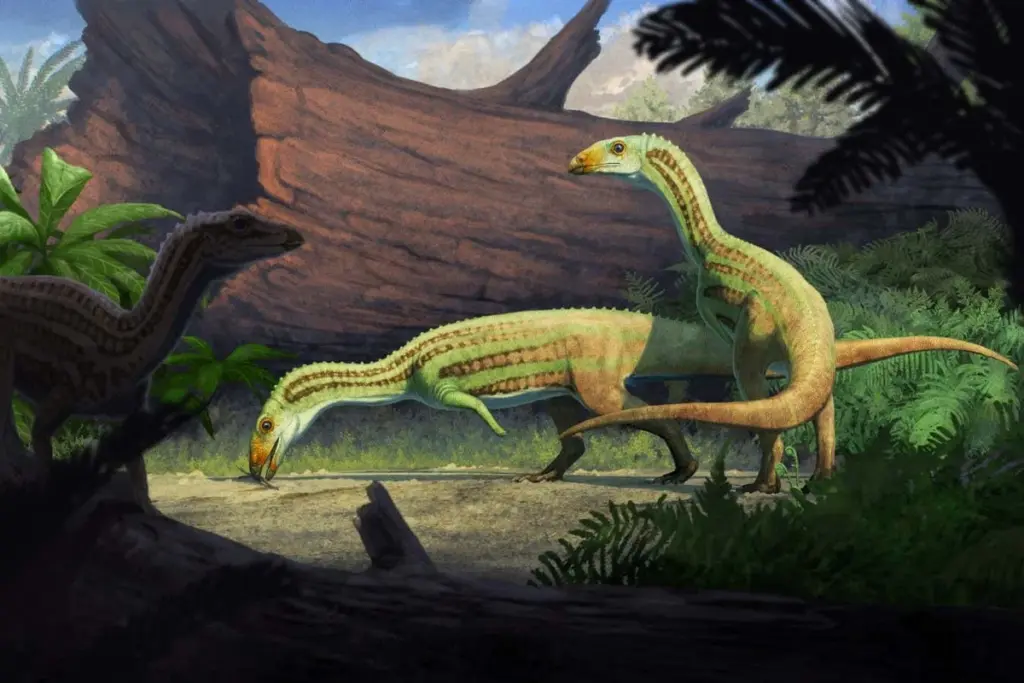
A prehistoric relative of modern crocodiles exhibited a remarkable developmental shift, spending its early years on all fours before transitioning to bipedal locomotion as an adult. This significant change in mobility was facilitated by differential growth rates between its forelimbs and hindlimbs. Elliott Armour Smith from the University of Washington in Seattle explained that the forelimbs initially constituted approximately 75 percent of the hindlimb length, a proportion that eventually reduced to around 50 percent.
This discovery contributes to a growing body of evidence highlighting the extreme diversity among crocodile-like animals during the early dinosaur era. Some of these creatures developed physical characteristics and ecological niches surprisingly similar to contemporary ostriches.
In collaboration with Christian Sidor, also of the University of Washington, Armour Smith led excavations at Kaye Quarry in Arizona’s Petrified Forest National Park. This geological site comprises mudstones and sandstones deposited by a river that flowed approximately 215 million years ago, during the Triassic period. The excavation yielded over 3,000 fossilized bones belonging to shuvosaurids, an ancient group related to crocodiles.
“It’s a jumbled mess of individual limb bones that don’t necessarily have an association between the individual animals,” Armour Smith commented on the collection of disassociated bones.
Despite the fragmented nature of the finds, the researchers successfully identified a new shuvosaurid species, which they named Sonselasuchus cedrus. Over 950 of the discovered bones belonged to this particular species. Rather than resembling a modern crocodile, Sonselasuchus cedrus bore a closer resemblance to flightless birds or theropod dinosaurs. Its forelimbs were comparatively short, and its mouth was equipped with a beak instead of teeth.
Shuvosaurids: Dinosaur-Like Traits in a Crocodilian Lineage
Other shuvosaurid species shared comparable body plans. Michelle Stocker of Virginia Tech described shuvosaurids as “absolute weirdos that live in the late Triassic,” noting that “They really look like dinosaurs.” Their morphology most closely aligns with ornithomimids, a group of ostrich-like dinosaurs that existed over 100 million years after shuvosaurids, during the late Cretaceous period.
Evidence suggests that Sonselasuchus cedrus began its life as a quadruped. Fossilized bones from younger individuals indicate that their front and rear limbs were of similar proportions. However, in more mature specimens, the hindlimbs showed significantly greater growth and were adapted to support more weight. Armour Smith observed that “The larger femurs in the population are rather robust,” while “even the largest humerus is relatively delicate.”
This developmental pattern is not entirely unprecedented. A 2019 study documented evidence of two dinosaur species that transitioned from quadrupedal to bipedal walking as they matured. These included a sauropodomorph, an ancestor to colossal sauropods like Brachiosaurus, and an early ceratopsian, a distant relative of Triceratops.
Stocker proposed that juvenile and adult S. cedrus might have occupied distinct ecological roles and potentially consumed different food sources, a behavior observed in some modern crocodilians. This developmental plasticity allowed them to exploit varied environmental niches throughout their lives.
Rethinking Pseudosuchian Diversity
Popular narratives of the dinosaur era often portray dinosaurs, particularly birds, as being at the forefront of evolutionary innovation, while crocodiles remained relatively static. According to Stocker, this portrayal inaccurately represents the diversity within pseudosuchians – the reptilian lineage that includes crocodiles. She argues that pseudosuchians were, in fact, pioneers of many novel and unusual evolutionary pathways, with dinosaurs later adopting similar adaptations.