
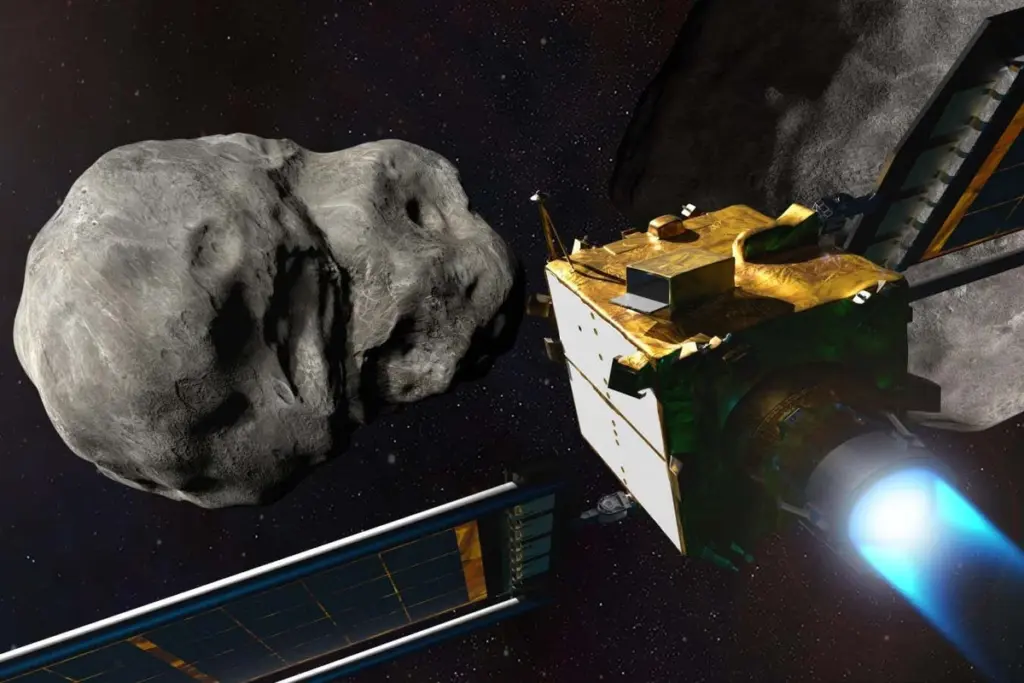
For the first time in history, humanity has successfully altered the orbit of an asteroid as it travels around the Sun. This achievement stems from NASA’s Double Asteroid Redirection Test, or DART, mission, which took place in 2022. The measurable effects of this remarkable feat have only recently been fully analyzed.
The DART mission targeted a small asteroid known as Dimorphos. This celestial body orbits a larger asteroid called Didymos. The DART spacecraft deliberately collided with Dimorphos with the primary goal of shifting its orbital path around Didymos. This test aimed to determine the efficacy of a method called a kinetic impactor, which could potentially redirect an asteroid’s trajectory if it posed a threat to Earth, guiding it safely past our planet.
The mission proved to be an unqualified success. The impact successfully shortened the orbital period of Dimorphos by 32 minutes. Following the impact, astronomers continued to meticulously observe the asteroid system. With nearly 6,000 individual observations logged over time, researchers have been able to accurately calculate the resulting change in the pair’s overall orbit around the Sun. This analysis revealed a deceleration of 11.7 micrometers per second, which translates to approximately 40 millimeters per hour. This slight reduction in speed is projected to decrease the radius of their solar orbit by roughly 360 meters.
“While this figure might not seem substantial at first glance, the fundamental principle behind these kinetic impact missions is that an early intervention, even a minor one, can lead to a significant alteration in the overall trajectory,” explained Rahil Makadia from the University of Illinois Urbana-Champaign, who was part of the team responsible for monitoring the asteroids’ orbits. “It’s a minuscule change, but when accumulated over decades, it can develop into a considerable deflection.”
The observed orbital slowdown was attributed to two distinct factors. The first was the direct impact of the spacecraft. The second involved an additional propulsive force generated by the plume of debris ejected from Dimorphos’s surface in the immediate aftermath of the collision. Makadia and his research colleagues determined that these two effects were roughly equivalent in magnitude. This understanding allowed them to accurately estimate the masses and densities of both asteroids. Notably, Dimorphos exhibits about half the density of Didymos. This finding lends support to the prevailing theory that Dimorphos is a “rubble pile” asteroid, formed from material ejected from Didymos due to its rotational forces.
All the data gathered from this mission is expected to be invaluable should a real-world scenario necessitate the deflection of a hazardous asteroid. “We now possess a crucial benchmark for predicting the outcomes of any future kinetic impact missions,” stated Makadia. Furthermore, the European Space Agency’s Hera spacecraft, currently en route to the Didymos system and scheduled for arrival in November, is anticipated to provide even more precise measurements. This enhanced data will be instrumental in guiding any subsequent efforts to safeguard Earth from approaching asteroids.