
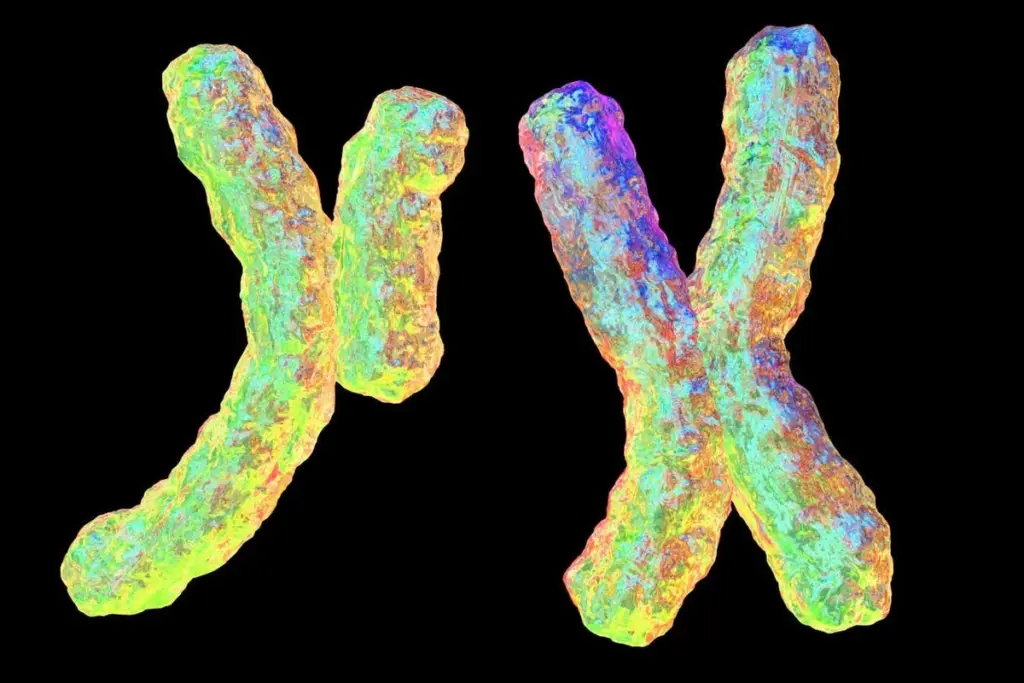
While it’s common to encounter families where children are predominantly of one sex, often attributed to mere chance, an extensive analysis of a Utah family tracing back to the 1700s suggests a possible biological explanation. Researchers have identified what they term a “selfish” Y chromosome, which appears to have a mechanism that hinders the birth of female offspring.
“This is a very significant family,” remarked James Baldwin-Brown from the University of Utah. “Selfish genes of this nature have been documented in numerous organisms, but their study within humans has presented considerable challenges.”
In the typical mammalian reproductive process, male genetic makeup includes one X and one Y chromosome. As stem cells in the testes divide to produce sperm, the expectation is that half will carry an X and the other half a Y, theoretically leading to an equal probability of male or female offspring. However, certain genetic variants within chromosomes can influence this ratio, leading to a skewed distribution towards more male or female births.
These variants can operate in different ways. Some selfish chromosomes interfere with the ability of other sperm to navigate towards an egg using scent cues. Others have been observed to eliminate sperm that do not possess them, although the precise biological mechanisms behind this remain a subject of ongoing investigation. “That’s a 100-year-old question that we’re still working on today,” noted Nitin Phadnis, also associated with the University of Utah.
In certain instances, evolutionary warfare occurs between selfish X and Y chromosomes. Each type strives to manipulate sex ratios in its favor, actively countering the survival strategies employed by its rivals. Given the prevalence of sex ratio-distorting selfish chromosomes across various animal species, it is plausible they also exist in humans. However, pinpointing active selfish chromosomes in contemporary human populations is notably difficult. “Even if you have five, six or seven boys in a row, say, the odds of that happening by chance are pretty high,” stated Baldwin-Brown.
To establish that a skewed sex ratio deviates significantly from what would be expected by random chance requires examining multiple generations. Baldwin-Brown, Phadnis, and their research team recognized the potential of the Utah Population Database, a comprehensive repository containing data on millions of individuals. For their specific study, they focused on a subset of 76,000 individuals.
The researchers employed two distinct statistical methodologies to analyze the gathered data. Both analytical approaches independently identified the same family as a pronounced outlier. This particular family exhibited a pattern where, across seven generations, 33 men inherited the same Y chromosome. Among the 89 children born to these men, 60 were male, while only 29 were female.
Due to the anonymized nature of the data, the team has not been able to conduct direct genetic analyses. “It’d be great to be able to de-anonymise these samples and go to these people and say, ‘Hey, can we sequence your sperm, try to understand what’s going on here?'” expressed Baldwin-Brown. He acknowledged the significant obstacles involved, noting that such ethical genetic research necessitates substantial paperwork and financial resources.
SaraH Zanders at the Stowers Institute for Medical Research in Missouri indicated that while she is inclined to believe the team has identified a selfish Y chromosome, the current data may still be insufficient for definitive conclusions. Her own research with microbes has sometimes revealed sex ratio biases exceeding statistical expectations, but these findings have often proven to be statistical noise that diminishes with larger sample sizes.
Zanders also raised the possibility of infidelity as a confounding factor. “I am not an expert on humans, but my heuristics, built on watching trashy TV, tell me that mis-assigned paternity may have happened a few times,” she commented. Baldwin-Brown confirmed that his team has indeed taken this potential issue into consideration. “We still have a lot of solid data that we think is reliable,” he maintained.
Potential Implications of Selfish Y Chromosomes
The identification of selfish Y chromosomes carries implications beyond purely academic interest, according to Phadnis. He suggests they might contribute to the unexpectedly high rates of male infertility observed in some populations. A biological mechanism that eliminates half of all sperm would naturally lead to reduced fertility. Furthermore, studies conducted in animals have demonstrated that selfish chromosomes can indeed result in infertility in affected individuals.
The research team intends to proceed with analyzing sperm samples to search for skewed proportions of X- and Y-carrying sperm. Their specific focus on selfish Y chromosomes in this latest study was driven by two key factors. Firstly, Y chromosomes are readily traceable through male lineages, simplifying genealogical tracking. Secondly, alternative explanations for an increased incidence of female births, such as lethal mutations, could also be attributed to selfish X chromosomes, making a targeted Y chromosome investigation more direct.
The concept of “selfishness” in genetics extends beyond sex chromosomes. Broadly defined, any segment of DNA that can enhance its own probability of inheritance beyond the standard 50% is recognized as a gene drive. Numerous forms of gene drives have been documented in the animal kingdom. Modern technologies like CRISPR gene editing have enabled the creation of artificial gene drives, with potential applications being explored for disease control, such as halting malaria transmission, and for managing pest populations.