
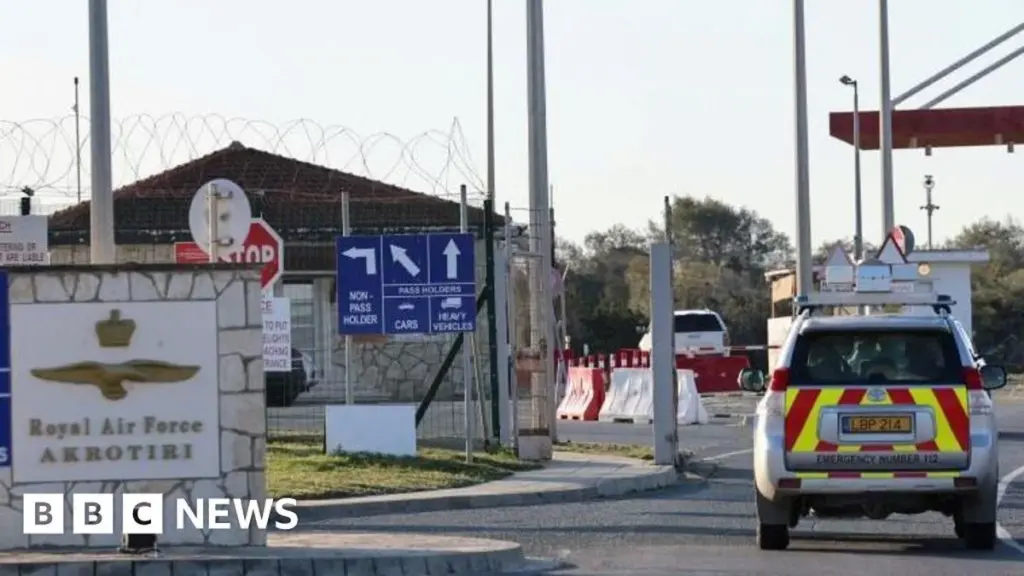
European nations are rapidly deploying naval assets and anti-drone systems to Cyprus in the wake of a drone attack on a British air base over the weekend. The island, situated in the Eastern Mediterranean, has unexpectedly become entangled in the fallout from recent US-Israeli strikes targeting Iran.
In response to the escalating situation, the United Kingdom has announced the dispatch of helicopters equipped with counter-drone capabilities, alongside the Type 45 Destroyer, HMS Dragon. French President Emmanuel Macron confirmed that a French frigate, the Languedoc, is scheduled to arrive in Cyprus by Tuesday evening.
Greece has already committed to sending four F-16 fighter jets and two frigates, including the Psara, which boasts a Greek-developed anti-drone system known as Centauros. During a visit to Nicosia on Tuesday, Greek Defence Minister Nikos Dendias emphasized Greece’s steadfast support: “Greece is present, and will continue to be present to assist in any way in the defence of the Republic of Cyprus.”
Strategic Reinforcements Amidst Regional Tensions
These military reinforcements are intended to deter further drone incursions and prevent any incidents that could draw Britain and the European Union into a conflict they have actively sought to avoid. As former military strategist Mikey Kay noted, the deployment of a Type 45 air defence destroyer near Akrotiri aims to establish a comprehensive, layered air defense system. Kay described the UK’s deployed equipment as “highly capable,” but also raised questions about its cost-effectiveness and capacity against coordinated swarms of drones like the Shahed 136.
Journalists at RAF Akrotiri, a base used for training and facilitating overseas operations in the Middle East, reported hearing the distinct sound of jets overhead. Although Britain did not participate in the US-Israeli strikes on Iran, its aircraft are engaged in “defensive operations” aimed at protecting UK citizens and allies in the region. The Ministry of Defence confirmed on Tuesday night that RAF F-35 jets operating over Jordan successfully intercepted an Iranian drone.
Evacuations and Diplomatic Concerns
The drone incident at Akrotiri on Sunday resulted in the evacuation of British families from the base and prompted the relocation of hundreds of local Cypriots residing nearby. The events have understandably caused anxiety among both British military families and some residents. Cyprus, however, has voiced criticism regarding the UK’s handling of the situation, particularly concerning an initial lack of clarity related to the use of British Bases in Cyprus.
A Cypriot government spokesperson stated that the initial understanding was that the bases would be used exclusively for humanitarian purposes. Cyprus has maintained that it is not involved in the escalating Middle East conflict and is not a direct target itself. Geographically, Cyprus is the easternmost EU member state, located off the coasts of Turkey, Syria, and Lebanon.
Historical Context and Security Readiness
The presence of British military facilities in Cyprus is a remnant of its colonial past. Upon gaining independence in 1960, the UK retained sovereign rights over specific sites, including a significant portion of the Akrotiri peninsula. These sovereign base areas now encompass approximately 3% of the island’s land, covering 98 square miles, extending beyond strictly military installations.
The British government is currently facing scrutiny regarding its preparedness to safeguard its overseas bases. Foreign Secretary Yvette Cooper informed the House of Commons that the UK has already enhanced its radar, air, and counter-drone capabilities. The drone attack on RAF Akrotiri on Sunday caused minor damage and no casualties. Two additional drones were reportedly intercepted on Monday.
The origin of the drone that struck the base remains officially undisclosed by the UK. However, the Cypriot government suspects the Iran-backed group Hezbollah, operating from Lebanon, was responsible. British officials believe the initial drone was launched prior to Prime Minister Keir Starmer’s announcement that the US would be permitted to utilize British bases for “limited” and “defensive” strikes on Iranian missile sites. Prime Minister Starmer has reiterated to the House of Commons that bases in Cyprus are not being used by US bombers.
RAF Akrotiri experienced a previous attack in 1986, when pro-Libyan militants wounded three individuals following US air strikes on Libya launched from UK airfields. These sovereign base areas maintain their own distinct police force.
Cyprus itself has been a divided island since 1974, following the Turkish invasion of the north after a military coup supported by Greece.