
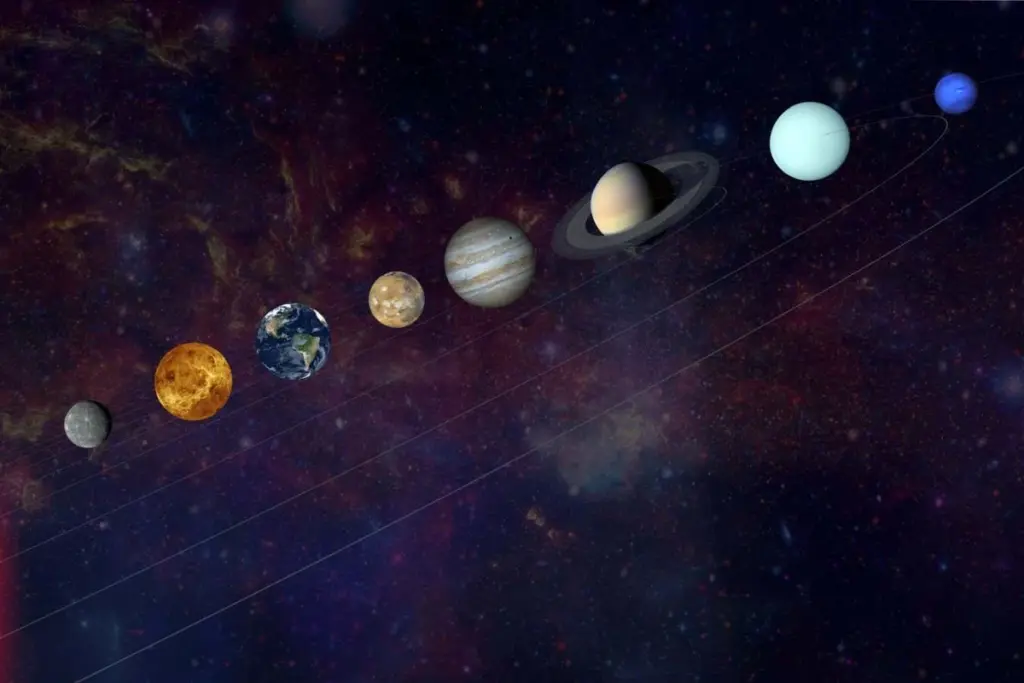
A rare celestial event is set to grace the night sky, with nearly all planets in our solar system lining up in a single-file formation. This planetary alignment, sometimes referred to as a planet parade, will feature every planet except Mars. Mars is currently on the opposite side of the sun from Earth, rendering it invisible to us.
Alignments of this nature occur only every few years. They happen when the orbital paths of all the planets converge, bringing them to the same side of the sun simultaneously. With each planet possessing a unique orbital period—Mercury completing its circuit in 88 Earth days while Neptune requires approximately 165 Earth years—these synchronized appearances are a fortunate convergence of orbital mechanics and geometric positioning.
The frequency of these alignments can vary. For instance, February 2025 witnessed a significant alignment, often called a “great alignment,” when all seven visible planets were observable at the same time. Conversely, there can be stretches of several years without a single such occurrence.
During a planetary alignment, the planets appear to trace a path across the sky along a celestial line known as the ecliptic. This line corresponds to the sun’s apparent path during the day. The slight inclinations of the planets’ orbits mean they will not form a perfectly straight line. Viewed from outside the solar system, the planets would not appear aligned; this linear perception is an optical effect stemming from the fact that all planets orbit the sun within roughly the same plane.
The visibility of this cosmic procession will extend over a range of dates, contingent on your geographical location. However, February 28 and March 1 are anticipated to offer the best viewing opportunities for most observers worldwide. To witness the event, find a location with an unobstructed view of the western sky and minimize light pollution.
On February 28, the optimal time to observe the planet parade will be within approximately an hour after sunset. Mercury, due to its close proximity to the sun, will descend below the horizon shortly after the sun does. Immediately following sunset, both Mercury and Venus will be discernible near the western horizon. Saturn and Neptune will be situated just above them, followed by Uranus, and finally Jupiter, appearing relatively close to a nearly full moon.
While Mercury, Venus, Saturn, and Jupiter are expected to be visible to the naked eye, binoculars will be essential for spotting Uranus. For Neptune, which is considerably more distant, a telescope will be required.